
How will your clients, your income and your reputation be impacted when you abruptly leave your practice? To most financial advisors, the business that they have been building over the years can be reduced to nothing without a proper succession plan. It is not just exit planning, but an effective method of safeguarding client trust, securing your legacy, and making certain that your firm will survive well beyond your departure.
There is more to your advisory practice than assets and portfolios, and there is a relationship, trust, and years of client confidence. This is why succession planning for financial advisors you may lose customers, decrease the value of your business, and have your employees caught off guard by abrupt changes.
A good succession plan will ensure continuity, revenue streams, and that even in the case of a change in leadership, your clients will not be affected because the service will remain the same. It also enhances the reputation of your firm and leaves a roadmap on how to grow the business, be it your retirement, selling your book of business, or introducing a next-generation advisor.
Here, in this final guide, you will get to know how to construct a smart succession plan, prevent expensive errors, and develop a long-term legacy that will keep your advisory business profitable, stable, and respected for many years to come.
Why Every RIA Needs a Solid Succession Plan?
Your RIA may appear great on paper, but without a clear transition strategy, your whole firm would be at a loss as to how to proceed overnight. The loss of a valued client when a colleague suddenly retires, has a health problem, a conflict with a partner, or an unforeseen market change can disrupt your client relationships and diminish your firm value. This is why succession planning with financial advisors is no longer optional-it is now a business survival strategy.
An effective succession plan helps to mitigate client trust by guaranteeing continuity of services, investment approach, and communication. Clients desire consistency, particularly in financial matters with long term objectives such as retirement, estate planning, and wealth protection. They tend to transfer their assets to other places when they find themselves in a state of uncertainty. A succession plan makes them faithful and assured.
It also protects your income and enhances the worth of your company. Investors and other buyers will be willing to pay more to an advisory business that has a defined leadership roadmap, written processes, and trained successor advisors. Lack of a plan will make your firm more difficult to sell and will cause you to lose power to negotiate when it is time to leave.
Above all, a succession plan safeguards your legacy. You have spent years of your life developing your reputation, expanding your clientele, and establishing a company that is able to provide actual value. Under succession planning for financial advisors, you are certain that your company will be successful, your clientele will be kept, and your wealth will be transferred with no chaos, rushed decisions, or skipped opportunities.
Valuing a Financial Advisory Practice: What is Your Firm Worth?
It might seem that your firm is profitable today, but the most important question is easy to answer: what would a buyer pay for it today? Most advisors focus solely on AUM, but valuation is based on recurring revenue, client retention, profitability, and the firm’s ability to operate effectively without the owner.
Revenue or EBITDA multiples are used by buyers in most deals. Mercer Capital notes that most advisory firms tend to sell between 6x and 10x EBITDA based on growth and risk. Companies that have high recurrent fees are normally offered better prices since purchasers are assured of reliable cash flow.
Client demographics also impact your firm’s worth. According to Cerulli Associates, the amount of money that will pass between older generations and their successors will be more than $84 trillion by the year 2045. Next-generation client relationships will become a significant source of value. Buyers might reduce the price in case your practice is reliant on aging clients.
A scalable business model that has been well documented will enhance valuation. With proper client relationships, your team, systems, and processes contribute to making your firm more valuable and easier to sell. Learn current strategies in what is digital bookkeeping? Benefits, tools, and best practices.
Types of Succession Strategies
There is no single formula for succession planning since each advisory firm is different. There are those RIAs who would prefer to be cleaned out and receive maximum payout, and those who would like to remain and carry over the clients gradually. The most appropriate one will be based on the size of your firm, the type of clientele, your revenue model, and your long-term objective. The correct succession strategy also safeguards your valuation, as the buyers will give a higher price to stability and continuity.
The most effective succession strategies financial advisors employ today are given below.
Internal Succession (Next-Gen Advisor Takeover)
The internal succession plan is preferred by many RIAs as it safeguards the relationships with clients and preserves the firm’s culture. This approach involves finding and training an advisor successor within your company and subsequently relinquishing ownership and responsibility to the client.
This strategy can oftentimes provide greater client retention since the clients already have confidence in the new advisor. It also minimizes transition risk, and this makes your firm more marketable. Based on the advisor’s insights into fidelity, companies that nurture internal successors tend to have an easier transition and less client loss since the relationship is in the same brand.
Selling to Another RIA (External Acquisition)
Other advisors may decide to sell their practice to a bigger RIA or wealth management company. The strategy is effective where you desire an expedited exit, lump-sum payment, or a structured earn-out deal.
Recurring revenues are a strong indicator of maximizing financial returns through external sales in your practice. Popular industry reports frequently indicate that performing RIAs may fetch 2-3 times annual revenues based on growth, margins, and client stability. Customers also pay higher prices when your company has younger customers and a referral channel.
Merger with a Strategic Partner
The merger is effective when you desire expansion, additional services, or an operational base. You do not wholly sell your practice but rather pool your practice with another advisory firm and share resources, staff, and infrastructure.
This approach tends to attract smaller RIAs wishing to compete with bigger companies. It also facilitates scalability at a time when advisory firms are being subjected to growing compliance and technology expenses. To illustrate, Cerulli Associates points to the fact that an increase in operational costs is still driving some smaller advisors to consolidation.
Gradual Transition with Partial Ownership Sale
Not all advisors desire to retire as soon as possible. A partial sale enables you to sell a percentage of your firm in the long run and remain in the management and relationships with clients.
This plan helps in long-term income since you will be able to receive a lump sum and still receive profit distributions. It also alleviates the shock of change to the clients, and this enhances retention. This structure is favored by many buyers as it reduces the risk, and the seller is committed to the handover.
Family or Legacy Transfer Plan
Other advisors would like to sell their company to a relative or a friend. This succession plan does not emphasize valuation but rather legacy. Nevertheless, legal and financial planning is still required to prevent wrangles and facilitate a hassle-free transfer of ownership.
This plan is most effective when the replacement already knows the business, and the replacement is credible to the clients. Family succession usually results in leadership gaps, which are harmful to firm stability without appropriate preparation.
Emergency Succession Plan (Business Continuity Strategy)
All RIAs should have an emergency plan, although retirement may seem distant. An immediate health problem, disability, or unexpected life event can interrupt client servicing on the spot. The advisory firms are also expected to have continuity in business by the regulators.
An effective emergency succession plan has a predetermined interim advisor, client data access, and operational guidelines. The US Bureau of Labor Statistics states that the average individual switches jobs several times during a lifetime, and unplanned problems with the head occur more frequently than companies assume. It is necessary to have an emergency succession plan to be more stable.
Choosing the Right Succession Strategy
The most lucrative succession plans are those that are in line with the long-term business objectives and client expectations. In case you wish to have total control and better retention, internal succession is the best. In case you are in need of more immediate liquidity, selling to another RIA can be more effective. A merger or partial sale will give you the best balance of power to grow and remain engaged.
Whichever strategy you adopt, your plan must safeguard clients, guarantee recurring income, and maintain the image you took years to attain. In the 10 benefits of outsourcing accounting services to growing businesses in 2026, learn how efficiency can be enhanced through outsourcing.
Key Steps to Building Your Advisor Succession Plan
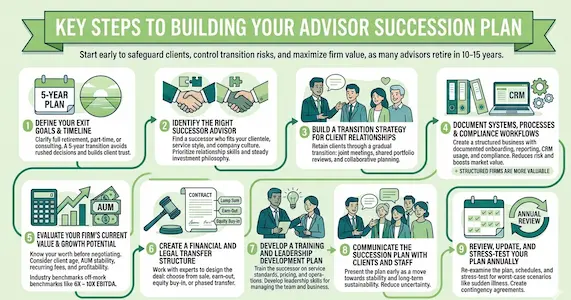
A good succession plan does not begin when imminent retirement is near but rather when you make a decision to safeguard your clients and ensure that the future worth of your company is guaranteed. Early planning advisors have greater control, less transition risks, and usually obtain superior deal terms upon selling or transferring ownership. Indeed, a study conducted by Cerulli Associates indicates that a significant percentage of advisors is going to retire in the next 10-15 years, and it implies that competition will be on the rise and companies that failed to develop a strategy might find it difficult to get premium buyers.
These are the key steps to help you develop a succession plan that can be successful.
1. Define Your Exit Goals and Timeline
Start with clarity. Choose to either retire fully, work part-time, or become a consultant. A five year transition plan is usually a good idea as it gives the clients time to get used to it and your successor can have time to earn the trust of the clients. By waiting till the last year, you subject yourself to rushed decisions which can lower your selling price.
2. Identify the Right Successor Advisor
Your replacement is required to suit your clientele, service manner and company culture. Clients have confidence in the advisors who can articulate themselves and exercise a steady investment philosophy. Select a person who is able to deal with relationships and not only numbers. An individual with good interpersonal skills tends to have more clients and save the day in terms of revenue transfer.
3. Build a Transition Strategy for Client Relationships
The success of any succession plan is dependent on client retention. The long-term relationships and recurring revenue constitute a majority of the advisory firm value. The most effective model is a gradual transition model where clients introduce the successor to the world by having joint meetings, reviewing portfolios and planning. Such a strategy will minimize the uncertainty and enhance loyalty of clients.
4. Document Systems, Processes, and Compliance Workflows
Successors and buyers desire a business that they can operate conveniently and not a practice that is all about a single individual. Prepare a comprehensive onboarding, reporting, financial planning workflow, CRM usage, compliance procedures, and communication plans. Structured companies lessen operational risk and that directly boosts market value.
This would also help valuing a financial advisory practice since buyers will offer more multiples to those businesses that are structured, scalable, and predictable in operations.
5. Evaluate Your Firm’s Current Value and Growth Potential
You need to know the worth of your practice today before you can negotiate any change. Valuing a financial advisory practice is not something you can value by examining revenue. It will cover the age distribution of clients, stability of AUM, the percentage of recurring fees, retention history, and profitability.
According to industry statistics provided by Mercer Capital, most advisory firms tend to sell between 6x and 10x EBITDA, based on margins and risk. In case your company is very reliant on a single advisor, buyers can devalue you. When your company has an efficient team and is performing well, then you are likely to fetch a premium.
6. Create a Financial and Legal Transfer Structure
Proceed with lawyers, accountants and valuation experts to design the deal appropriately. Choose whether you would like:
- a lump-sum sale
- an earn-out structure
- equity buy-in with time.
- phased ownership transfer
7. Develop a Training and Leadership Development Plan
Even an experienced heir must be trained to operate an advisory business. Show them your standards of service, expectations of your clients, prices and how you operate. Management of a team also involves different skills than management of a book of business, so you need to develop leadership skills, too.
8. Communicate the Succession Plan with Clients and Staff
Clients do not fear change-they fear uncertainty. Get your plan out early and present it as a good move towards stability and long term sustainability. Report on how the transition shields their objectives, service quality and enhances the future of your firm.
9. Review, Update, and Stress-Test Your Plan Annually
The succession plan must be changed as your firm expands. Re-examine it annually, revise schedules, and run it through worst-case scenarios such as unexpected sickness or market shocks. A significant number of RIAs also develop emergency continuity agreements to provide clients with continuous service.
Tax and Financial Considerations
The succession planning is not only about the clients or leadership, but also about preserving your wealth. Overlooking tax and financial considerations may diminish the value of your firm and introduce some liabilities out of the blue. Strategic planning provides a hassle-free flow of money and lowers taxes and preserves your legacy.
Most deal structure has a direct tax impact when selling your practice. A lump-sum sale may result in a capital gains tax that is over 20%, whereas a phased ownership or earn-outs can spread income over a period and lower your tax bill. Advisors who sell to family members should also take into account the taxes on estates since in 2026, the estate over $13.6 million will be subject to a high federal tax. Using trusts, gifting strategies, and charitable contributions can help minimize these costs.
Financial outcomes are also influenced by retirement accounts and client assets. Massive withdrawals of retirement plans would put you in the highest 37% federal tax bracket and the transfers of assets would ensure that clients are not caught in the blind when their tax rates rise, trusting and retaining them.
The vast majority of RIAs collaborate with financial and tax professionals to achieve maximum after-tax value. Cerulli Associates survey found that more than three out of every five RIAs engage experts in their exit planning, enhancing results and adherence. To further build a financial strategy, advisors can use such resources as The Ultimate Guide to eCommerce Financial Metrics, which offer practical knowledge on financial performance and planning.

Conclusion
Succession Planning for Financial Advisors is not just a retirement plan, but a means of ensuring your customers, ensuring that your income stream continues and that your years of hard work are not wasted. Early start advisors, those who document, plan on leadership, tax, and financial considerations, place their firms in a good position to undergo smooth transitions and receive the best value.
This guide will help you to keep your advisory business successful long after you have moved on by taking the following steps outlined in this guide: identification of successors, appreciation of a financial advisory practice, client transition planning, and tax planning. An effective financial advisors planning program builds customer trust, protects recurrent income, and leaves a legacy that tributes your vision in business.
Do not leave your future in the hands of unforeseen circumstances in order to determine the future of your firm. Start your succession planning as a financial advisor and make your advisory legacy count.
Frequently Asked Question
What is a financial advisor succession planning?
Financial advisor succession planning is a business development strategy that guarantees an uninterrupted leadership process, client relationship safeguarding, retained revenue and long term financial advisory practice value.
What is the importance of succession planning to RIAs?
Succession planning helps avoid interruptions in the service to clients, preserves the value of your firm, and guarantees the continuity of operation. Early planners are trustworthy, minimize risks, and create more opportunities to exit.
What is my valuation of a financial advisory practice?
A financial advisory business is evaluated by looking at the revenue, profitability, client demographics, recurring fee structure, and operational efficiency. Companies that have high client retention and scalable systems tend to have a high market value.
What are typical succession strategies of advisors?
Typical approaches are internal succession, nurturing a successor internally at the firm, selling to a different RIA, mergers with strategic partners, partial transfers, family transfers and emergency succession planning to continue.
What might be the effect of tax planning on succession planning?
Correct tax planning reduces capital gains, estate and retirement account taxes when transferring ownership. Structured sales, earn-outs and trusts have the potential to lessen liabilities and safeguard advisor wealth as well as client assets.
When should I start succession planning?
Begin succession planning when you are still young enough, at least 5-10 years prior to your intended retirement. Early planning enables the transition of client relationships, preparation of a team, and maximization of the firm valuation.