
In the current dynamic business environment, organizations are reconsidering the way they manage time, money, and people. This trend towards outsourcing is one of the most significant changes. From IT to customer service, and now finance, outsourcing has become a smart choice for organizations that want to grow without unnecessary stress.However, the main question still emerges:
Why outsource accounting services?
Outsourced accounting involves contracting an outside accounting firm to take care of financial functions like bookkeeping, payroll, and taxation. Rather than constructing a big internal department, the businesses outsource these services to professionals with a specialization. This strategy is becoming common in many parts of the world, not only among large companies, but also among startups and mid-sized organizations. The obvious reason is that it saves the cost of overheads, saves time, and enables leaders to direct their efforts towards core business activities.
Deloitte Global Outsourcing Survey found that cost savings are the primary reason why nearly 70% of companies outsource.
However, other than money, outsourcing also comes with flexibility and the availability of expertise. Delegating routine accounting to professionals allows business owners to focus more attention on planning, innovation, and long-term development. It is not a temporary trend but an effective approach. With the growth in competition in every industry, outsourcing accounting solutions is proving to be a viable way to achieve more sensible and sustainable business growth.
Why Do Businesses Outsource Accounting?
Outsourcing accounting involves engaging an external company to handle accounting services like bookkeeping, tax, payroll, and reporting. Rather than maintaining all these responsibilities within the company, businesses outsource them to specialists who concentrate solely on accounting. This means that the owners and managers no longer need to divide their time between balancing spreadsheets and focusing on growth and strategy.
When making a comparison between in-house vs. outsourcing accounting, the differences are evident. An in-house team entails total control but also high expenses that include salaries, training, software, and office space. Outsourcing, on the other hand, will give access to financial expertise without incurring additional costs. It also introduces expertise that will not always be present in a smaller support group within an organization.
Another big reason is its flexibility. The accounting support can increase as the business expands through outsourcing. Companies may begin small with the scope of work and increase it when necessary. It is especially useful to startups and mid-sized companies that cannot afford to invest in a big finance department earlier on.
According to a Clutch survey, 37% of small companies outsource at least one business procedure, with accounting as the most popular.
This indicates the popularity of outsourcing by different organizations. For those looking for outsourced accounting for small businesses, the advantages could be even more evident. Rather than fretting about compliance and deadlines or fearing a mistake, owners attain satisfaction in knowing that the numbers are in the hands of the professionals. The benefit of this support means that they can make wiser decisions, dedicate time where it can have the most impact, and can strategise growth more wisely. Simply put, companies outsource accounting as it is cheaper, less stressful, and it introduces professional backing. It is not about lessening control, but rather about using resources more intelligently.
Outsource Your Accounting Today And Unlock Smarter Business Growth
Common Accounting Challenges Startups & SMEs Face
Running a small business is exciting, but the management of money can bring unexpected hardships. Startups and SMEs have few resources, shifting priorities, and constant pressure to grow. These challenges may easily become risks without good financial systems. Now, here are the most popular ones.
1. Cash Flow Mismanagement
The cash flow is the spine of any business. However, most owners find it difficult to keep a record of incoming and outgoing resources.
A study by U.S.Bank suggests that 82% of small businesses fail because of ineffective cash flow.
This demonstrates the importance of budgeting well. Even profitable businesses can run out of cash to meet bills, suppliers, or pay employees, unless cash flow control is working well.
2. Compliance and Tax Preparation
Financial regulations and tax rules are subject to changes. It is easy to lose track of what it means to be compliant and to become bogged in the confusion about that when startups do not have the services of experts to advise them. Errors in filing or reporting are not only time-consuming, but can also attract penalties. Maintaining accurate and current reporting of financial information is imperative, but most small teams lack the resources or expertise to make this happen.
3. Scalability Issues
The change that comes with growth presents new challenges. A small arrangement working in the initial phase might not be sufficient as the business grows. There is more transaction tracking to be done, payroll is increased to cover a wider team, more complex reports are needed, and therefore, more powerful systems are required. Lacking scalable processes, businesses are met with delays and inaccuracies.
These accounting challenges faced by startups are not just obstacles; they can be a drag on future achievement. It is here that outsourcing will be handy. External accounting experts also come with tools (tools cannot always be afforded by the small business), skills, and systems. Outsourcing will provide startups with proper reporting, compliance on time, and the ability to scale with the business.
To sum up, outsourcing addresses what startups and SMEs find the most problematic in keeping their finances healthy, legal, and prepared to go out there and prosper.
Strategic Benefits of Outsourced Accounting
When a company considers the concept of outsourcing, the question is no longer whether it works or not, but how much we can take advantage of it. We understand at Outsourced Accountants how outsourcing accounting services can turn things around. The benefits are not limited to cost reduction, but also assist companies in creating more intelligent, robust, and flexible growth platforms.
Cost & Efficiency Savings
Cost reduction is one of the main reasons why companies outsource. Having an in-house accounting team will be costly in terms of salaries, benefits, training, and office space. Throw in software and upgrades, and the costs grow even higher. By working with offshore teams helping reduce overhead costs businesses are instantly saving money and eliminating unwanted expenses.
Our team is dedicated to designing processes in a way that enables clients to be cost-effective and productive. Routine work is assured, and is being carried out expeditiously and to perfection, with the in-house resources then being able to concentrate on growth and sound strategy. Simply put, we ensure that your business spends less and does more
Access to Experience and Technology
Modern finance is based on digital tools, but not all businesses can afford to implement them. Cloud computing and outsourcing allow immediate access to cloud accounting services and remote accounting support to streamline compliance, reporting, and forecasting.
A survey by PwC indicates that access to specialized skills via outsourcing will enable 78% of CFOs to make better decisions.
This is what we provide: experts with extreme experience and the most up-to-date technologies who scope up clear, correct, and executable conclusions. We also enable businesses to keep up with modern cloud-based bookkeeping services, so they do not have to spend extra time learning them or incur high expenses related to their introduction.
Scalability & Flexibility
Growth usually reveals weak areas in accounting. A system that served a 5-person team might prove problematic once the business doubles in size. The way around this is outsourcing, which provides scalable accounting options for e-commerce brands, startups, and small to mid-sized enterprises. With us, support customizes as you scale.
Our accounting services are versatile, so whether you require simple bookkeeping now or a fully functioning finance department in the future, we can adapt to suit your requirements. No fixed models, no lost expenses. The precise level of skills, at the precise moment.
We do not simply crunch numbers, but we ensure that businesses achieve lasting success. Whether it is about minimizing the overhead, offering professional insights, or creating a level of clarity, confidence, and control, our services are designed to help.
Risks & How to Mitigate Them
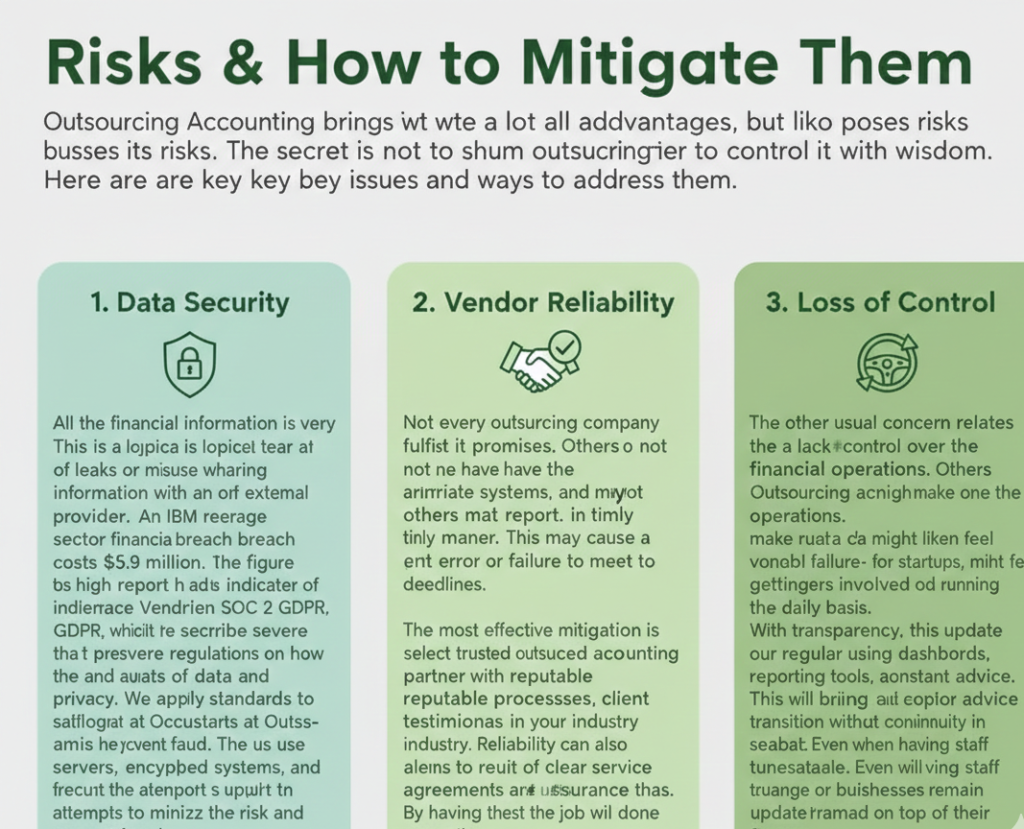
Outsourcing Accounting brings with it a lot of advantages, but like all business decisions, it also poses its risks. The secret is not to shun outsourcing but rather to control it with wisdom.
Here are the key issues and ways to address them.
Business Types, highlighting how to outsource accounting services for startups, SMEs, e-commerce brands, enterprises, and franchises.
1. Data Security
All the financial information is very confidential. This is a logical fear of leaks or misuse when sharing information with an external provider.
An IBM report has it that the average financial sector breach costs $5.9 million. This figure is the indicator of how grave a matter of security in accounting is.
The answer to that is high compliance. Vendor possibilities use frameworks such as SOC 2 or GDPR, which prescribe severe regulations on how to deal with data and privacy. We apply the standards to safeguard all information at Outsourced Accountants. The use of secure servers, encrypted systems, and frequent audits should support the attempts to minimize the risk and prevent fraud.
2. Vendor Reliability
Not every outsourcing company fulfills what it promises. Others do not have the appropriate systems, and others may not report in a timely manner. This may cause an error or failure to meet the deadlines. Businesses require a partner they can rely on. The most effective mitigation is to select a trusted outsourced accounting partner with reputable processes, client testimonials, and experience in your industry. Reliability can also be a result of clear service agreements and periodic performance reviews. By having these in place, the companies get assurance that the job will be done correctly.
3. Loss of Control
The other usual concern relates to the lack of control over the financial operations. Outsourcing accounting might make one feel vulnerable to possible failure- for startups, it might feel like getting strangers involved in running operations on a daily basis. With transparency, this can be minimized. We update our clients on a regular basis using dashboards, reporting tools, and constant advice. This will bring about continuity in transition without setback. Even when having staff changes or a smooth staff turnover, businesses remain updated and on top of their figures.
Outsourcing accounting does not mean losing control, but means responsible sharing with specialists. When the right partner is there, security is high, and the processes are clear, risks become opportunities to grow in a smarter way.
Technology & Workflow Automation in Outsourced Accounting
People are only part of modern outsourcing, and what drives it is technology. In the modern world, companies depend on digital tools that make accounting faster and minimize human error. Technology allows quicker and more effective financial management, making it more reliable and easier to track through cloud platforms and other AI features.
McKinsey estimates that 60 percent of accounting tasks can be automated using existing technologies.
It implies that mundane tasks such as data entry, invoice tracking, and reconciliations do not need time-intensive manual inputs anymore. Rather, these can be dealt with in a matter of minutes through automation tools and provide appropriate, timely financial data to business leaders to make more informed decisions.
Smarter Workflow Automation
Accounting works smoothly when advanced software is used. Workflow automation eliminates bottlenecks and ensures no step is omitted.
As an example, efficient accounts payable and accounts receivable flows result in all bills being paid promptly, customer accounts being accurately billed, and cash levels remaining within acceptable parameters. Not only does this save time, but it also increases the trust in suppliers and clients.
Document Management Simplified
Paperwork can easily prove to be the worst nightmare in accounting. All the documents are collected on a cloud system, are classified automatically, and are accessible at any time. Document management systems eliminate the possibility of loss of files and save a lot of storage expenses. Businesses also obtain secure access to records during reviews or audits rather than digging through heaps of folders.
Clear Dashboards & Budget Reporting
Real-time dashboards provide a good picture of business wellness. Managers and owners are able to view expenses, profits, and forecasts in one location. Correct budget reporting would make it simpler to plan ahead and make changes to the spending. Our team also provides integrated payroll solutions to growing companies to ensure that staff payment, tax, and compliance are timely.
What makes outsourced accounting really work is technology. Automation, cloud tools, and smart reporting save businesses time, reduce errors, and provide greater control of their accounts. In brief, the combination of outsourcing and automation can lead to more rapid outcomes, reduced risks, and additional opportunities to concentrate on the growth in question.
Services Tailored to Business Types
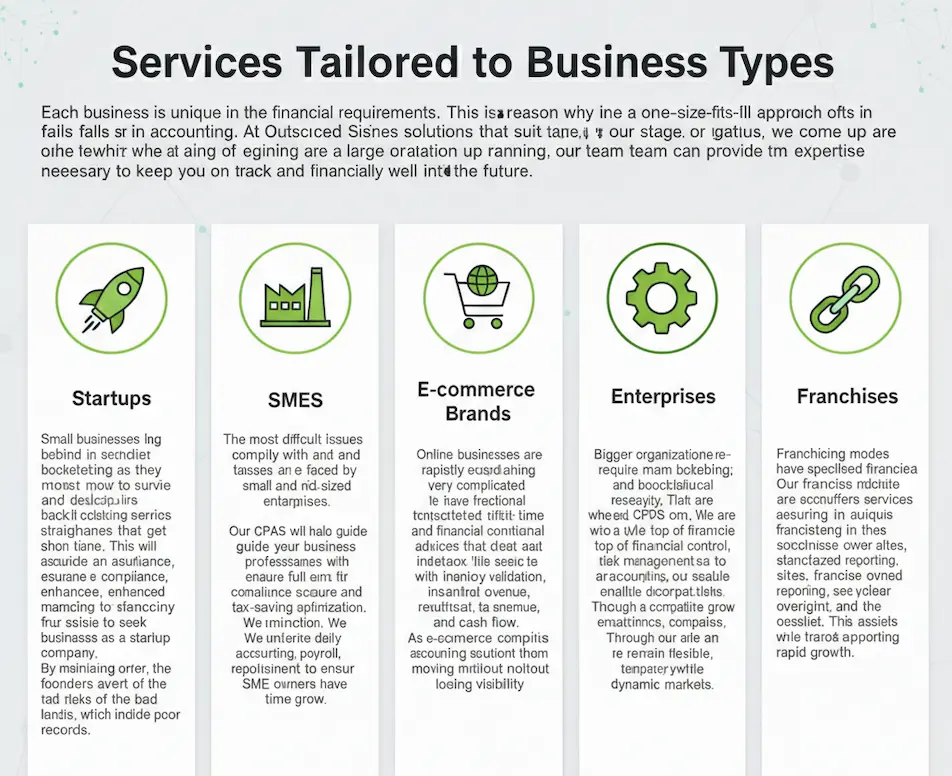
Each business is unique in its financial requirements. This is the reason why a one-size-fits-all approach often fails in accounting. At Outsourced Accountants, we come up with solutions that suit your stage, size, and business objectives. Regardless of whether you are beginning a small business or getting a large organization up and running, our team can provide the expertise necessary to keep you on track and financially healthy well into the future.
Startups
Small businesses lag behind in bookkeeping as they concentrate more on how to survive and develop. We offer backfill bookkeeping services that get records straightened out in a short time. This will provide an assurance of compliance, enhanced decision-making, and readiness to seek financing for businesses as a startup company. By maintaining order, the founders avert the risks of the bad credit lenders, which include poor records.
SMEs
The most difficult issues to comply with and taxes are mostly faced by small and mid-sized enterprises. Our CPAs will help guide your business with professional advice to ensure full compliance and tax-saving optimization. We undertake daily accounting, payroll, and reporting requirements to ensure SME owners have time to grow.
E-commerce Brands
Online businesses are rapidly expanding and very complicated with respect to finance. We have fractional and full-time financial controller services that can assist with inventory validation, multi-channel revenue, and cash flow. As e-commerce companies grow, our scalable accounting solutions keep them moving without losing visibility.
Enterprises
Bigger organizations require more than bookkeeping; they require strategy. That is where our outsourced CFOs come in. We are at the top of the range of financial control, projection, and risk management, to enable enterprise decision-making. Through our assistance, companies are able to remain flexible and competitive in dynamic markets.
Franchises
Franchising models have specialized financial investments. Our franchise care accounting offers services that are unique in assuring there is consistency in the franchisor sites, standardized reporting, and that the franchise owners see clear oversight. This assists in transparency while supporting rapid growth.
The future of outsourcing continues to grow brighter. Statista states that the accounting outsourcing market worldwide will amount to $53.4 billion by 2026. This indicates how an increasing number of businesses are transferring to us due to intelligent money management.
We are more than just financial stewards at Outsourced Accountants; we will build a long-term relationship. We have the tools, people, and strategy to drive your success, whether you are a startup, SME, or global enterprise. As we grow, together, we should grow smarter.
Why Do Companies Outsource Accounting?
The explanations are straightforward but effective. The advantages of outsourcing accounting are that it saves money, guarantees compliance, and offers access to financial expertise that companies can be hard-pressed to develop internally. Whether a startup or an enterprise, the advantages are evident: accurate and updated financial reporting, cash flow improvement, and the ability to concentrate on growth.
The other reason is strategy. Outsourcing teams can provide leaders with strategic advice in the form of clear insights and timely information. Rather than dealing with paperwork or deadlines, companies can lean on professionals who are knowledgeable about compliance and growth plans. Take an example of our tax management support for accuracy and compliance to enable the companies to avoid any penalties and maximize their tax strategies.
During the decision stage, the question is not whether to outsource but rather whom to trust with the figures. That is where we can help. Our customized solutions are efficient, easy to upgrade, and assure long-term stability.
Want to streamline your accounting and spend time growing? Reach out to us today and find out how our offshoring services can revolutionize your company.
Conclusion
Outsourcing accounting is no longer simply a cost-cutting initiative but indeed a strategy to grow. The advantages of lowering overheads, having access to the expertise of specialists, and the abilities of cloud technology and automation are evident. Startups, SMEs, ecommerce brands, and enterprises all benefit through outsourcing due to flexibility within their organizations, accuracy of the reporting, and the provision of decision support.
Naturally, there are some risks, such as data security and vendor reliability. With proper protection and a reputable outsourced accounting firm, however, such risks become a source of more efficient systems and sound procedures. Compliance systems, workflow automation, and professional supervision make outsourcing safe, secure, and effective.
Ultimately, the desired outcome is quite straightforward: smarter growth. Outsourcing helps businesses save time and money, and gives them the assurance to concentrate on what counts: innovation and growth.
Are you ready to take the smarter route? Give us a call and talk to one of our trusted outsourced accounting partners and see how we can help your business grow with clarity and confidence.
Frequently Asked Questions
Why Outsource Your Accounting?
Outsourcing accounting helps businesses save costs, reduce stress, and get access to expert financial guidance. It also ensures accurate reporting and compliance without the overhead of a full in-house team.
What percentage of businesses outsource their accounting tasks?
According to Clutch, 37% of small businesses outsource accounting. It’s the most commonly outsourced function among small companies because it frees up time and improves accuracy.
How much can businesses save by outsourcing accounting services?
Outsourcing cuts salaries, training, and software costs. According to Deloitte, businesses can save up to 40% in operational costs by outsourcing.
How does outsourcing accounting help companies focus on growth?
By outsourcing, companies save time and focus on core business activities like product development, sales, and customer relationships. Financial tasks are handled by experts, giving leaders more energy for strategy and innovation.
What are real-world examples of success through outsourced accounting?
- Startups: A young business struggling with records avoided failure by outsourcing catch-up bookkeeping and improving cash flow.
- E-commerce brands: An online retailer scaled globally with outsourced controllers managing multi-channel revenue.
Franchises: A franchise network stayed compliant across multiple locations thanks to outsourced franchise-focused accounting support.