
If you’re wondering what a bookkeeper do for a small business, you are not alone. Most new entrepreneurs start their dream business only to realize that managing money, monitoring daily transactions, and keeping records with numbers is a full-time job. And that is where a bookkeeper comes in, the silent and mighty backbone of any stable business. In its simple form, bookkeeping is concerned with recording, arranging, and maintaining financial ledgers and records.
It may seem easy, but it is the basis on which all financial decisions you will ever make will be based. A bookkeeper makes your business transparent and financially healthy, from knowing how much cash you have on hand to knowing what products are making you the most profit.
Why Bookkeeping Matters for Small Businesses
This is why this position matters more than most small business owners think.
QuickBooks reports that 42 percent of small business owners acknowledge that they were financially illiterate when they started their business.
It means that almost half of them ventured into the business without knowing how to decipher profit/loss statements or balance sheets. Without organized bookkeeping, you can easily find yourself going blind on where the money is moving in or out.
And the figures are even more serious.
82% of small businesses fail due to poor management of cash flow, according to the U.S. Bank and Kruze Consulting
.Cash flow is like the heartbeat of a business, and a bookkeeper makes sure that the pulse never goes flat. They track accounts and monitor the sales and expenses of the company on a daily basis and ensure that your bills are paid at the right time. They present you with a clear and updated picture of your finances.
Bookkeeping can be considered an early warning system for your business. With a current financial ledger, you are able to identify trends, spot problems, and make wiser decisions before they turn into serious issues. This is one of the biggest small business bookkeeping benefits; it keeps owners proactive rather than reactive.
Although one might already be working with an accountant, it is the bookkeeper who keeps the information flowing daily. They lay the financial base upon which accountants summarize financial statements or file taxes. Many small business owners depend on professional accounting support to ensure accurate financial records and smooth operations.
The Real Impact on Your Business
To put it simply, a bookkeeper is not just a number cruncher; they are the ones who bring order, clarity, and calmness. Whether you are just starting out or planning to grow, one of the best things you can do for your small business is to have someone who understands your numbers on a daily basis.
The Role of a Bookkeeper in a Small Business
All the small businesses operate on the basis of numbers, sales, expenses, profits, and plans. However, such figures do not appear out of thin air. A bookkeeper, the financial backbone, carefully tracks them, organizes and interprets them to make sure that they account for all rupees or dollars.
Haven states that bookkeepers receive daily transactions, reconcile bank accounts, deal with accounts payable and receivable, and prepare financial statements.
Concisely, they help to make your business decisions clear and accurate in financial upheavals.
Below is a simple breakdown of what a bookkeeper actually does on a daily basis.
1. Recording Daily Transactions
Recording all the transactions made daily, all the sales, purchases, receipts, or payments made to your business, is one of the most necessary activities in a business in terms of day-to-day bookkeeping. These entries are used as the basis of future analysis and report development.
At Outsourced Accountants, we frequently hear ourselves say that this is like polishing your teeth: small, routine, but critical to long-term well-being. Any delay in the receipt of updates may cause confusion in the future during the accounts reconciliation or tax reporting.
2. Maintaining Financial Ledgers and Records
All these transactions that take place daily are deposited and arranged in financial records or ledgers. It is here that precision is important. A fine bookkeeper maintains your books to the extent that they are clean, up to date, and in agreement with your bank account.
Proper recordkeeping assists with the monitoring and management of accounts / financial records so that payments are not missing or entered twice. It is the foundation of all the correct financial reports that will be produced subsequently.
3. Reconciling Bank Statements
At the end of every month, your bookkeeper compares the internal records with real bank statements. This is referred to as reconciliation and is useful in identifying mistakes, transactions that are not registered, or even fraud.
It is one of those invisible yet important tasks that keep the financial story of your business honest and transparent.
4. Managing Accounts Payable and Receivable
Every small business deals with bills to pay and customers to invoice. Bookkeepers manage invoices and bills, keep track of who owes you money (accounts receivable), and maintain the time you pay your vendors (accounts payable).
This continuous stream of organization maintains cash flow to continue operating effectively, a significant source of small business bookkeeping advantages.
5. Preparing and Generating Financial Reports
Every week or month, the bookkeepers will generate financial reports that will indicate the position of your business. These are profit/loss statements, balance sheets, and cash flow summaries.
The insights can assist the business owners to make informed decisions, such as reducing expenses, investing, or planning taxes.
What Does a Bookkeeper Do on a Daily Basis?
Being a small business owner is like having dozens of moving pieces to deal with each day, including sales and customers, suppliers and cash flow. With all that going on, a bookkeeper makes sure that the financial front does not fall through the cracks.
But what does a bookkeeper exactly handle on a daily basis?
Now, we are going to divide their day into clear, real-life tasks that will keep your business on its path and your budget in an ideal shape.
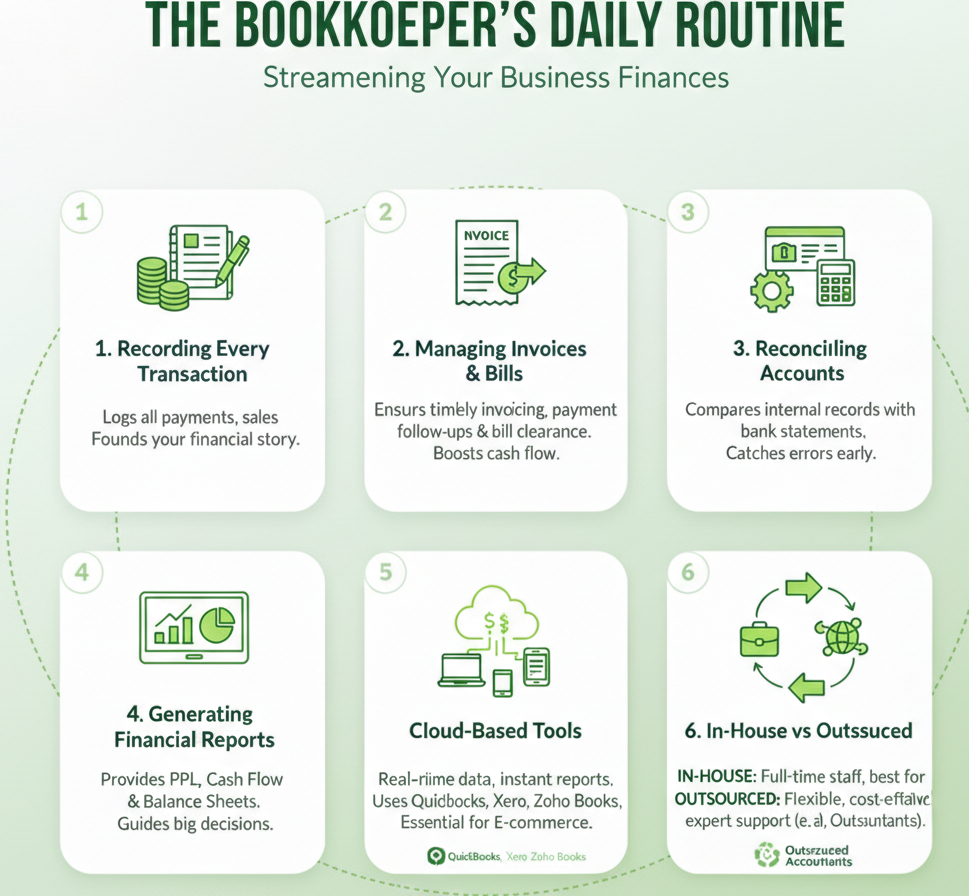
1. Recording Every Transaction
The bookkeepers begin their day by recording daily transactions, all payments made, sales, and expenses incurred.These are the foundations of your financial story, which can be found in financial ledgers and records.
Tracking the money accurately will make you know exactly where your money is going and will also ensure that there will be no surprises in the future. A missed transaction today might become an expensive discrepancy at tax time tomorrow.
2. Managing Invoices and Bills
Invoice and bill management is one of the most useful things done in a daily bookkeeping task. Bookkeepers make sure that customers are invoiced in time, receipt of payments is followed up, and bills of suppliers are cleared in good time.
This maintains your cash flow constant, which is critical, given that lack of financial literacy costs small business owners an average of 118,121 dollars in lost profits (QuickBooks).
Efficiency in your invoices and bills will mean that your business does not incur late fees or miss the opportunity of earning an income.
3. Reconciling Accounts and Bank Statements
Internal records are regularly compared with bank statements by the bookkeepers to ensure that all the numbers are the same. This is called the reconciliation process and will identify minor mistakes before they become enormous.
It is the secret of keeping a track of accounts and financial records and being confident about it. Just imagine it like a financial checkup every day, and make sure that your business is in good health.
4. Generating Accurate Financial Reports
A good bookkeeper does not merely record; they generate financial reports that give an overview of the position of your business. These reports can include:
- Financial statements of profit and loss.
- Cash flow statements to monitor liquidity.
- Balance sheets that indicate your assets and liabilities.
All the big decisions, including the decision to hire new employees, or plan to invest in the future, are guided by these reports, which are summarized in financial statements.
5. Using Cloud-Based Bookkeeping Tools
Current bookkeepers are bound to bookkeeping software and bookkeeping platforms that are in the cloud. These tools allow them to revise data on a real-time basis, share and disseminate reports immediately, and minimize errors in manual data entry.
The use of bank feed software such as QuickBooks, Xero, or Zoho Books automatically reconciles transactions, making it quicker and more dependable. At Outsourced Accountants, our teams use these platforms on a daily basis to assist our clients in smoothing out finances and being able to access their data anywhere, safely.
E-commerce jobs, especially those in online bookkeeping, are often the main source of e-commerce brands that use this method to remain organized and competitive. No order, refund, or fee will be left unmonitored, and this is of great benefit to fast-moving digital stores.
6 In-House vs. Outsourced Bookkeeping
In the allocation of these tasks, small businesses are mostly faced with a dilemma: whether to employ in-house or outsourced bookkeeping.
Your in-house bookkeepers are part of your team; it is best suited in large-scale operations where there is a need for financial attention.
Outsource bookkeeping services, such as those provided by Outsourced Accountants, are flexible, professionally supported, and offer access to up-to-date tools at prices lower than full-time staffing.
Outsourcing aids in the management of your books, saves money and time, and ensures that your books are handled by professionals with the most appropriate technology.
The Bigger Picture
These are some of the things that may appear to be normal day-to-day activities, but they are the blood and bones of your business funds. Every transaction logged, account reconciled, and report created leads to stability, growth, and wiser decision-making.
An expert bookkeeper does not merely score points, he/she assists you to be ahead of the game.
Why Accurate Bookkeeping is Crucial for Small Businesses
The dynamic nature of the small business requires that you get a good grasp of your numbers in order to be successful. At this point, sound bookkeeping can be useful not only as a compliance measure but also as a competitive edge. A healthy financial record keeps your business in check, ready, and informed of all the choices that you make.
Financial experts actually suggest that bookkeeping assists businesses in monitoring revenues and expenditures, determining patterns, and ensuring that cash flows remain healthy, which is rather critical in long-term development and success.
Let us consider the major ideas of small business bookkeeping benefits that prove why this process cannot be negotiable.
Improved Cash Flow Management
The blood of any business is cash flow. Lack of proper tracking can easily make you overspend or face an unexpected shortage. Bookkeepers help by monitoring the inflow and outflow of money daily.
They track daily payments, manage invoices and bills, and make sure money is paid and received on time. This visibility removes surprises and gives owners a clear picture of available funds.
With accurate books, you can plan purchases, pay suppliers, and still keep resources for reinvestment and growth. Small business owners find that small business bookkeeping solutions help them make smarter financial decisions because they can see their financial position in real time.
Accurate Profit/Loss Statements
One of the most important effects of well-managed bookkeeping is the development of precise and transparent statements of profit/loss. These reports give you insight into whether you are making or losing in business, and as such, you can change strategies to match.
The frequent financial reporting will enable you to monitor monthly or quarterly performance in comparison with the previous ones and detect trends. Do some months always take longer? Is there a more profitable product? Proper bookkeeping will answer these questions before they turn into blind spots that might cost a lot.
In the case of outsourced teams such as Outsourced Accountants, producing such reports is a normal task in serving the clients. Financial reports prepared by bookkeepers are simple to understand, and thus, the owner of a small business can make superior and quicker business decisions without being overwhelmed by the data.
Preparation for Taxes and Audits
Unless your books are in the best order, Tax season can be a stressful affair. A bookkeeper makes sure that all transactions are properly logged in, all receipts are placed, and that your accounts are reconciled.
This preparation makes the filing easier as well as minimizes the chances of expensive mistakes or fines. In case you are audited, you will already have proper financial reports and proper financial ledger/records to provide.
Periodical reviews and an automated storage of data are also part of the outsourced bookkeeping services, which help the small businesses to have a restful sleep knowing that they can access any record at any time they have a short notice.
Supports Informed Decision-Making
The best business decisions are based on facts, not guesses. Bookkeeping provides that foundation. With up-to-date financial information, owners can see where improvement is needed, where expenses can be reduced, and where growth opportunities exist.
Financial reporting helps set realistic goals, plan budgets, and evaluate performance. In simple terms, bookkeeping turns financial data into action and gives clarity instead of confusion.
At Outsourced Accountants, bookkeepers ensure reports are clear, timely, and structured to support better decision-making, not just compliance.
Signs Your Small Business Needs a Bookkeeper
Any business begins with a passion, not a spreadsheet. However, when your business grows, financial management may become a challenging task in a short period of time. It is usually the first indication that you need professional assistance.
When things begin to get complex in numbers and time begins to run out, it is the bookkeeper who interferes. They ensure that all the transactions are monitored, all are paid, and all the financial reports are prepared whenever you need them.
The following is the way to determine whether your small business is at that stage.
Your Financial Transactions Are Getting Complex
At first sight, it may be easy to handle a few invoices or expenses in Excel. However, the larger you become, the larger the clients, vendors, and payments, and the complexity increases.
When you are starting to receive more than one account, recurring payments, or payroll, a trained bookkeeper can save you hours of confusion. They keep your financial books and records, do reconciliations, and make sure that everything makes sense in all the transactions.
The fact is that, once your finances get layered and intertwined, it is no longer feasible to use manual record-keeping.
You Lack the Time or Expertise
Being a business owner involves having numerous hats. However, it is easy to become exhausted in your attempts to stay up late, juggling books, or in a frantic search after lost receipts.
When bookkeeping becomes a burden, it is time to outsource. Experts possess the expertise, tools, and accounting software that enable them to make the process effective and error-free. This gives you an opportunity to grow as they can cover the day-to-day basis tracking and organization.
Along with the expansion of your business, you will also require systems that are compatible with other things, such as POS systems and CRM. Syncing these systems and automating these tedious tasks is what outsourced professionals, such as Outsourced Accountants, do so that you can enjoy the benefits of real-time visibility without having to do any manual work.
Your Business Is Growing
The exciting part of growth is that with growth comes financial complexity. An increased number of customers implies an increased number of invoices, transactions, and reports to be handled.
The scalable startup bookkeeping services are extremely useful here. To handle the complex financial aspects of scaling up, startups can use such assistance to reduce the workload on their own teams.
A bookkeeper can assist in building structure and keeping things in line, and paving a path to a finance team that can grow as you grow. They also make proper financial statements that help them attract investors or get finances by portraying control and transparency.
You’re Struggling to Track Daily Transactions
When you are invariably a few weeks behind on your books, or when you do not know your exact balance, that is a big warning sign. Statements of transactions can be lost daily, and this can result in missing payments, late invoices, and ultimately poor cash flow.
And this is the ugly truth: 82 percent of small businesses end up failing because of poor management of cash flow.
This statistic alone demonstrates the fact that timely and accurate bookkeeping is indeed critical. The accounting bookkeeper keeps you up to date with your numbers, and you will have a daily picture of your business position, not only at the end of the month.
You Confuse the Difference Between Bookkeeper and Accountant
In case you do not know who does what, you are not alone. There are numerous business owners who interchange the roles of bookkeeper and accountant, yet they serve different purposes.
Bookkeepers are employees who are involved in the day-to-day recording of transactions, in the invoices, account reconciliation, and report preparation.
Accountants step in for financial strategy, tax planning, and analysis based on those records.
Put simply, it is the bookkeepers who construct the data, and accountants who interpret it. By engaging a bookkeeper at an early stage, your accountant will be able to do more work that will help the business grow and not reconstruct missing information.
Professional Bookkeeping Services for Your Small Business
Once you expand your business, the daily financial needs may begin to weigh heavily on you. You are invoicing, paying vendors, costing, and yet you are trying to get down to strategy. This is where the outsourced bookkeeping service comes in, offering structure, precision, and tranquility without the necessity to hire a full-time staff member.
By collaborating with professionals such as Outsourced Accountants, the small business owners can completely delegate their books without any hesitation that all the numbers will be done with great accuracy.
Why Outsourced Bookkeeping Works
Accuracy You Can Rely On
Even minor errors in bookkeeping can cause huge financial pains in the future. The professionals of our company maintain sophisticated bookkeeping software and cloud-based bookkeeping software to ensure that your ledgers are error-free and up to date. This not only enhances accuracy but also assists in eliminating repetitive work and manual data entry.
Timeliness and Transparency
Outsourced bookkeepers have set schedules, and your daily transactions will be captured on time, regular accounts will be reconciled, and reports will be submitted according to your schedule. You will never be left in a position of guessing the state of your business financially; your data is always up-to-date, available, and trustworthy.
The Advantage of Working with Outsourced Accountants
We do not simply input numbers at Outsourced Accountants; we assist you in making meaning out of the numbers. Our services are designed to:
- Access and control accounts / financial records in real time.
- Generate financial records that are understandable, precise, and decision-ready.
- Prepare the end-of-year financial statement summary and tax filing.
- Provide scalable best solutions that can expand along with your business.
You could be a local store, a digital agency, or a fast-growing startup, and we will make our bookkeeping process meet your workflow, business size, and objectives.
Outsourcing is not only cost-effective, but transformational to many small business owners. You can acquire the expertise of a seasoned finance team without the expense of employing, developing, or supervising one.
Ready to Simplify Your Finances?
When you are at the stage where you consider bookkeeping a waste of time and not a strength, you need to bring in the professionals. Allow our professionals to simplify your operations, save time, and make your finances crystal clear every quarter of the year.
It’s never too early (or too late) to hire a professional bookkeeper in New York and get the clarity your business deserves.
Outsourced Accountants will not only provide you with a bookkeeper, but a partner who will ensure that your business remains stable financially and has its goals and strategies.
Conclusion: The Real Value of a Bookkeeper for Small Businesses
Behind any successful small business, there is a definite financial tale, and that is the tale authored by a proficient bookkeeper. Bookkeeping, which involves monitoring daily transactions, as well as reports and reconciliation of accounts, is an invisible system that ensures the smooth running of every business.
It is not only about the numbers being recorded, but it is also about being able to understand them. Proper bookkeeping procedure will assist in tracking and managing accounts / financial records, expenditures, and cash flow, the very blood and bones of your business.That fact alone demonstrates why monitoring your finances closely is not a choice; it is a necessity.
You become clear and confident when you are generating financial reports on a regular basis. You are able to see the opportunities, be ready to deal with the challenges, and make more constructive decisions regarding growth, hiring, or investment. The better the books you have, the better your business base.
And although some entrepreneurs begin with spreadsheets or simple applications, most of them soon discover that professional help is the difference maker. By working with trusted accounting experts, you will be assured of accuracy, timeliness, and long-term viability, and can concentrate on what is truly important to your business: its growth.
Concisely, bookkeeping is not merely an office activity. It is the beat of economic prosperity. Either you do it yourself or you employ professionals such as Outsourced Accountants; anything you do in the form of planned finances today will pay off tomorrow in terms of saving, growth, and peace of mind.
FAQs:
What Is the Difference Between a Bookkeeper and an Accountant?
A bookkeeper records daily financial transactions and maintains accurate financial records, while an accountant analyzes this data to provide insights and prepare financial statements.
When Should a Small Business Hire a Bookkeeper?
Small businesses should consider hiring a bookkeeper when they experience growth, face complex financial transactions, or lack the time or expertise to manage their finances effectively.
What Are the Benefits of Outsourcing Bookkeeping Services?
Outsourcing bookkeeping allows small businesses to access professional expertise, reduce overhead costs, and focus on core business activities while ensuring accurate financial management.
How Can Bookkeeping Improve Cash Flow Management?
Regular and accurate bookkeeping helps businesses track income and expenses, identify financial trends, and make informed decisions to maintain healthy cash flow.
What Are Common Bookkeeping Mistakes Small Businesses Should Avoid?
Common mistakes include mixing personal and business finances, neglecting to reconcile accounts regularly, and failing to maintain organized financial records.