
Picture the last time you devoted countless hours to organizing worn receipts or reconciling bank statements manually late in the evening. It is slow, tiring, and makes it easy to drop the ball on big mistakes. Many business owners in the United States still do their books this way, which costs them more time and money than they realize. Electronic Bookkeeping is an easy practice to move away from paper files and messy spreadsheets and step into a smart cloud system.
This technology catches and sorts your monetary data automatically, moving you from reacting to problems to stopping them before they grow. You might ask, what is electronic bookkeeping at its core? This is a digital utility monitoring each dollar flowing into or leaving your account instantly. Leveraging this approach eliminates the need to postpone profit assessment until year’s end. Rather, you gain a transparent overview of your enterprise’s status on a daily basis.
What is the Biggest Advantage of Electronic Bookkeeping?
Many company leaders aim to learn one key piece of information immediately. Is this shift actually worth the effort? The answer is a clear yes. The benefit of electronic bookkeeping shows up in your daily peace of mind. You no longer have to guess how much cash you have in the bank. You do not have to call an office and wait for someone to find a file.
Access Your Data Anywhere, At Any Time
The answer to what is the biggest advantage of electronic bookkeeping is simple. It gives you live access to your money data 24 hours a day. You can check your numbers from any phone, tablet, or computer. You do not have to wait for a person to send you a report. You do not even have to be in your office. If you are at a lunch meeting and need to check your budget, you can pull it up right then. This matters because money problems do not wait for the end of the month. A late payment or an extra charge shows up in real time. You can fix it fast.
Ready to simplify finances and boost growth with expert virtual bookkeeping solutions today?
High Accuracy With Less Human Work
Manual work means someone must type in every single bill. They have to match it to an account and check it against a bank page. There are a lot of steps where things can go wrong. With a digital system, your bank connects to the software. Transactions flow in on their own and get sorted by rules. A human still looks at the work, but they are looking for big patterns instead of doing boring data entry. This cuts down on errors that cause tax trouble or wrong reports.
7 Ways Virtual Bookkeeping Streamlines Your Finances
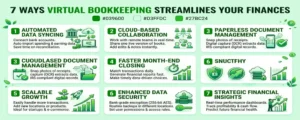
1. Automated Data Syncing and Bank Connections
Cloud tools like QuickBooks Online and Xero connect to your bank accounts. They use secure links to pull in your spending and earning data. Every time you buy something or get paid, the data moves into your books. You do not have to download files or type in numbers from a bank statement.
Why This Technology Saves Time
In the past, someone had to log in to the bank and download a file. Then they had to upload it and check every line. For a busy company, that could take a whole day of work. With automated syncing, recurring transactions like your rent, utility bills, and merchant sales feeds get imported automatically for your review and one-click reconciliation based on pre-set bank rules. Outsourced Accountants helps set up these links so your data goes to the right place from day one.
Catching Errors Early
Because the data moves every day, you see mistakes fast. If a vendor charges you twice, you will see it the next morning. You don’t have to wait thirty days to get your money back. This keeps your cash flow healthy and your records clean without extra effort.
2. Cloud-Based Collaboration for Teams
In a world of paper, your books live in one folder on one desk. If you want to see them, you have to go to that desk. If you use a computer file, you have to email it back and forth. This leads to having many versions of the same file. It creates a lot of confusion.
Working Together in Real Time
When your books are in the cloud, you and your outsourced accounting professionals work in the same spot. You both see the same live numbers. If your bookkeeper makes a change, you see it on your screen instantly. Every edit is saved with a note about who did it and when. There is no more guessing about which file is the most recent one.
Support for Remote Teams
Many US companies now have staff working from home. Cloud access makes this easy. Your team can upload bills from one state while you review them from another. It keeps the whole company connected to the financial truth without needing a physical office.
3. Paperless Document Management and Records
The IRS says you must keep your receipts and bills for many years. In a paper system, this means keeping boxes in a closet. These papers can fade, get lost, or even get destroyed in a fire. Searching for one specific bill from two years ago can take hours.
The Magic of Digital Capture
Digital systems connect to apps on your phone. You can take a photo of a receipt while you are still at the store. The app uses OCR technology to extract the vendor name, date, transaction total, and sales tax, seamlessly mapping the digital receipt image directly to the corresponding ledger entry for a permanent, IRS-compliant audit trail. Switching to cloud-based bookkeeping solutions means you can stop printing every single email.
Staying Ready for the IRS
If you ever get an audit, you will be happy you went digital. You can search for a vendor name and see every bill you ever paid them. You can show the auditor the exact receipt they want to see in seconds. This makes your business look professional and saves you from big stress.
4. Faster Month-End Closing Processes
Closing the books used to be a giant project. It usually took ten days or more after the month ended. By the time you got your reports, the information was already old. It was hard to use that data to make good choices for the next month.
How Reconciliation Happens Daily
Virtual systems make this much faster. Because the bank data flows in every day, most of the work is done before the month even ends. You are matching transactions as they happen. What used to take a week now takes just a few hours.
Getting Reports When They Matter
When you close your books fast, you can see your profit while you still have time to act. If you spent too much on supplies in May, you will know it by June 2nd. You can change your spending for June right away. This speed gives you a big edge over companies that are still waiting for their paper reports.
5. Scalability That Grows With Your Sales
When a paper-based business grows, it usually has to hire more people. More sales mean more invoices and more data to type. This means you have to pay more for salaries, desks, and insurance. It makes growing your business very expensive.
Software That Handles More Volume
Cloud systems scale in a different way. Adding more transactions does not slow the software down. You can add a new store or a new product line with just a few clicks. Scalable bookkeeping support for startups lets you grow from one employee to fifty without a headache.
Ideal for Online Sellers
This is very helpful for Advanced online bookkeeping for ecommerce brands. If you sell on Amazon and Shopify at the same time, the system can handle thousands of orders easily. You don’t need to hire a giant team just to keep track of your sales. The technology does the heavy lifting for you.
6. Enhanced Data Security and Backups
A paper book can be ruined by a leaky roof. A laptop can be stolen. These are real risks that can destroy your business history. Many owners do not think about these things until it is too late.
Enterprise-Grade Protection
Cloud platforms deploy bank-grade security protocols, utilizing 256-bit AES encryption at rest and in transit, multi-factor authentication (MFA), and routine SOC 1 and SOC 2 Type II compliance audits. Your records are also copied to different servers in different parts of the country. If one server breaks, your data is still safe on another one.
Control Who Sees What
You can also set rules for who can see your financial data. You might want your manager to see sales but not your bank balance. You might want a clerk to enter bills but not see payroll. This keeps your private data safe even as your team grows. This is a key part of bookkeeping for small businesses that want to stay professional.
7. Strategic Financial Insights and Better Decisions
Most owners only look at their full money picture once a year for taxes. That is like driving a car while only looking at the rearview mirror. You can see where you went, but you cannot see where you are going.
Using Real-Time Dashboards
Modern systems give you a dashboard that shows your profit, your debt, and your cash flow. You can see these numbers anytime. You can see which parts of your business are making money and which parts are losing it.
Predicting the Future
With good data, you can start to predict what will happen next month. You can see if you will have enough cash to buy new equipment or hire a new person. This changes you from a person who just records history into a person who builds a future. Virtual bookkeeping turns your messy piles of paper into a powerful tool for growth.
| Feature | What It Replaces | Primary Business Benefit |
| Automated Bank Feeds | Manual data entry | No more entry errors |
| Cloud Teamwork | Sending files by email | Everyone sees the same data |
| Digital Receipts | Paper folders and boxes | Find any bill in seconds |
| Fast Monthly Close | Protracted manual reconciliations | Books close in hours |
| Easy Growth | Hiring more office staff | System grows with your sales |
| Top Security | Physical files and keys | Data stays safe and backed up |
| Smart Reports | Waiting for a CPA report | Know your profit right now |
The Core Benefit of Electronic Bookkeeping for Small Businesses
Small companies in the USA have the most to gain from this change. You do not have the big budget of a giant corporation. You need every dollar to work hard for you. Digital systems give you the same power as a big company, but at a price you can afford.
A Fair Cost Comparison
If you hire a full-time person to sit in your office and do the books, it costs a lot. In the US, a good bookkeeper might cost you $50,000 or more each year when you add up taxes and health insurance. That is a huge bill for a small company to pay. A cloud-based service costs much less. You only pay for what you need. If your business is small, your bill is small. If you grow, your service grows with you. This makes your costs much easier to manage.
Staying Audit-Ready at All Times
Audit readiness is something you hope you never need, but you must have it. A digital system creates a clear trail of every dollar. It shows who touched every transaction. This makes banks and the IRS happy. If you want to get a loan for your business, the bank will want to see your books. If your books are digital and clean, you will get that loan much faster.
Why You Need a Virtual Bookkeeper
Even though the software is very smart, it cannot do everything. That’s because it isn’t aware of the specific tax laws for your state. It cannot determine whether an asset acquisition qualifies for immediate expensing under Section 179 or Bonus Depreciation, or if it must be capitalized and depreciated over its specific IRS asset class life. This is why the human element is still an important factor.
What Software Can’t Do Alone?
Automation is great for speed, but it lacks judgment. A computer does not know if a meal was a business lunch or a personal dinner. It doesn’t know if a payment was a gift or a loan. A Virtual Bookkeeper looks at the data the software collects. They make sure the rules are being followed and the data is actually right.
The Value of Professional Advice
A bookkeeper does more than just sort numbers. They help you understand what the numbers mean. They can tell you if your labor costs are too high compared to other businesses in your field. They can help you get ready for tax season so you don’t have a giant bill you didn’t expect. Outsourced Accountants provide this expert touch. We use the best tools to give you the best advice.
The Perfect Mix of Tech and Talent
The best way to run a business is to use the speed of software and the brain of a professional. The software handles thousands of small tasks. The bookkeeper handles the big decisions. This gives you a financial system that is fast, safe, and very smart. It lets you focus on your customers while we focus on the math.
Electronic Bookkeeping Is No Longer Optional for Modern US Businesses
The gap between businesses that use digital tools and those that do not is growing. Companies using manual paper systems are moving too slowly. They are taking too many risks with their data. They are spending too much money on office work that could be automated. Transitioning to electronic bookkeeping is a necessity if you want to stay in business in the modern world.
Take a look at your desk right now. If you see piles of paper and feel a sense of stress, it is time for a change. You do not have to do this alone. Moving to a digital system is faster and easier than you think. Once you make the switch, you will wonder how you ever managed without it. Your business deserves a clear financial future. Reach out to Outsourced Accountants today to start your digital journey.
Frequently Asked Questions
How does electronic record-keeping contrast with conventional ledger methods?
Online platforms utilize remote servers for automatic data capture and organization. Manual methods necessitate writing or typing all entries manually. Digital solutions offer greater speed, enhanced security, and remote access to your figures.
What is the chief advantage of adopting a ledger service hosted online?
The key perk is gaining an immediate view of your fiscal standing. You receive precise figures daily, rather than awaiting a periodic statement. Furthermore, it significantly slashes overhead expenses by eliminating physical storage footprint requirements, minimizing paper processing bottlenecks, and reducing billable accounting hours spent on manual data entry.
How robust is the protection for online bookkeeping compared to tangible archives?
Web-based setups provide superior safeguards. They employ advanced scrambling techniques and maintain numerous backups of your information across various sites. Hardcopy files are susceptible to loss, theft, or damage from environmental factors like water or fire.
What is the timeframe required to shift to a remotely managed online accounting solution?
The majority of smaller enterprises can migrate to an internet-based platform within a fortnight to a month. This timeframe encompasses transferring historical records and establishing financial institution connections.
Is an online accounting framework suitable for enterprises operating across multiple divisions or sales channels?
Affirmatively, it excels for companies operating sales through various venues such as Amazon and Shopify. It can consolidate numerous separate bank accounts and operational hubs within a unified, straightforward interface.