
Why does Controller vs Bookkeeper get so confusing?
As a small business owner, you’ve likely heard the terms “controller” and “bookkeeper” and wondered whether they mean the same thing.
According to a 2024 study by Clutch, 37% of small businesses struggle to distinguish between financial roles such as bookkeepers, accountants, and controllers.
Such a misunderstanding frequently results in the recruitment of the wrong individual to the wrong job, and only realizes this after a few errors that are highly expensive.
The Overlap That Causes Mix-Ups
Both the bookkeepers and the controllers deal with your company’s money. Both are concerned with numbers, invoices, and reports, and both are fundamental to financial well-being. However, this is where the confusion starts: Bookkeepers are concerned with and when it occurs, whereas controllers are concerned with controlling and understanding the significance of the records they produce. Consider one as keeping your financial journal and the other as going through that journal in order to identify patterns, mistakes, or risks.
Why It Matters For Small Businesses
At the beginning of your business or when it is expanding, you might not need both roles immediately. A bookkeeper is often a starting point for many owners to maintain day-to-day finances in order to record sales, expenses, and payments. With the expansion of the company, the transactions become complicated, and the decisions begin to influence the cash flow, taxes, and planning. This is when a controller intervenes with accuracy, compliance, and smarter financial control.
Expert Insight From Outsourced Accountants
At Outsourced Accountants, we consistently experience this confusion. Our goal isn’t just to manage your books but to make you know the people behind them. In this guide, we will define the difference between a bookkeeper and a controller, what each of them actually does, and how to tell which one your business requires at the beginning.
What Does A Bookkeeper Do?
Every business, big or small, runs on numbers. And to arrange those things in order is where the bookkeeper comes in. A bookkeeper is the one who ensures that all the financial transactions that your business undertakes are properly recorded. Think of them as the financial organizer of your business, making sure income, expenses, and cash flow never slip through the cracks.
In simple words: A bookkeeper documents daily operations, balances a bank account, and maintains financial accuracy.
According to Statista (2024) reports, 75% of small businesses in the U.S. continue to use the help of external bookkeepers to be accurate and compliant.
This is because bookkeeping is not just data entry, it creates a clear financial picture that supports better decision-making at the right time.
The Main Responsibilities Of A Bookkeeper
A competent bookkeeper deals with various moving elements of your finances. Here’s what they typically do:
- Record Daily Transactions: They capture all the sales, purchases, and payments so that your ledgers show the current business operations.
- Bank Reconciliation: Comparing your bank balances to your internal records to identify mistakes or missing items before they get you into trouble.
- Accounts Payable/Receivable: Keeping the cash flowing in and out, staying predictable and steady.
- Expense Management: Categorizing expenses correctly so you know where your money is going.
- Payroll Support: The financial management of the payment, deductions, and tax regulations of employees.
- Financial Reporting: Making balance sheets, income statements, and cash flow statements to provide you with a picture of your financial state.
Why Bookkeeping Matters More Than You Think
Even profitable businesses may fail without good bookkeeping. Uncleared invoices, lack of receipts, and unbalanced accounts may spiral to misleading financial statements, and that will impact everything, including tax filings and funding sources.
This is why a lot of expanding companies prefer to outsource the bookkeeping operations rather than struggle with them internally. Expert outsourcing will maintain consistency, accuracy, and adherence without putting pressure on your internal resources.
Small business bookkeeping support can be a game-changer for business owners who prefer to keep things clean and transparent in their finances. It is a smart move towards ordered books and hassle-free audits.
You Can Also Read Our Breakdown Of What Bookkeeping Services Include And How They Work.
What Does a Controller Do?
When a bookkeeper handles your business to run smoothly in day-to-day operations, it is a controller who ensures that the entire system is properly functioning. The integrity, accuracy, and structure of the finances in your company are the responsibility of a controller. They do not merely document numbers; they interpret them, impose internal controls, and inform smarter decisions.
The U.S. Bureau of Labor Statistics (2024) indicates that the number of jobs in the realm of financial controllers has grown by 16%, and this demonstrates how enterprises are acknowledging the need to have a robust financial control system internally.
The Core Responsibilities of a Controller
Controllers have been viewed as the linking point between executive management and the bookkeeping. They control the accounting procedure, supervise reporting, and guarantee that there is adherence to financial regulations and rules. The following are the general responsibilities of a controller:
- Internal Controls and Separation of Duties: They develop systems that do not allow errors and fraud, such as making sure that a payment cannot be approved and recorded by the same person. These are the protection mechanisms that make your financial information credible.
- Month-End and Year-End Close: Controllers check all accounts at the end of every month and reconcile the information and create detailed reports, which demonstrate the financial performance of the company. This is to identify problems at an early stage before they grow to cause serious problems.
- Financial Analysis and Reporting: Preparation of financial statements, variance reports, and forecasting summaries is done by controllers. They use the data to provide knowledge that allows the management to comprehend the trends and make informed decisions on budgeting.
- Budget Management: Controllers manage the money in and out of the system and make sure that the budgets are attainable, the expenditure is within limit, and future projections are on schedule.
- Team Oversight: The controller usually oversees bookkeepers or accounting assistants in expanding organizations to ensure uniformity between the departments.
Why a Controller Matters as You Grow
Once your business begins to grow, with new customers, additional dealings, and more complicated business operations, you cannot afford to simply maintain the books any longer. You require a person to manage the process, authenticate reports, and be supportive in the long-term financial strategy. It is just at this point that a controller comes in. They add order, clarity, and risk management to your financial system so that you can be sure that any report you read is accurate and measurable. For expanding companies, exploring controller services for growing businesses can be a smart move. It provides financial control, accountability, and confidence, which are very fundamental as your business transforms from a small-scale operation to sustainable growth.
Full-Charge Bookkeeper vs Controller
The first thing that one may notice is that a full-charge bookkeeper and a controller may seem to be doing the same thing, both working with finances, reports, and numbers. However, when you take a closer look, their functions are performing other functions within the financial structure of your company. A full-charge bookkeeper has the responsibility to handle all the daily accounting functions of recording transactions to drafting simple financial statements. A controller, however, manages those functions, checks precision, and introduces a dimension of the financial strategy and control.
Accounting Today (2024) indicates that the time required to close the month ends is 25% lower in businesses with a full-charge bookkeeper than without specially employed staff.
It is a definite indicator of the importance of proper bookkeeping to effective financial performance.
Comparing Skill Levels and Focus
| Role | Focus | Skill Level | Key Tools | Main Objective |
| Full-Charge Bookkeeper | Daily Accounting Operations | Intermediate | QuickBooks, Xero, Excel | Record and Reconcile Financial Data |
| Financial Controller | Financial Oversight and Strategy | Advanced | ERP Systems, Analytics Software | Ensure Accuracy, Compliance, and Strategic Planning |
Full-charge bookkeepers do all the manual work, they reconcile the books, keep the ledger, and do payroll. They are transactional and detail-oriented and ensure that your books remain on track and in balance. Meanwhile, controllers pay attention to the financial reporting, internal controls, and cash flow management. They examine information provided by the bookkeeper, undertake variance analysis, and track financial KPIs such as gross profit margin, accounts receivable turnover, and days cash on hand.
Responsibility And Decision-Making Authority
Duties of a Bookkeeper
- Manages daily transactions and reconciliations.
- Prepares and checks invoices, expenses, and payments to vendors.
- Assists in closing the month-end by balancing ledgers and bank accounts.
- Generates basic financial statements for review.
- They generate operative decisions, the what and when of financial data entry.
Duties of a Controller
- Check and certify the work of the bookkeeper.
- Internal controls and division of duties should be designed and implemented to prevent fraud.
- Lead the process of closing at the end of the month and verify compliance in reporting.
- Deliver deeper financial reporting and forecasting to the management.
- Track financial KPIs and make smarter cash flow management decisions.
- Controllers deal with the questions of why and how financial decisions are made, finding patterns, risk prediction, and directing future policy.
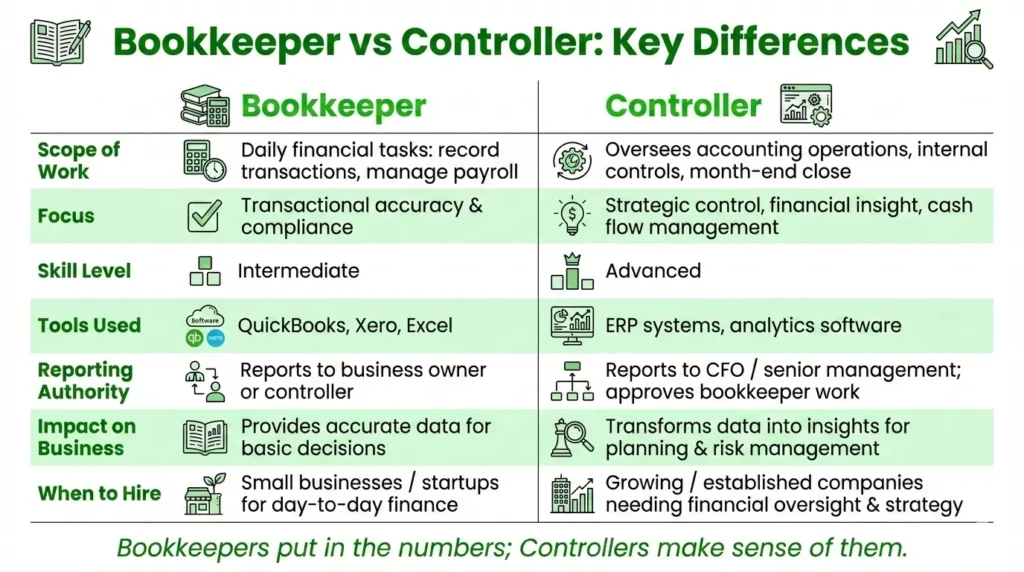
Key Differences of Bookkeeper and a Financial Controller
The bigger your business is, the more complicated your finances become. The initial phase of bookkeeping may seem sufficient, making records of sales, costs, and storing receipts in order. However, when you begin to scale, you need to be more strategic in decisions regarding budgets, cash flow, and compliance. It is then that you start seeing the true distinction between Bookkeeper vs Controller.
The two roles are vital, yet they play quite different roles in the way your financial system works and develops. The following breakdown simplifies it to the extent that one can easily view who does what, how they do it, and why both are important.
| Aspect | Bookkeeper | Financial Controller |
| Scope of Work | Handles daily financial tasks like recording transactions, managing payroll, and performing bank reconciliation. | Oversees accounting operations, establishes internal controls, and leads the month-end close process. |
| Tools Used | Accounting software, such as QuickBooks, Xero, or Wave, focuses on transaction management. | Advanced systems such as NetSuite or ERP tools for budgeting, forecasting, and financial reporting. |
| Reporting Authority | Reports to the controller or business owner. | Reports to CFO or senior management; reviews and approves the bookkeeper’s work. |
| Impact on Business Decisions | Provides accurate data for basic financial decisions. | Transforms financial data into insights for planning, risk management, and KPIs for finance. |
| Focus Area | Transactional accuracy and compliance. | Strategic control, data interpretation, and cash flow management. |
| When to Hire | Ideal for small businesses and startups managing day-to-day finances. | Necessary for established or growing companies requiring deeper oversight and forecasting. |
How a Bookkeeper Supports Startups in Their Early Stage
Think about a small digital marketing startup that is just getting off the ground. They possess limited customers, fewer personnel, and low-complex payment systems. What they most need is a person who can follow up on expenses, prepare invoices, and deal with payroll.
A bookkeeper perfectly fits this need. They maintain the financial data of the company correctly and at tax time without needless complexities. Such businesses can keep their books clean and their financial position transparent on day one by investing in strong startup bookkeeping solutions.
See A Detailed Breakdown Of The 10 Functions Of A Bookkeeper.
When a Growing eCommerce Business Needs a Financial Controller
Now, imagine a rising e-commerce company. They have climbed fast, with several internet platforms, hundreds of deals per day, and more suppliers coming into the picture. Bookkeeping is not sufficient at this stage. They require financial guidance in order to be accurate in all operations, monitor performance, and ensure compliance. A financial controller steps in to:
- Monitor the work of the bookkeeper.
- Review monthly reconciliations and financial reporting.
- Establish internal controls and separation of duties.
- Manage budgets and oversee month-end close procedures.
- Track cash flow control and maximize finance-related KPI such as sales margins or liquidity ratios.
This dual setup will enable the firm to run smoothly as the book officer will be dealing with daily numbers, whereas the controller will be ensuring that there is financial integrity and sustainability.
Why Businesses Often Need Both Roles
When the two roles align, then your business will have the full picture of finances. The bookkeeper makes sure that it is accurate, and the controller makes sense of that information to guide smarter decisions. This is the same route that we tend to follow with our clients at Outsourced Accountants, with outsourced bookkeeping at the beginning and an outsourced financial controller added over time as the business expands. The combination of them develops a powerful base of growth, compliance, and profitability.
Why Outsourcing Bookkeeping and Financial Controller Services Works Better
Employing full-time, in-house accounting employees is no longer the only or the most intelligent choice for many businesses today. Outsourcing is not only cost-effective but also a strategic and efficient solution with the emergence of digital accounting platforms, cloud systems, and virtual finance teams. Whether you require a daily outsourced bookkeeping service or an outsourced controller who deals with strategy and compliance, this strategy provides you with expert financial management at a cheaper, less complex cost than internal hiring.
The Deloitte Global Outsourcing Report (2024) says that overhead can be decreased by 45% when finance functions are outsourced, particularly in the case of SMEs. That will be a big increase in cash flow and flexibility of operations, which every growing company must have.
Why Businesses Are Turning To Outsourced Accountants
1. Significant Cost Savings
The in-house accounting departments are associated with wages, bonuses, software licenses, and training expenses. Outsourcing means that you only pay for what you require, whether it is part-time bookkeeping or complete financial management. This versatile model allows startups and intermediate-sized companies to upsize or downsize without having to worry about fixed expenses. To take an example, bookkeeping outsourcing may cost 50-70% less than having a bookkeeping team, and, nevertheless, you have access to certified professionalism and reports certified by a CPA.
2. Access to Expert Oversight and CPA Supervision
The accounting firms that are outsourced, such as Outsourced Accountants, tend to hire experienced controllers, accountants, and CPAs who review all reports to ensure accuracy and compliance. It implies that all transactions, reconciliations, and statements are processed by experts, which many smaller companies would not be able to sustain internally. In the case of an outsourced controller, you can have the benefit of strategic knowledge in financial reporting, month-end close, and internal controls without developing that expertise internally.
3. Advanced Tools and Real-Time Data
Spreadsheets are no longer the only way to deal with modern accounting. The most recent financial software, including QuickBooks Online and Xero, as well as NetSuite and ERP, is used by outsourced teams and, therefore, provides the ability to work in real-time and use transparent dashboards. This also provides business owners with immediate access to crucial financial KPIs, allowing them to monitor cash flow management, track expenses, and make confident decisions.
4. More Flexibility and Scalability.
At some point, every business goes through phases of growth, where the needs evolve rapidly. Perhaps you are going global or introducing a new product line. Outsourcing provides the flexibility to deploy a finance team on demand, growing from simple bookkeeping to full controllership without taking months to hire. For smaller companies, starting with outsourcing your bookkeeping so your central systems are taken care of professionally. As you expand, an outsourced controller will be a natural extension.
A True Benefit for Small and Medium Businesses
It is a common struggle for many startups and developing businesses to be financially accurate and yet remain affordable. Outsourcing fills that gap. It allows you to:
- Strengthen internal controls without extra headcount.
- Keep your financial reporting compliant and timely.
- Focus your internal resources on growth, not spreadsheets.
- Gain access to seasoned professionals who monitor KPIs and risk areas before issues arise.
The fact is that with outsourced teams, you receive longer hours of support, shorter turnaround times, and consistent performance, all safely stored in the cloud.
Smart Finance with Expert Support
At Outsourced Accountants, it is not only about doing your numbers, but it is also about growing your business with a sense of safety and assurance. Our team will implement the appropriate level of strategic oversight for your business, whether that requires regular bookkeeping, monthly financial close, or comprehensive strategic management.
When you are willing to have trusted, expert-driven support, explore our experienced accounting support, which can make all the difference in how you handle your finances, one precise report at a time.
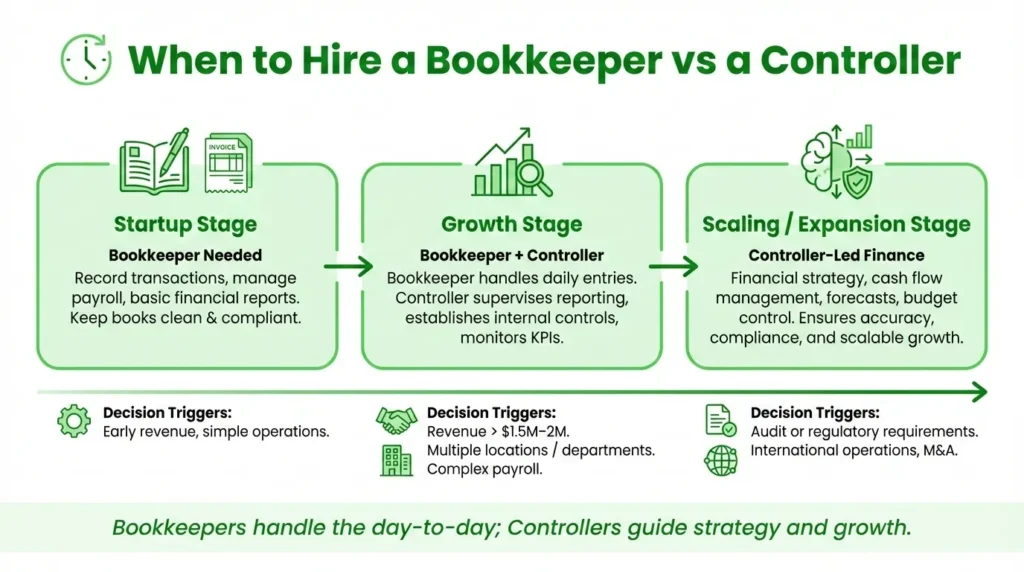
When to Hire a Financial Controller vs a Bookkeeper
Most small enterprises start with a full-charge bookkeeper, particularly when the volume of transactions is medium and operations are not complex. However, with the increase in operations, various departments, increased cash flow, and complicated reporting, a controller is needed.
When to hire a bookkeeper or controller depends on your size, stage of growth, and complexity of the financial operations in your company. An expanding company can even have both, one handling day-to-day entries, the other making sure that everything is in line with strategic objectives.
However, as things grow, so do the transactions, and regulation requirements get stricter; at some point, you will find that financial precision will require organization. That is when one will ask the question, Should I hire an accountant, a bookkeeper, or a controller? We will break down and see when each of these roles is necessary and how the timing can help you avoid expensive financial blind spots.
When to Hire a Bookkeeper
The first financial professional that your business needs is usually a bookkeeper. Their work is to ensure that your books are balanced, your numbers are tabulated, and that your records are clean. You need to employ a bookkeeper when:
- You are wasting your time on administration rather than the growth of the business. When invoices, receipts, or reconciliations have become part of your working day, a bookkeeper can relieve you of this burden.
- The number of transactions is rising. The more clients, vendors, or repetitive payments, the greater the possibility of error without appropriate recording.
- You need an accurate bank reconciliation. Monthly or weekly balances will help you check whether your books are the same as your bank statements to avoid fraud or confusion about cash flow.
- You need basic reporting of finance. A bookkeeper makes your balance sheet, income statement, and expense summaries, and makes sure that your numbers tell the truth.
- You want smoother tax preparation. Clean records translate into fewer headaches during the time of filing returns or meeting with the auditors.
Simply put, a bookkeeper is needed as soon as your financial load begins to consume your business productivity.
When to Hire a Financial Controller
It is not about replacing one with another; it’s about evolving your financial structure. A bookkeeper makes sure that all is added properly; a controller makes sure that these additions can be translated into valuable information. There are a lot of small and medium-sized companies that use a hybrid model in outsourced accounting, where the two services collaborate.
The arrangement provides a scalable system at a low cost as opposed to full-time employment, as your budget remains streamlined as your company grows without reservation. Growing businesses and startups will find the world of startup accounting and controller solutions to be an intelligent move to consider. It fills the gap between the day-to-day bookkeeping and strategic financial leadership to ensure that your company does not miss a beat as it develops.
That’s where Outsourced Accountants bridge the gap. Our balanced model is different because we help companies to streamline operations by providing outsourced bookkeeping and outsourced financial controller services. This dual structure makes sure your financial records are not only accurate but also strategically aligned with your business goals.
How Outsourced Accountants Build Real Financial Confidence
At Outsourced Accountants, we believe that the foundation of managing finances well is all about trust, trust in your data, trust in your systems, and trust in those who run the systems. This is the reason why our foundation relies on competence and openness as opposed to the delivery of services.
We also have qualified CPAs and seasoned financial controllers who have years of hands-on experience in various industries, startups, construction companies, e-commerce, and healthcare organizations. We do not simply operate ledgers, but assist business owners to make sense of numbers, enhance internal controls, and create plans that result in the courage of making decisions.
Global Reach, Local Understanding
Our expert team, having a strong operational status in the U.S and Oman, introduces a global approach to finance management. We know that each market works in different ways, such as the compliance with the regulations in the U.S. or the introduction of a new business ecosystem in the Middle East. This dual presence enables our team to accommodate clients in different time zones with cultural sensitivity and real-time communication, with the provision of uniform quality and accessibility regardless of the locality of your business.
Technology That Keeps You in Control
We think modern accounting must be visible, collaborative, and easy. That is why our accounting platform is cloud-based, like QuickBooks Online, Xero, and NetSuite. These applications provide our customers with complete access to their financial information, at any time and location, without complicated logins and spreadsheets. You are in a position to monitor financial reports, cash flow management, and other performance measures in real time through secure dashboards. We also have inbuilt data encryption and automatic backup systems, which make sure that your financial data is safe and updated.
Transparency at Outsourced Accountants
All reports that we provide are supported by the CPA review and data verification. All processes are documented, traceable, and constructed to be easily understandable, be it bank reconciliation, month-end close, or controller-level reporting. We also believe in complete communication: no inner lingo, no ambiguous prices, and no conjecture. Clients are kept in the loop since the first day, and regular updates, insights, and strategic guidance are provided, but never confusing.
Why Businesses Rely on Outsourced Accountants
- Professional Knowledge: U.S. and Oman-based accountants, controllers, and CPAs.
- International Standards: The international accounting principles.
- Open Processes: All reports read, checked, and distributed publicly.
- Technology-Based: Cloud-based applications, speed, accuracy, and accessibility.
- Client-First Approach: Every solution is business-oriented, not the other way around.
Numbers are important at the end of the day, but trust is more important. And that is what we want to win with each balance sheet, each report, each partnership that we develop.
Final Thoughts: Choosing the Right Financial Support as Your Business Grows
Understanding the difference between a controller and a bookkeeper is not only knowing the job titles, but also what your business actually requires at each phase of development. A bookkeeper keeps your financial base in check and in compliance, and a controller enhances strategy, internal controls, and decision-making.
At Outsourced Accountants, we work to help businesses fill that gap with flexible, scalable solutions, whether you require outsourced bookkeeping, controller oversight, or both. Our professionals will make sure that your financial reporting, your cash flow, and your month-end close will run smoothly so that you can build, not balance. The appropriate financial structure does not merely follow up on your growth, but it also speeds it up.
Frequently Asked Questions
What is the main difference between a controller and a bookkeeper?
The greatest distinction is between supervision and performance. A bookkeeper is in charge of handling the day-to-day finances, and responsibilities include recording transactions, bank reconciliation, and creating simple financial reports. A controller, however, has control over the said reports, making sure that reports are accurate, compliant, and strategic.
Simply put: the bookkeeper puts in the numbers; the controller makes sense out of them. The role of the controller is based on financial control, internal controls, and month-end close reviews that ensure that your financial image is stable and free of errors.
When should a small business hire a controller instead of just a bookkeeper?
You ought to think about when to hire a controller when your business no longer needs basic record-keeping, which is about the time your revenue hits the 1.5M-2M mark, or your finances become complicated, e.g., more than one location, large payroll, or audits. At that point, you require further analysis, internal controls, and order financial reporting to assist the decision-making. Early-stage startups can use a bookkeeper, but when you grow larger and desire to use financial information to turn into a business strategy, a controller is necessary.
Can a business outsource both bookkeeping and controller services?
Absolutely. It is common in the business world today to find that many businesses outsource their bookkeeping and employ an outsourced controller to help cut down on the expenses incurred as they retain professional supervision. This is a daily precision, strategic vision approach, at a cost-effective cost in terms of salary expenses. By partnering with such firms as Outsourced Accountants, you can receive both services in a single place and have your month-end close, reconciliations, and compliance procedures running smoothly at the same time while having access to modern tools and CPA-level oversight.
What Key Performance Indicators(KPIs) should a controller track versus a bookkeeper?
A bookkeeper is concerned with operational accuracy in terms of the timeliness of invoice entry, error-free bank reconciliation, and on-period month-end close. However, a controller tracks larger KPIs in finance, such as cash flow management, budget variances, accounts receivable turnover, and profitability ratios. In essence, bookkeepers make sure that transactions are correct, controllers make sure that the story of the numbers is correct, and that they will push the business forward.
How do internal controls and separation of duties change when you hire a controller?
Your internal controls are more organized, and separation of duties is enforced when you introduce a controller. It is to say that neither a single individual handles both transaction processing and approval, lessening the chances of fraud or mistakes. The controller develops checks and balances among bookkeeping, approvals, and reporting units, making all levels accountable. Such oversight provides the leadership with credible information and a solid base for further auditing and compliance inspection.