
The Bureau of Labor Statistics estimated a full-time bookkeeper in the middle at a $49,210 salary in May 2024. Add payroll taxes, benefits, software and a workspace on it and that one employee can easily cost you $60000 or more annually before you even verify the accuracy of the books.
The actual question of outsourced vs in-house bookkeeping is all about the confusion of whether you construct a team or give your books to another team. Misjudge it, and you will pay too much for a position that you did not require, or you lose the practical control that your business requires.
Most articles on this subject lean on one side before you even read a single word. This one doesn’t. You’ll receive the actual cost breakdowns, a table that will compare the two side by side, a calculator that you will be able to interact with and run your own numbers and a decision framework that is tailored to your specific business rather than a sales pitch in disguise.
Quick Answer of Outsourced vs In-House Bookkeeping
In the majority of cases under $5 million in revenue, bookkeeping is cheaper and quicker to outsource. In the short-term small business owners usually spend $500-2500 a month compared to $49000 a year plus one employee.
In-house bookkeeping is the winner when you require access to your books the same day, onsite, or you are dealing with a high volume of transactions which warrants a full-time position. No single answer exists to this question. The answer to you is different depending on your size, budget and your growth rate.
In-House vs. Outsourced Accounting: Key Differences
You need to have the fundamentals in place first before weighing the pros and cons. These two models address the same issue totally differently.
What Is In-House Accounting?
In-house accounting refers to the hiring of a single employee or more employees who report directly to your company, handle your books, payroll and financial reporting all in-house. They are on your payroll, attend your meetings, and are answerable to you only. The Bureau of Labor Statistics indicates that more than 1.7 million individuals are employed as bookkeeping, accounting, and auditing clerks in the US, the vast majority of them in precisely this type of in-house position.
What Is Outsourced Accounting?
Outsourced accounting is when you give out your books to a third-party company or individual and uses End-To-End Remote Bookkeeping Services to work with your books, typically using cloud-based software such as QuickBooks or Xero. It is not that you are managing an employee but a relationship with a provider who provides their own team, systems, and expertise to your business.
The Core Difference: Ownership vs. Access
It is not merely the real difference between being in the office and being remote. It is property vs. possession. In-house will offer you a committed individual who is totally a part of your business. Outsourced accounting vs in-house accounting is ultimately a matter of trading direct control for wider expertise and flexibility.
Outsourced vs In-House Bookkeeping: Cost, Scalability and Risk Compared
This decision is easier when using numbers compared to opinions. This is how outsourced bookkeeping compares to having an in-house hire on the factors that actually do impact your bottom line: cost, scalability, security, and the speed at which you can be up and running.
| Factor | In-House | Outsourced |
| Average monthly cost | $4,000-$5,500 (salary + benefits + overhead) | $500-$2,500 |
| Time to hire/onboard | 4-6 weeks | 3-7 days |
| Expertise breadth | Limited to one hire’s skill set | Full team, multiple specialists |
| Scalability | Slow and requires new hires as you grow | Fast and adjust service tier as needed |
| Data security control | Direct, in-house oversight | Vendor-dependent, contractually defined |
| Compliance risk | Higher and one point of failure | Lower and built-in redundancy |
| Best for the company stage | Established, stable operations | Growing, scaling, or seasonal businesses |
| Technology access | Budget-limited, self-funded | Included in service |
| Turnover risk | High and average bookkeeper tenure runs 2-3 years | None and provider maintains continuity |
This trend is not subtle. In-house wins on direct control; outsourced wins on cost and scalability in nearly all the rows that count to a business on the way to expansion. But the table is half the story. What happens when your volume of transactions is threefold in a quarter is where the real difference will be reflected, and that is what the following section will decompose.
In-House Accounting: Pros and Cons
In-house hiring is not a bad idea, just the right customized bookkeeping plans matter in this or that situation. This is a candid insight into what it does best and what it is doing to your wallet.
Benefits of In-House Accounting
Direct Control
Your accountant is not across the hall, but on the other side of a support ticket. Don’t have time before a 2 PM meeting? Walk over and ask. Such access is most important when you need to make decisions quickly, and you cannot afford to wait for an email response.
Business Familiarity
Acquaintance is something that develops with time and can not be achieved in the shortest possible time through outsourcing. A two-year in-house accountant familiar with you knows your suppliers, your peaks and valleys of cash flow, and that customer who never pays on time. Such a setting becomes quicker and more acute financial decision-making.
Tighter Confidentiality
Your financial information remains within your walls and is administered by one who only answers to you. In the case of businesses dealing with particularly sensitive information, consider M&A activity or investor relations; that chain of custody does have a literal meaning.
Challenges of In-House Accounting
Higher Cost
The median salary of a full-time bookkeeper is $49,210 annually, as calculated by the BLS, and with benefits, payroll taxes, software licenses, and office space added in, the figure reaches nearer to $65,000-$70,000 total cost. That is a high price for one individual to manage one operation.
Turnover Risk
The median bookkeeper only spends 2 to 3 years in one position, and every leaves, you lose weeks of productivity, you have to start the hiring process again, and you have to worry about holes in your records as they vacate.
Limited Skill Breadth
A single hire cannot be a payroll, tax strategy, multi-state compliance, and forecasting expert simultaneously; no one can. When your company is up against a knotty financial issue, having an in-house team of one is usually, in any case, an outsourcing of the difficult bits, just informally and under pressure.
A comparison of the pros and cons of the in-house accounting model against one another shows that this type of accounting serves businesses with highly predictable business operations much better than it does those in their growth phase.
Outsourced Accounting: Pros and Cons
Outsourcing reverses the hiring and managing to plug in and go. This is where that trade-off will come in handy and also where it will demand something of you.
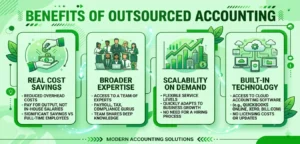 Benefits of Outsourced Accounting
Real Cost Savings
Most small businesses are paying outsourced bookkeeping and accounting services of between $500 and $ 2,500 a month instead of spending $65,000 and above on a fully-equipped in-house position. And that is the greatest, most regularly mentioned benefit in any survey of industries on the subject, and it is not difficult to understand why. You are paying output and not overhead.
Broader Expertise
One provider translates to having a whole team of experts on board: payroll, tax planners, multi-state compliance gurus, instead of relying on one employee to do it all. When a tax question arises that is hard to answer, one of the team members has already answered it a dozen times.
Scalability on Demand
Your revenue doubles, your transaction volume peaks around the holidays, or you open a second location; an outsourced provider simply changes your service level, without a hiring process. The said flexibility is among the most obvious advantages of outsourced accounting to a business in the growth stage. You will never be caught paying more than you should be paying in terms of unutilized capacity.
Built-In Technology
Most outsourced packages include cloud services such as QuickBooks Online, Xero, Bill.com and the updates and security patches that ensure they operate. You forego the licensing cost and learning curve.
Challenges of Outsourced Accounting
Less Direct Control
Your provider isn’t sitting down the hall. A request made the same day can take a few hours to respond to rather than a few minutes, and that delay can be painful when making a decision quickly or when there is a time constraint.
Data Security Considerations
Giving financial information to a third party implies reliance on their systems and protocols. Well-known vendors apply encryption and SOC 2-conformant infrastructure and signed NDAs, but you are still trusting them with their security posture rather than your own.
A Ramp-Up Period
A new provider is not aware of your business on day one as a two-year employee. Allow yourself some weeks of additional explanation, check-ins and then you will find them catching nuances to your cash flow even before they are told.
Considering the advantages and disadvantages of outsourced accounting in tandem, the trend is evident: such a model is losing some immediacy and hands-on familiarity to save on costs, enlarge its expertise and expand its space. A compromise that favors the majority of small and medium-sized businesses.
Make confident bookkeeping decisions with expert support
How Much Does In-House vs. Outsourced Accounting Actually Cost?
Each pro-and-con list plays around the real number. Let’s not do that. This is the actual cost of each model, line by line to run this calculation against your budget.
In-House Accounting Cost, Line by Line
The in-house accounting cost starts with salary, but salary is just the entry point.
| Cost Component | Annual Estimate |
| Base salary (BLS median, bookkeeper) | $49,210 |
| Payroll taxes + benefits (~28-30%) | $13,780–$14,760 |
| Accounting software (QuickBooks, Xero, etc.) | $600–$1,800 |
| Office space, equipment, utilities (allocated share) | $2,500–$4,000 |
| Recruiting and onboarding (amortized) | $1,500–$3,000 |
| Total annual cost | $67,590–$72,770 |
And that is without a raise, or a promotion, or the six weeks of decreased production that you have every time you hire a new employee. No single salary line ever tells the entire tale; the loaded figure often is 35-40% more than the actual paycheck.
Outsourced Accounting Cost, Tier by Tier
This is not the same with the cost of outsourced accounting; a service level is being purchased, not an individual.
| Service Tier | Typical Monthly Cost | Best For |
| Basic bookkeeping | $500–$900 | Startups, sole proprietors and simple transaction volume |
| Standard bookkeeping + reporting | $900–$1,800 | Small businesses with payroll, AP/AR, monthly close |
| Full accounting + controller support | $1,800–$3,500 | Growing businesses needing forecasting, compliance and multi-entity work |
| Outsourced CFO-level support | $3,500–$10,000+ | Businesses preparing for funding, acquisition, or rapid scale-up |
Even at the highest level, a business that spends $10,000 a month $120,000 a year could be getting the equivalent of a controller, a bookkeeper and a compliance specialist in one- three positions that most companies could not afford to pay separately.
The Side-by-Side Number
In-house Outsourced Accounting Cost in 2026, fully loaded, about $68,000-$73,000 annually. A similar outsourcing service level costs between $10,800 and 21,600 annually. That is about a difference of $50,000-$60,000- money that is immediately reinvested in inventory, marketing or filling positions, which have to occupy your office.
Cost isn’t the only factor in this decision. However, when budget is fueling yours, the arithmetic is seldom kind to assembling a team before you get past real size.
Which Model Fits Your Industry?
The correct answer will vary with what you really do. A flat outsource everything/hire everything approach disregards the variability in the way industries create transactions and risk.
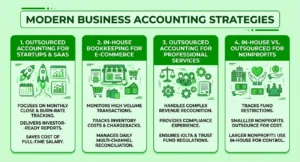
Outsourced Accounting for Startups and SaaS
Startups spend money quickly in their initial stages and do not require a full-time employee until product-market fit. Outsourced accounting for startups includes monthly close, burn-rate tracking and investor-ready reports, which are precisely the deliverables that a Series A due diligence process requires, without the addition of a $65,000 salary to your runway calculations.
In-House Bookkeeping for E-Commerce
The change in calculation is due to the high volume of transactions. A store that takes orders in thousands a month requires a person who monitors inventory costs, chargebacks and multi-channel reconciliation every day. In-house bookkeeping for e-commerce enterprises with monthly revenues in the 6-figure range can easily recoup the cost of the accounting service by itself due to quicker fraud prevention and better margins.
Outsourced Accounting for Professional Services
Billing in law firms, agencies and consultancies is either per hour or per project, and this makes revenue recognition and trust accounting very complex quickly. Professional services outsourced providers are the source of compliance experience that most solo hires and in-house positions do not have yet. Especially when it comes to IOLTA and client trust fund regulations.
In-House vs. Outsourced for Nonprofits
The tracking and restriction of funds and board-ready financial statements require a particular type of expertise. Smaller nonprofits tend to outsource due to cost considerations, and larger organizations with more complicated, restricted funding sources will tend to adopt accounting in-house to allow a tighter day-to-day control over the flow of every dollar.
How to Decide: A Simple Framework
Take away the noise and this choice reduces to four questions which are answered sequentially.
1: What is the size of your company and its revenue?
For revenue less than five million, outsourcing is nearly always cheaper. Beyond that, the math begins to move towards a hybrid or in-house model.
2: How complicated are your financial activities?
Basic and simple, repetitive transactions prefer either model. Multi-entity structures, multi-state compliance, or industry-specific rules are most suitable for outsourced experts who have already solved that particular problem.
3: What is your real budget?
When it is not in the budget to pay more than $65,000+ to hire any one person, then you can eliminate that barrier by outsourcing; you can begin with $500 a month and increase.
4: What is your rate of growth?
A stable and predictable operation is more appropriate with an in-house hire. The built-in flexibility of outsourcing is appropriate in situations where the business is growing rapidly, experiencing seasonal fluctuations or unpredictable transaction volume.
Be honest with those four, and you will know how to decide on outsourced and in-house accounting for your particular business, not a generic business.
The Hybrid Approach: Best of Both Worlds
The majority of businesses do not have to choose one lane. With a hybrid accounting model, you can have sensitive and day-to-day tasks near at hand, but you can outsource the specialized work that you probably cannot justify a hire on at the same time.
This is what such a split normally looks like in action:
| Task | Keep In-House |
| Daily transaction entry | Keep In-House |
| Vendor and client relationships | Keep In-House |
| Payroll processing | Outsource To Provider |
| Tax preparation and filing | Outsource To Provider |
| Multi-state compliance | Outsource To Provider |
| Monthly financial reporting | Outsource To Provider |
| Cash flow forecasting | Outsource To Provider |
| Strategic budget decisions | Keep In-House |
A business owner who invoices clients directly, but sends payroll, tax filings, and monthly reporting to an outsourced vendor, obtains the control desired most and the experience that they would spend six figures to acquire. It is commonly the first step in a business that is moving off of a fully in-house model without immediately moving to full outsourcing.
A Real-World Example
Both models were operated in a 12-person digital marketing agency with annual revenue of $2.8 million. They employed an in-house bookkeeper who exited after 18 months at a salary of $52,000 a year, and this departure cost them about six weeks of invoicing delays and a rush to balance the books of Q2 before the tax season.
They changed to outsourced bookkeeping of $1,400 a month or $16,800 a year and added a part-time controller service of $2,200 a month at tax season. Annual cost of outsourcing: approximately $20,000 – a quarter of the cost the in-house position had been during the benefits and software included.
The trade-off: their team took six weeks to provide complete context to the new provider, and they lost immediate access (same day, walk-over-and-ask) that they had previously had. As in the case of a business their size, that adjustment period was outweighed by the savings and the removal of the turnover risk.
The actual form of the outsourced versus in-house bookkeeping decision in the real world is not some abstract argument, but a particular trade-off in dollars and weeks.
Conclusion
The outsourced vs in-house bookkeeping debate is not a universal competition, but rather a matter of which one fits your business at this point. In-house provides the benefit of immediate access, in-depth knowledge, and direct control, and it justifies its price in situations where your operations are complex, stable, and large enough to warrant a full-time employee. Outsourced is cheaper, offers greater experience, and can scale without the need to hire someone, and it deserves to be considered when you are expanding, cost-conscious, or managing the volume of transactions that change every month.
Enter your own business numbers into the above calculator, see where you fall on the decision model, and do not dismiss a hybrid split when neither of these models fits suitably on its own. This call should be made by the math and not a sales pitch.
In case you would prefer not to use the spreadsheet and discuss your individual numbers with someone who does it every day, contact us at Outsourced Accountants to have a free consultation without any obligation.
Frequently Asked Questions
Is outsourced accounting less expensive than in-house?
Yes, in most cases. In-sourced accounting ranges between $500-2,500 a month, and a full-service, in-house bookkeeper costs between $65,000-$73,000 a year, including salary, benefits, software, and overhead costs. Outsourcing tends to be much less expensive for businesses with less than 5 million in revenue.
Is it possible to change from in-house to outsourced accounting?
Absolutely. This switch is made by many businesses as they expand or the costs increase. Arrange a transition of several weeks to ensure that your new provider has time to look at historical records, familiarize themselves with your chart of accounts, and assume the reins without missing any reports.
Is accounting outsourcing secure?
Trusted vendors apply bank-level encryption, are SOC 2 certified, and have signed an NDA to safeguard your information. Request any provider regarding their security certifications, location of data storage, and history of breaches before signing on the dotted line. The danger here is not outsourcing; it is outsourcing to an unvetted provider.
What’s the difference between outsourced bookkeeping and outsourced accounting?
Day-to-day transaction recording, reconciliation, and data entry are all included in bookkeeping. Financial analysis, reporting, tax strategy, and forecasting are additions to accounting. Some of the outsourced vendors provide both services under a single roof and scale with your requirements.
What is the cost of in-house accounting to a small business?
In addition to the median $49,210 bookkeeper wage, there are about 28-30% of payroll taxes and benefits, software, office space, and onboarding expenses. The all-in realistic number ranges between $65,000 and $73,000 a year to hire one full-time employee.
When do you consider a business should outsource accounting?
Examples of common triggers are a rapid increase in revenue, seasonal peaks or declines in revenue, an internal hire quitting, or a report that is always late or ambiguous. When your books are unable to keep up with your choices, that is the indication to outsource.
Will the outsourced accounting take care of payroll and tax filing as well?
Yes. The majority of outsourced accounting companies offer payroll processing, tax preparation, and compliance filing with a combination of the typical bookkeeping and reporting, at a reduced overall cost compared to having individual specialists perform each of the functions.
Are hybrid accounting models superior to either of the two?
Yes, to a good number of mid-sized businesses. A hybrid model retains sensitive, day-to-day activities such as client relationships and invoicing in-house and outsoruces specialized activities such as payroll, tax filings, and compliance.