
2026 Payroll Calendar has one snag every employer will be familiar with: biweekly payroll will have 27 pay periods, rather than the typical 26. This occurs due to the calendar effect of 2026 that will push an additional payday into the year of any business operating on a Thursday/Friday cycle that begins in early January.
Approximately 1 out of 4 employers in the US will reach this 27 th pay-period, based on their initial pay date of the year. That fact alone transforms the calculations of salaries, tax withholding and benefits deductions for millions of workers. This blog will explain everything you need to know about the 2026 payroll calendar as an employee and employer.
What Is a Payroll Calendar and Why Is 2026 Different?
A payroll calendar is a list of all pay periods and pay dates in a calendar year. It is used by employers to plan how to process, tax deposits and direct deposits. On the face of it, a payroll calendar for 2026 seems to be the same as any other 52-week, 12-month, four-frequency pay calendar. That means it will have 27 paydays rather than 26 weekdays.
As reported in the data on employer pay practices by the U.S. Bureau of Labor Statistics, the most common pay period in the country is biweekly, which encompasses nearly 43% of employers in the US. The 27-period year has more businesses than any other quirk of the calendar in recent times because biweekly pay is the most common schedule.
Let us handle your 2026 payroll.
What Are the 2026 Pay Periods at a Glance?
All four standard payroll schedules of 2026 are compared in a single view in the table below.
| Schedule | Pay Periods in 2026 | Typical Pay Day | Best For |
| Weekly | 52 | Every Friday | Hourly, construction, hospitality |
| Biweekly | 26 (27 for some employers) | Every other Friday | Corporate, retail, healthcare |
| Semi-Monthly | 24 | 1st & 15th | Salaried, office, finance |
| Monthly | 12 | Last business day | Executives, commission-based roles |
One thing is apparent in this pay period calendar 2026: Biweekly and weekly employers are much more likely to submit payroll than semi-monthly or monthly teams. That increases the level of risk in getting the 2026 payroll schedule accurate on the first day.
What Does the 2026 Weekly Payroll Calendar Look Like?
The 2026 weekly payroll calendar has 52 pay periods beginning Friday, January 2 up to Friday and December 25. The year 2026 is not a leap year and the number of Fridays in that year is 52, exactly with no 53rd payday this year unlike 2016 when the 1st January 2017 start of the year will push the number to 53.
There are two Fridays that are going to be heavy in 2026. Both Juneteenth (June 19) and Christmas Day (December 25) fall on a Friday, a regular payday. Employers will need to submit ACH earlier in both weeks, as banks will shut down on the holiday itself, and will not take direct deposits that day.
| Pay Period | Sample Date |
| 1st | Friday, January 2, 2026 |
| 26th | Friday, June 26, 2026 |
| 52nd | Friday, December 25, 2026 |
What Is the 2026 Biweekly Payroll Calendar and Why Does It Have 27 Pay Periods?
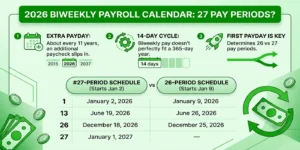
The 2026 biweekly payroll calendar consists of 27 pay periods for any employer that has the first payday of 2026 on Friday January 2. The 14-day pay cycle does not split evenly into a 365-day year and so about every 11 years, an additional payday will slip into the calendar. This occurred in 2015, will recur in 2026 and will not recur until 2037.
Not all biweekly employers receive 27 checks. The result is completely based on the initial payment date of the year:
| # | 27-Period Schedule (starts Jan 2) | 26-Period Schedule (starts Jan 9) |
| 1 | January 2, 2026 | January 9, 2026 |
| 13 | June 19, 2026 | June 26, 2026 |
| 26 | December 18, 2026 | December 25, 2026 |
| 27 | January 1, 2027 | — |
An employer who starts the year on January 9 and continues on a standard biweekly pay cycle for 2026 periods, since the cycle ends on the 27th, which is outside the current calendar year but the 27th falls into the next calendar year.
What Is the Semi-Monthly Payroll Calendar 2026?
Any semi-monthly payroll calendar 2026 will give a total of 24 pay periods which will be paid on the 1st and 15th of each month no matter how many days are between checks. Semi monthly does not add a period as does biweekly pay as it is based on the calendar month and not a set number of days.
Nine of 24 semi monthly pay dates in 2026 require correction since the 1st or 15th is on a weekend or federal holiday. 2026 will have nine semi monthly pay dates that need to be adjusted because they fall on a weekend or federal holiday. The 8th day of the week, Saturday or Sunday is February 1, February 15, March 1, March 15, August 1, August 15, November 1 and November 15. The 1st of January is New Year’s Day, which means the next business day is the payday, even though it is on a weekday.
| Month | Standard Dates | Adjusted Pay Date (if needed) |
| January | 1st, 15th | 1st moves to Dec. 31, 2025 |
| February | 1st, 15th | Both move to Jan. 30 / Feb. 13 |
| March | 1st, 15th | Both move to Feb. 27 / Mar. 13 |
| April | 1st, 15th | No adjustment needed |
| May | 1st, 15th | No adjustment needed |
| June | 1st, 15th | No adjustment needed |
What Is the Monthly Payroll Calendar for 2026?
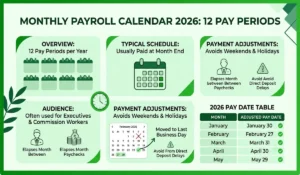
Monthly payroll is based on 12 pay periods, and is usually paid at the end of each month on the last business day. This time frame is applicable to executives and commission workers more so than hourly workers because a month elapses between paychecks.
The actual pay date will be moved to the weekend of various 2026 month-end dates. The 28th of February, 2026, is a Saturday, thus the payroll becomes Friday, 27 February. Any employee payroll calendar 2026 that is constructed to support monthly pay must warn of month-end weekend collisions long before it is processed, as a three-business-day delay in direct deposits from Fridays to Mondays can occur.
| Month | Adjusted 2026 Pay Date |
| January | January 30 |
| February | February 27 |
| March | March 31 |
| April | April 30 |
| May | May 29 |
Why Does 2026 Have an Extra Pay Period? Employer and Employee Impacts
The 27th pay period modifies the math of payroll on both sides of the paycheck. Employers have to decide on how to address annual salary division, benefits deductions, and IRS withholding tables, and employees experience the immediate impact on their bank accounts.
| Impact Area | Employer Perspective | Employee Perspective |
| Salary math | Divide the annual salary by 27, or pay one extra full check | Slightly smaller paychecks, or one bonus-like extra check |
| Benefits deductions | Skip one deduction cycle, spread deductions across 27 checks, or double one check | Watch for a check with no deduction or a larger-than-usual deduction |
| Tax withholding | IRS withholding tables assume 26 periods, so totals may need review | Employees may see minor over-withholding or under-withholding |
| Communication | Notify staff 30+ days ahead as a payroll best practice | Confirm with HR which method the employer uses this year |
Employers who pay yearly wages divided by 27 pay slightly less but prevent paying more than anticipated. Employers that pay an extra full check receive a one-time increase in payroll costs of approximately 3.8% of the annual payroll in that pay group.
How Do 2026 Federal Holidays Affect Payroll Processing?
In 2026, the federal government will include 11 holidays, and all of them will impact payroll processing via bank closures and ACH delays.
| Holiday | 2026 Date | Payroll Note |
| New Year’s Day | Thursday, Jan. 1 | Banks closed; submit payroll by Dec. 30 |
| MLK Day | Monday, Jan. 19 | ACH is delayed one business day |
| Washington’s Birthday | Monday, Feb. 16 | ACH is delayed one business day |
| Memorial Day | Monday, May 25 | ACH is delayed one business day |
| Juneteenth | Friday, Jun. 19 | Falls on a scheduled weekly payday |
| Independence Day | Saturday, Jul. 4 (observed Fri., Jul. 3) | Submit payroll early in the week |
| Labor Day | Monday, Sep. 7 | ACH is delayed one business day |
| Columbus Day | Monday, Oct. 12 | Federal banks closed; most private payroll unaffected |
| Veterans Day | Wednesday, Nov. 11 | ACH is delayed one business day |
| Thanksgiving | Thursday, Nov. 26 | Submit payroll 2-3 business days early |
| Christmas Day | Friday, Dec. 25 | Falls on a scheduled weekly and semi-monthly-adjacent payday |
Payroll 2 and 3 are submitted at least 2-3 business days before any week with a holiday, which insulates against delays in ACH processing. Professional Contractor Payroll Services are commonly used by project-based and contract workers who must operate under stricter deadlines, and it is at this point that the annual mid-cycle holiday is encountered.
What State Laws Affect Your 2026 Payroll Schedule?
The minimum pay frequency under state law, and the minimum is much less different than many employers think it is. Other states, such as New York and Massachusetts, impose a weekly pay on manual workers regardless of company size. In other states, such as Alabama and Florida, there is no minimum frequency whatsoever, and the schedule is completely at the mercy of the employer. A third category such as California, permits monthly payment only on specified exempt positions with semi-monthly payment on all others.
This variance exposes multi-state employers in a real sense. The minimum-frequency law can be broken by using a single payroll calendar that is up to date in a particular state and punishments are usually given on a pay period basis for each employee. This risk is something that ecommerce businesses that have remote teams in place, spread across multiple states, will always face, making Customized Ecommerce Payroll Services an ideal solution for sellers who need to scale a distributed workforce without a dedicated compliance team.
How Do You Choose the Right 2026 Payroll Schedule?
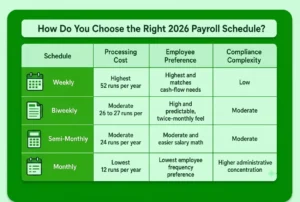
The optimal schedule represents the strike between the processing cost, preference to the employees and complexity of compliance.
| Schedule | Processing Cost | Employee Preference | Compliance Complexity |
| Weekly | Highest (52 runs/year) | Highest and matches cash-flow needs | Low |
| Biweekly | Moderate (26-27 runs/year) | High and predictable, twice-monthly feel | Moderate |
| Semi-Monthly | Moderate (24 runs/year) | Moderate and easier salary math | Moderate |
| Monthly | Lowest (12 runs/year) | Lowest and longest gap between checks | Low, but state minimums apply |
Any employer who alters schedules during the year is required to adhere to the expectations of the Fair Labor Standards Act regarding advance-notice, usually requiring written notice of at least 30 days before any change in pay frequency may occur. Failure to give that notice leaves the business subject to wage-payment claims in those states that have stringent frequency laws.
How Do Outsourced Accountants Simplify Your 2026 Payroll Calendar?
Outsourced Accountants develops the 2026 pay calendar to reflect each client’s specific pay frequency, state requirements, holiday schedule and processes it in such a way that the 27th pay period, weekend-adjusted dates and multi-state rules never land on the plate of the business owner. Small businesses with lean teams receive the same calendar accuracy as a full in-house payroll department, without increasing the number of employees. Payroll Service For Small Businesses is a service that fulfills this very requirement: proper scheduling of 2026, proper withholding, and direct deposits on time, managed end-to-end.
Conclusion
The 27-pay-period biweekly year is the most significant payroll fact of 2026, and it impacts salary math, tax withholding, and benefits deductions in the biggest proportion of employers in the U.S. Ahead of it – and the semi-monthly dates (adjusted to weekends) and the holiday-related ACH delays – will keep payroll in order throughout the year. Outsourced Accountants develops that accuracy into the calendar of all its clients between January 1 and December 31.
Frequently Asked Questions
What is the number of pay periods in the 2026 biweekly payroll?
Most biweekly employers will experience 26 pay periods with one in 27 paydays where the first payday of the year is January 2 as the 14-day cycle moves an additional payday into the year in 2026.
What is the reason why 2026 has 27 pay periods rather than 26?
A 365-day year does not partition into 14-day cycles, and when the starting date is early in January then there would be a 27th payday on January 1, 2027 just within the first week of the next year.
Is 2026 a leap year?
No. 2026 will be a weekly payroll calendar with 52 pay periods and no 53rd Friday with 365 days to go.
A semi-monthly payroll calendar has how many pay periods in it?
A semi-monthly plan provides 24 pay periods every year, which are paid on the 1st and 15th of each and every month, as it will be based on the calendar month and not a specific number of days.
What is the most optimal payroll schedule of a small business in 2026?
The optimal 2026 pay plan will be conditional upon the type of workforce: twice a month best suits the majority of corporate and retail teams, whereas weekly best suits hourly and hospitality employees who require a regular cash flow.
What impact will federal holidays have on 2026 payroll processing?
Federal holidays shut down banks, which postpones ACH direct deposits. The submission of payroll 2 to prevent late paychecks should be considered in a payroll processing calendar 2026 in order to submit payroll 2-3 business days before any holiday week.