
Outsourced bookkeeping gives a CPA firm access to trained bookkeeping staff without adding full-time headcount. This guide explains why small and mid-sized CPA firms are moving to this model, what it actually costs in 2026, which tasks to hand off first, and how to choose a provider that protects your margins and keeps client data safe.
This guide covers:
- Why CPA firms face a growing bookkeeping capacity problem
- Current 2026 pricing for outsourced bookkeeping services
- The day-to-day tasks a bookkeeping team handles
- Data security standards a firm should require
- A step-by-step transition process with realistic timelines
- Common mistakes that reduce the value of outsourcing
What Is Outsourced Bookkeeping for CPA Firms?
Outsourced bookkeeping is an arrangement where a CPA firm hands routine bookkeeping work to an outside team instead of hiring for it internally. That team records transactions, reconciles bank and credit card accounts, manages accounts payable and receivable, and handles month-end close. Meanwhile, the firm’s CPAs stay focused on advisory work, tax strategy, and client relationships.
The scope is different from a fractional accounting arrangement, where a single professional provides financial analysis and planning. Outsourced bookkeeping stays narrower: it’s the transactional, process-driven work that keeps a firm’s books, and its clients’ books, accurate and current.
Why Do CPA Firms Face a Bookkeeping Capacity Problem?
Is There Really a Shortage of Accounting Talent?
Yes. Bureau of Labor Statistics data cited in AICPA pipeline research shows the accounting profession lost roughly 340,000 professionals, or about 17% of its workforce, between 2019 and 2023. The most recent AICPA PCPS CPA Firm Top Issues Survey, based on responses from 629 firms collected in the spring of 2026, found that staffing pressure hasn’t let up: hiring experienced staff ranked as the top current issue for firms with 11 to 30 professionals, and staff retention placed in the top five concerns for every firm size except solo practitioners.
On top of that, keeping pace with technology and AI adoption is now the issue firms across nearly every size group expect to have the biggest impact on them over the next five years. That combination of thin staffing and rising technology demands hits bookkeeping and staff-level roles hardest, since those positions see the highest turnover.
Why Does This Matter for Small and Mid-Sized Firms?
A small to mid-sized CPA firm competes for the same shrinking talent pool as the national firms, but without the salary budgets to win that competition. Client workloads keep climbing anyway, especially during tax season, which leaves firm owners doing bookkeeping work instead of billable advisory work. Outsourced bookkeeping meets this need without a multi-month domestic hiring search.
Core Benefits of Outsourced Bookkeeping for CPA Firms
How Much Does Outsourced Bookkeeping Actually Save a Firm?
A firm typically saves 40% to 70% compared with a similar in-house hire. The BLS put the median annual wage for bookkeeping, accounting, and auditing clerks at $50,670 in May 2025, a figure that excludes benefits, payroll taxes, and office overhead, which usually add another 20% to 30% on top. Outsourcing eliminates most of those fringe costs, since a firm pays only for the hours or workload it actually needs.
What Does This Look Like With Real Numbers?
A firm paying an in-house bookkeeper $60,000 a year, once benefits and overhead are included, can often replace that cost with an outsourced monthly retainer of $1,500, or $18,000 a year. That’s a savings of $42,000, roughly 70%. A firm managing books for several clients can run the same math on each engagement, and the total savings grow as more clients move to the outsourced model.
Does Outsourcing Give Firms Access to Better Expertise?
Outsourced bookkeeping teams work under US accounting standards and serve multiple CPA firm clients at once, which builds deeper, faster expertise than a single generalist employee typically develops alone. A firm gains that specialized knowledge immediately instead of spending months training a new hire on its specific processes.
How Does Outsourcing Handle Seasonal Workload Spikes?
Tax season brings a predictable surge in bookkeeping and reconciliation work every year. An outsourced provider can add capacity during those peak months and scale back once the season ends, without the cost of hiring seasonal staff the firm doesn’t need the rest of the year.
What Time-Zone Advantage Does Outsourcing Provide?
A remote bookkeeping team often works while US business hours are asleep. A firm can hand off a batch of reconciliations at the end of its business day and find them checked in and ready to review the next morning. That effectively extends the firm’s working hours without anyone on the US side staying late.
What Tasks Does an Outsourced Bookkeeping Team Handle?
Which Transactional Tasks Move First?
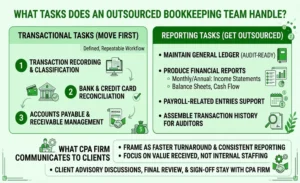
An outsourced team typically starts with transaction recording and classification, since this work follows consistent rules and offloads easily. Bank and credit card reconciliation comes next, matching transactions against statements to catch anomalies early. Accounts payable and receivable management, tracking vendor invoices, payment schedules, and client collections, also transitions well because it runs on a defined, repeatable workflow.
Which Reporting Tasks Get Outsourced?
Beyond day-to-day work, outsourced teams typically maintain the general ledger and keep accounts balanced and audit-ready. They produce monthly and annual financial reports, income statements, balance sheets, and cash flow statements on a schedule the firm can rely on. Most providers also support payroll-related bookkeeping entries and help assemble the transaction history an auditor might request.
What Should a CPA Firm Communicate to Clients About This Change?
A firm considering outsourced bookkeeping for client accounts should decide upfront how transparent to be with clients about the arrangement. Most firms find it more effective to frame the change around faster turnaround and consistent monthly reporting, rather than the internal staffing reasons behind it. That keeps the client conversation focused on the value they receive.
Final review, client advisory discussions, and sign-off typically stay with the CPA firm, which keeps direct control over quality and client relationships in-house.
Outsourced Bookkeeping vs In-House vs Fractional Accounting
CPA firms often mix up these three models, since all three involve some form of external or part-time support. Here’s the distinction:
| Model | Scope of Work | Control Level | Best Fit |
| In-house hire | Whatever the role covers | High | Firms with 35+ hours of steady weekly bookkeeping work |
| Outsourced bookkeeping | Transaction recording, reconciliation, reporting | Moderate | Firms needing clean books without strategic input |
| Fractional accounting | Bookkeeping plus financial analysis and planning | Moderate to high | Firms wanting insight, not just data entry |
A firm that only needs accurate, current books across its client base fits the outsourced bookkeeping model. A firm that wants strategic financial guidance alongside the numbers should look at fractional accounting instead.
Outsourced Bookkeeping Cost for CPA Firms in 2026
What Pricing Models Do Providers Offer?
Outsourced bookkeeping providers typically use three pricing structures, each suited to a different kind of workload.
| Pricing Model | Typical Cost | Best Suited For |
| Hourly rate | $15 to $30 per hour | Variable or seasonal workloads |
| Fixed monthly retainer | $300 to $2,500+ per month | Predictable, ongoing bookkeeping needs |
| Project-based pricing | $2,000 to $6,000 per project | One-time cleanup or catch-up work |
How Does This Compare to an In-House Hire?
| Cost Factor | In-House Bookkeeper | Outsourced Bookkeeping |
| Base annual cost | $50,000 to $65,000+ | $15,000 to $30,000 |
| Benefits and payroll taxes | 20 to 30% added on top | Not applicable |
| Recruitment and training | Recurring cost per hire | Included in provider onboarding |
| Seasonal scalability | Requires temporary hiring | Hours flex within days |
A firm doing catch-up bookkeeping for a client behind on records generally fits the project-based model. A firm running an ongoing monthly engagement fits the fixed retainer model instead.
Which CPA Firms Benefit Most From Outsourced Bookkeeping?
Does Firm Size Change the Value of Outsourcing?
The quickest payoff shows up at solo practitioners and two- to five-person firms, which don’t have the client volume to justify a full-time in-house bookkeeper but still need consistent, accurate books for every client. Mid-sized firms with 10 to 30 employees tend to outsource bookkeeping for their largest clients first, freeing senior staff to handle advisory work on smaller, less complex accounts in-house.
Do Certain Practice Types Benefit More?
Firms serving e-commerce, real estate, or multi-location clients handle higher transaction volumes and see correspondingly bigger time savings from outsourcing. Firms focused mainly on tax preparation, with less ongoing bookkeeping, also turn to outsourcing to get through the tax-season spike rather than as a year-round practice.
Data Security: What CPA Firms Should Require
Is Outsourced Bookkeeping Safe for Client Financial Data?
Yes, as long as the firm works with a provider that holds specific, verifiable security certifications. A qualified provider carries SOC 2 Type II certification, which confirms its internal controls meet an independent audit standard, and ISO/IEC 27001 certification for information security management. Secure file storage, role-based access, and a signed non-disclosure agreement should be standard, not add-ons.
What Questions Should a Firm Ask Before Sharing Client Data?
When a firm asks a prospective provider for proof of SOC 2 or ISO certification, it should request the actual current certificate rather than a verbal assurance, since certification status can change. A firm should also confirm how the provider handles data access when a staff member leaves the account, since ongoing access control matters as much as the initial certification did.
How to Choose the Right Outsourced Bookkeeping Provider
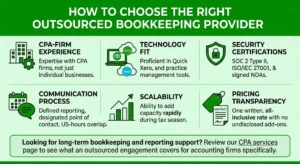
| Selection Criteria | What to Look For |
| CPA-firm experience | A track record specifically serving CPA and accounting firms, not just individual businesses |
| Technology fit | Proficiency in QuickBooks, Xero, and any firm-specific practice management software |
| Security certifications | SOC 2 Type II, ISO/IEC 27001, signed NDA |
| Communication process | Defined reporting schedule, named point of contact, US-hours overlap |
| Scalability | Ability to add capacity within days during tax season |
| Pricing transparency | One written, all-inclusive rate with no undisclosed add-ons |
A firm looking for long-term bookkeeping and reporting support should review our CPA services page, which details exactly what an outsourced engagement covers for accounting firms specifically.
How to Transition to Outsourced Bookkeeping: Step by Step
How Long Does a Typical Transition Take?
The average transition takes two to four weeks, covering scope definition, secure software access setup, and a test batch of transactions before full handover.
What Are the Actual Steps in This Process?
Define the scope of work. Before any work transfers, a firm records exactly which tasks move to the outsourced team, daily reconciliations, payroll support, and so on. This step alone prevents most of the scope misunderstandings that turn into unplanned costs later.
Set up a communication protocol. Before live work starts, a firm agrees on reporting frequency, escalation paths, and a single point of contact with the provider.
Run a pilot phase. A firm starts with a smaller slice of the workload, one client’s books or a month of transactions, to check accuracy and turnaround time before rolling out the full engagement.
Review and adjust. After the pilot, a firm gathers feedback from its own staff and adjusts scope, communication frequency, or task assignments based on what worked and what didn’t.
Common Mistakes That Reduce the Value of Outsourcing
What Should a Firm Avoid When Outsourcing Bookkeeping?
Skipping the pilot phase. A firm that moves every client to an outsourcing provider on day one has no early warning if the fit is wrong. A pilot phase catches quality problems before they touch every client.
Choosing price over experience. The lowest hourly rate on the market often signals limited experience with US accounting standards, and it usually costs more in extra review time than a slightly higher rate would have.
Leaving the scope undefined. A loose arrangement with no written task list invites scope creep, extra billed time that was never agreed to. A written scope with clear hour limits keeps costs predictable.
Ignoring provider staff turnover. A rotating provider forces the firm to keep re-explaining its processes, which eats into the time outsourcing was supposed to save. Before signing, ask a provider for its average staff retention rate per account.
Beyond Cost Savings: The Strategic ROI for CPA Firms
What Value Does Outsourcing Add Beyond the Invoice?
Most of the conversation focuses on cost cutting, but outsourced bookkeeping actually changes how a firm uses its most valuable asset: partner and senior staff time. Freed from transactional work, staff can put more hours into advisory services, tax planning, and client relationships, all of which bill at higher rates than bookkeeping.
A firm that outsources bookkeeping for even a handful of clients often finds it can take on more advisory work without adding headcount, which raises revenue per employee rather than just cutting expenses.
Outsourced Bookkeeping Trends for CPA Firms in 2026
Dedicated account teams are replacing rotating staff pools. Firms increasingly want the same outsourced bookkeeper across every billing cycle rather than whoever is available, since consistency cuts down on errors and retraining time.
Security certification is now a baseline requirement, not a differentiator. CPA firms are filtering out providers that can’t produce a current SOC 2 or ISO 27001 certificate before price even enters the conversation.
AI adoption is reshaping the outsourcing conversation. With technology and AI integration now ranking among the top issues CPA firms expect to face over the next several years, more providers are pairing outsourced staff with AI-assisted transaction matching to speed up reconciliations, letting firms take on more client volume without proportional cost increases.
Conclusion
Outsourced bookkeeping gives small and mid-sized CPA firms a direct answer to a shrinking talent pool and rising client demands, at a fixed cost that doesn’t come with a full-time hire. The firms that get the most value define scope clearly, pilot before rolling out broadly, and confirm security certifications in writing rather than by verbal assurance. Outsourced Accountants offers a free consultation to help your firm calculate its specific savings before choosing a provider.
See if outsourced bookkeeping is right for your firm
Frequently Asked Questions
What does outsourced bookkeeping for CPA firms mean?
It’s an arrangement where a CPA firm hands basic bookkeeping work, recording transactions, reconciliations, and reporting, to an external team instead of internal employees.
What does outsourced bookkeeping cost for a CPA firm?
Depending on client volume and scope, costs typically run $15 to $30 an hour or $300 to $2,500 a month as a retainer. Our accounting cost guide for outsourced services breaks down current pricing across related services.
Is outsourced bookkeeping secure for client financial data?
Yes, if the provider holds SOC 2 Type II or ISO/IEC 27001 certification and uses role-based access controls. Confirm those certifications before transferring any client records.
How is outsourced bookkeeping different from outsourced accounting?
Outsourced bookkeeping covers recording transactions, reconciliation, and reporting. Outsourced accounting includes that work plus broader financial analysis, forecasting, and strategic input. Our outsourced vs in-house bookkeeping comparison covers this distinction in more detail.
Can outsourced bookkeeping scale during tax season?
Yes. A reputable provider can add staff or hours within a few days to cover seasonal peaks, saving the time and expense of hiring temporary domestic workers every year.
How long does onboarding take with a new outsourced bookkeeping provider?
The average transition takes two to four weeks, covering scope definition, software access setup, and a trial batch of work before full handover.
Is a pilot phase worthwhile for a small CPA firm?
Yes. Starting with one client’s books or a month of transactions lets a firm confirm quality and turnaround time before committing its full client base.
What bookkeeping-adjacent activities should stay in-house at a CPA firm?
Final review, client advisory conversations, and sign-off on financial statements typically stay in-house. Outsourced teams handle the groundwork those decisions are built on.
How is outsourced bookkeeping different from fractional accounting?
Outsourced bookkeeping is limited to recording transactions, reconciliation, and reporting. Fractional accounting adds financial analysis, planning, and strategy from a dedicated professional.
Can a CPA firm outsource bookkeeping for only some of its clients?
Yes. Most firms start by outsourcing bookkeeping for a small group of clients, usually the busiest accounts, then expand the arrangement once the provider has proven itself.