
Offshore bookkeeping services typically cost 40% to 70% less than hiring an equivalent in-house employee in the United States. This guide breaks down exactly where those savings come from, how offshore bookkeeping is priced in 2026, the costs providers don’t always mention upfront, and how to calculate your own total savings before making the switch.
In this guide, you’ll find:
- Why in-house bookkeeping costs more than most owners realize
- 2026 pricing models for offshore bookkeeping, with real numbers
- A direct onshore-vs-offshore cost comparison
- The hidden costs providers rarely mention upfront
- How long a transition to offshore bookkeeping actually takes
- Answers to the most common cost-related questions
Why Does In-House Bookkeeping Cost So Much?
What Does a Full-Time Bookkeeper Actually Cost?
A full-time, in-house bookkeeper costs a business far more than the salary line suggests. The U.S. Bureau of Labor Statistics’ most recent estimate puts the median annual wage for bookkeeping, accounting, and auditing clerks at $50,670. That figure doesn’t include payroll taxes, health insurance, paid leave, or retirement contributions, which typically add another 20% to 30% on top of base salary.
What Other Overhead Does an In-House Hire Require?
The true cost of an in-house bookkeeper climbs further once you factor in office space, a workstation, accounting software licenses, and IT support. On top of that, a business absorbs a productivity gap during onboarding, since a new hire rarely works at full capacity for the first few months.
How Much Does Hiring Itself Cost?
Hiring is its own recurring expense. Job postings, interviews, background checks, and formal onboarding all take weeks of management time before a new bookkeeper can do meaningful work. Because bookkeeping roles turn over fairly often, many businesses repeat this cycle annually, and the resulting cost is one owners frequently overlook.
What Does a Real In-House Cost Breakdown Look Like?
Say a business hires one full-time bookkeeper at the BLS median wage of $50,670. Once payroll taxes and benefits are added, the loaded cost runs closer to $61,000 to $66,000. Add $3,000 to $5,000 a year for software licenses and a workstation, plus a one-time hiring cost of $3,000 to $6,000 in staff time and job-board fees, and the realistic, all-in cost of a single in-house bookkeeper lands between $67,000 and $77,000 in the first year alone, a number most owners never calculate before posting the job ad.
Offshore Bookkeeping Cost by Business Type
Does Cost Vary by Industry?
Offshore bookkeeping cost depends less on industry and more on transaction complexity and volume. E-commerce businesses generate high transaction volume across multiple sales channels, which usually places them in the mid-to-high end of the pricing range. Service-based businesses with fewer transactions typically qualify for lower rates. Startups with simple, early-stage books often pay entry-level rates until their transaction volume grows.
What Does a Sample Monthly Cost Look Like by Business Size?
| Business Profile | Estimated Monthly Transactions | Typical Offshore Monthly Cost |
| Solo consultant or freelancer | Under 100 | $150 – $400 |
| Small service business (5–15 employees) | 100 – 500 | $400 – $1,200 |
| Growing e-commerce or multi-location business | 500 – 2,000+ | $1,200 – $3,000+ |
These figures cover routine bookkeeping, including recording and reconciling transactions plus monthly reporting. Add-on services like payroll or tax preparation increase the monthly total.
Offshore Bookkeeping Pricing Models Explained
How Much Does Offshore Bookkeeping Cost Per Hour?
Offshore bookkeeping runs $8 to $25 an hour in 2026, compared with $30 to $60 an hour for onshore bookkeeping in the United States. The lower end covers routine transaction recording and reconciliation, while the higher end applies to more advanced work like financial forecasting.
What Do Fixed Monthly Retainers Cost?
Retainers give a business predictable billing instead of variable hourly charges. Basic small-business packages typically start around $300 to $1,500 a month, while full-service bookkeeping for a mid-size organization can run as low as $2,500 a month.
When Does Project-Based Pricing Make Sense?
Project-based pricing fits one-time needs: a bookkeeping cleanup, a software migration, or catching up on records that fell behind for months. Providers generally charge $3,000 to $6,000 for this kind of work, depending on the size and condition of the books. This is the model our own catch-up bookkeeping service uses for businesses working through a backlog.
Onshore vs Offshore Bookkeeping: Cost Comparison
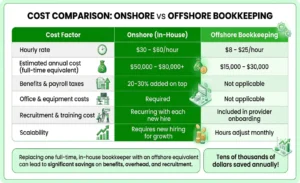
| Cost Factor | Onshore (In-House) | Offshore Bookkeeping |
| Hourly rate | $30 – $60/hour | $8 – $25/hour |
| Estimated annual cost (full-time equivalent) | $50,000 – $80,000+ | $15,000 – $30,000 |
| Benefits & payroll taxes | 20–30% added on top of salary | Not applicable |
| Office & equipment costs | Required | Not applicable |
| Recruitment & training cost | Recurring with each new hire | Included in provider onboarding |
| Scalability | Requires new hiring for growth | Hours adjust monthly |
For a business replacing one full-time, in-house bookkeeper with an offshore equivalent, the combined savings on benefits, overhead, and recruitment can add up to tens of thousands of dollars a year.
Hidden Costs to Watch For
What Costs Do Offshore Providers Not Always Disclose Upfront?
Some offshore bookkeeping firms charge fees on top of the hourly rate. Ask about these four categories before signing a contract.
Onboarding and transition fees. Providers often charge a one-time fee for workflow mapping, software access setup, and process documentation before regular billing begins.
Software licensing costs. Some providers bill separately for access to QuickBooks, Xero, or NetSuite instead of folding it into the base rate.
Quality control and review costs. A provider that adds a senior reviewer or dual-check process to each reconciliation may charge extra for that added accuracy.
Security and compliance upgrades. Encrypted file transfer, SOC 2 or ISO 27001-certified workflows, and secure cloud storage sometimes carry a premium, but they cost far less than the risk of a data breach.
How Does a Business Avoid These Hidden Costs?
The best way to avoid hidden costs is to get one all-inclusive quote in writing before signing anything. Ask the provider directly to confirm whether the quoted rate includes software licenses, review layers, and security certifications, or whether those are billed separately. Locking a fixed number of hours into the scope agreement also removes the risk of surprise charges once work begins.
Real Savings for Small Businesses
How Much Can a Small Business Save With Offshore Bookkeeping?
A small business paying $30 to $60 an hour for local bookkeeping can bring that down to $8 to $25 an hour offshore, a reduction that alone can cut the hourly rate by roughly half to as much as 85%, in line with the overall 40% to 70% total-cost savings most businesses see once benefits and overhead are factored in. A company that would spend $50,000 to $80,000 on an in-house hire typically spends $15,000 to $30,000 on offshore bookkeeping to cover the same work. According to Outsourced Accountants’ own client data, businesses that make this switch save more than 66% on headcount costs. Our outsourced accounting costs guide breaks pricing down further by service type, not just bookkeeping.
Does Company Size Change the Savings?
Savings scale with transaction volume. A small business with fewer transactions often sees the highest percentage savings, since fixed overhead (office space, software licenses) is eliminated rather than just reduced. Larger businesses with higher transaction volume still save significantly, and bulk pricing from providers can lower the effective offshore rate by another 10% to 20%.
How to Calculate Your Own Offshore Bookkeeping Savings
What Formula Should a Business Use?
A business can calculate its real savings using three figures: current in-house cost, projected offshore cost, and one-time transition cost. Start with the full in-house cost, meaning salary plus benefits, software, and a share of office overhead. Subtract the estimated offshore monthly cost, multiplied by 12. Then subtract the one-time onboarding fee only in year one, since it won’t recur in later years.
What Does This Look Like With Real Numbers?
Take a company paying an in-house bookkeeper $70,000 a year in fully loaded cost, including salary, benefits, and overhead. It switches to an offshore provider charging $1,200 a month, plus a one-time $500 onboarding fee. In year one, the company pays $14,900 total ($1,200 × 12 + $500). In year two and beyond, it pays $14,400 a year. That’s a savings of about $55,100 in year one and $55,600 a year after that, roughly 79% of the original in-house cost.
Find out how much your business could save today
Why Do Savings Estimates Vary So Widely Across Providers?
Savings percentages vary because businesses compare different baselines. A company that compares offshore bookkeeping only to a bookkeeper’s base salary will land on a smaller savings percentage than one that properly includes benefits, payroll taxes, and office overhead in the in-house figure. Calculate the true, fully loaded in-house cost first, before comparing it to any offshore quote.
How Long Does It Take to Transition to Offshore Bookkeeping?
A typical offshore bookkeeping transition takes two to four weeks, covering process mapping, software access setup, and a trial period before full handover. Transitioning an entire accounting function, rather than a single bookkeeper role, usually takes six to eight weeks.
A business can speed this up by preparing clean, organized financial records before the transition begins and by assigning one internal point of contact to handle the provider’s onboarding questions.
Is Offshore Bookkeeping Safe?
What Security Standards Should a Business Require?
A legitimate offshore bookkeeping provider holds SOC 2 Type II or ISO/IEC 27001 certification, encrypts data in transit and at rest, and signs a non-disclosure agreement before starting work. Ask for a copy of the actual certificate, not a verbal assurance, since certification status can change over time.
Does Offshore Bookkeeping Meet US Accounting Standards?
Yes, provided the provider trains its staff on US GAAP and the tax rules relevant to the client’s business. A provider with real US-client experience typically needs less oversight and produces fewer compliance errors than one operating outside that context.
How to Choose the Right Offshore Bookkeeping Partner
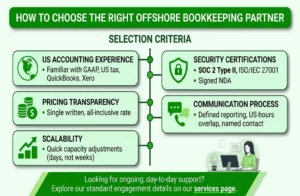
| Selection Criteria | What to Look For |
| US accounting experience | Familiarity with GAAP, US tax rules, and platforms like QuickBooks or Xero |
| Security certifications | SOC 2 Type II, ISO/IEC 27001, signed NDA |
| Pricing transparency | One written, all-inclusive rate with no undisclosed add-ons |
| Communication process | Defined reporting schedule, named point of contact, US-hours overlap |
| Scalability | Ability to add or reduce hours within days, not weeks |
A business looking for ongoing, day-to-day bookkeeping support rather than a one-time cleanup should review our bookkeeping services page, which outlines exactly what a standard engagement includes.
What Questions Should a Business Ask Before Signing?
Four questions give a business the clearest picture of actual cost: Does this rate include software licensing, or is that billed separately? What does the onboarding fee cover, and is it one-time or recurring? How many US clients does your team currently serve, and in which industries? What is your staff retention rate per client account? A provider that answers all four in writing is typically more transparent about total cost than one that gives vague pricing answers.
Common Mistakes That Increase Offshore Bookkeeping Costs
Why Do Some Businesses Not See the Savings They Expected?
Some businesses switch to offshore bookkeeping and see their costs creep up over time. Three mistakes explain most of it.
Skipping the scope agreement. A business that hands over general bookkeeping support without a defined task list often ends up paying for scope creep: extra hours billed for work that was never explicitly agreed upon.
Choosing the lowest hourly rate without checking experience. The cheapest offshore rate on the market usually signals limited US-accounting experience, which leads to more errors, more rework, and more of the business owner’s time spent reviewing and correcting the books.
Ignoring the provider’s staff turnover rate. A provider with high staff turnover forces a business to re-train new bookkeepers on its processes repeatedly, which erases the time savings even at a low hourly rate.
Beyond Cost: The Non-Financial ROI of Offshore Bookkeeping
What Value Does Offshore Bookkeeping Add Beyond the Dollar Savings?
Cost reduction is the most visible advantage, but offshore bookkeeping delivers value that doesn’t show up on an invoice. Time-zone coverage means work submitted at the end of a US business day is often ready for review the next morning. A business also gains access to specialized skills on demand, such as industry-specific bookkeeping expertise, without running an extended hiring search.
Finally, an established offshore provider brings continuity: documented processes keep the work running smoothly even if one staff member leaves, unlike a single in-house employee whose departure can leave an immediate knowledge gap.
Offshore Bookkeeping Cost Trends for 2026
Security compliance is no longer optional. It’s the baseline. Many providers now build SOC 2 Type II into their base pricing instead of charging for it as an add-on, as US businesses increasingly treat certification as a minimum requirement rather than a premium feature.
AI-assisted reconciliation is helping hold hourly costs down. Providers using automated transaction-matching tools complete routine reconciliation faster, which has let some offshore providers hold their 2025 pricing steady into 2026 even as regional wages rise.
Flat monthly plans are gaining ground over pure hourly billing. Small businesses increasingly prefer fixed fees for easier budgeting and to avoid the risk of scope-creep bills that come with variable, hours-based pricing.
Conclusion
Offshore bookkeeping delivers real, measurable cost savings once a business accounts for salary, benefits, overhead, and recruitment costs together, not just the headline hourly rate. The businesses that save the most get a written, all-inclusive quote upfront and confirm security certifications before signing. Our case study on modernizing bookkeeping with technology shows this exact cost-saving transition in practice. Outsourced Accountants offers a free consultation to calculate your specific savings before you commit to a provider.
Frequently Asked Questions
Is offshore bookkeeping cost-effective for small businesses?
Yes. Small businesses typically save 40% to 70% compared with hiring an in-house bookkeeper, once salary, benefits, and overhead are all factored into the comparison.
How much can a business save annually with offshore bookkeeping?
A business commonly saves $20,000 to $50,000 a year by replacing one full-time, in-house bookkeeper with an offshore equivalent, depending on transaction volume and scope of work.
Is my financial data safe with an offshore bookkeeping provider?
Yes, provided the provider holds SOC 2 Type II or ISO 27001 certification and follows documented data-security practices. Confirm these certifications directly before sharing any financial records.
What’s included in offshore bookkeeping pricing?
Standard pricing usually covers transaction recording, bank reconciliation, and monthly financial reports. Confirm separately whether software licenses, senior review, and security certifications are included or billed as extras.
Can offshore bookkeeping scale during tax season?
Yes. Offshore providers can add hours or staff during peak periods without the recruitment delay a business would face hiring domestically on short notice.
What’s the difference between offshore and outsourced bookkeeping?
Offshore bookkeeping specifically means the provider’s team works from outside the United States. Outsourced bookkeeping is the broader term, covering both US-based third-party providers and offshore ones. Our comparison of outsourced vs. in-house bookkeeping covers this distinction in more depth.
How quickly does a business start seeing cost savings?
Most businesses see reduced costs starting with the first billing cycle, since offshore rates replace in-house salary and overhead as soon as the transition is complete.
Do offshore bookkeeping providers work with QuickBooks and Xero?
Yes. Established providers work across the major cloud platforms, including QuickBooks, Xero, and NetSuite, so a business rarely needs to change its existing software.
Is a cheaper offshore hourly rate always the better deal?
No. A very low hourly rate often signals less US-accounting experience, which can lead to errors that cost a business more in corrections and lost time than a slightly higher, more experienced rate would have cost upfront.
Can a business negotiate offshore bookkeeping pricing?
Yes. Providers commonly offer volume discounts once a business’s transaction count reaches a few hundred entries a month, and many will tailor a monthly retainer to a business’s specific scope rather than a generic package.
What happens if a business outgrows its offshore bookkeeping plan?
A business simply increases its contracted hours or upgrades to a higher-tier monthly package. Reputable providers scale support within days, avoiding the multi-week delay of hiring an additional in-house employee.