
A fractional CFO is a seasoned financial executive who works with a business part-time rather than as a full-time employee. This guide explains exactly what a fractional CFO is, what the role costs in 2026, how it differs from a virtual CFO, an interim CFO, and a financial controller, and what triggers a business to hire one.
In this guide, you’ll find:
- What the role is and how it differs from similar titles in finance
- What a fractional CFO actually does day-to-day
- Real 2026 pricing across hourly, retainer, and project-based models
- How engagement models work
- When a business needs to hire one, and how to pick the right person
- The real risks and limits of the arrangement
What Is a Fractional CFO?
What Does “Fractional CFO” Mean?
A fractional CFO is a Chief Financial Officer who works with a company part-time rather than full-time. Most fractional CFOs serve several businesses at once, splitting a fixed number of hours among clients rather than working for a single employer. In exchange, a company gets senior-level financial management, strategy, forecasting, and fundraising support at a fraction of what a full-time executive would cost.
How Is a Fractional CFO Different From a Virtual CFO or Interim CFO?
A virtual CFO does the same work as a fractional CFO but delivers it remotely; the two terms are largely interchangeable, and many providers use them loosely. An interim CFO, by contrast, is a temporary full-time hire that bridges the gap between two permanent CFOs, typically during a transition, rather than an ongoing part-time arrangement.
A financial controller is different again: controllers focus on the accuracy of financial records (bookkeeping, reporting, and compliance) rather than the strategic planning a CFO provides. Our Financial Controller page covers this distinction in more depth.
What Does a Fractional CFO Actually Do?
What Are the Core Responsibilities of a Fractional CFO?
A fractional CFO typically handles five core functions for a growing business:
Financial strategy and forecasting. The CFO builds revenue forecasts, models growth scenarios, and sets the financial plan a company will follow over the next 12 to 36 months.
Cash flow management. The CFO tracks liquidity, identifies where cash is tied up, and extends the company’s runway by cutting unnecessary spending or tightening collections.
Fundraising and investor readiness. The CFO prepares the financial models, valuation materials, and due diligence documents investors expect to review before committing capital.
Systems and process implementation. The CFO selects and rolls out accounting software, reporting dashboards, and financial controls that can scale as transaction volume grows.
Audit preparation and risk management. The CFO organizes financial records, flags compliance gaps, and reduces the risk of costly surprises ahead of an external audit.
Board and investor reporting. The CFO builds recurring reports, such as monthly or quarterly board decks, investor updates, and KPI dashboards, that keep stakeholders informed and confident in the company’s financial decisions.
Does a Fractional CFO Replace a Bookkeeper or Accountant?
No. A fractional CFO doesn’t replace bookkeeping; the role sits above it. Bookkeepers and accountants process transactions and maintain accurate books, and a CFO uses those numbers to make strategic decisions. Most businesses keep both functions, whether in-house or outsourced, alongside a fractional CFO.
How Is a Fractional CFO Different From Fractional Accounting?
Fractional accounting covers bookkeeping, reconciliation, and financial reporting delivered by a part-time professional. A fractional CFO works a level above, using those same financial records to build forecasts, raise capital and set strategy. A business with simple bookkeeping needs and no strategic demands usually only needs the accounting tier; a business going through a fundraise, scaling quickly, or facing complex decisions needs the CFO tier layered on top of that accounting support. Our guide on the pros and cons of fractional accounting breaks this distinction down further.
Fractional CFO vs Full-Time CFO vs Controller vs Outsourced CFO
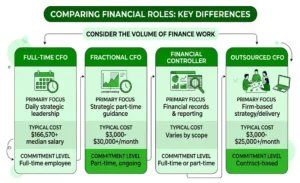
| Role | Primary Focus | Typical Cost | Commitment Level |
| Full-time CFO | Daily strategic and operational financial leadership | $166,570+ median salary (BLS, May 2025) | Full-time employee |
| Fractional CFO | Strategic guidance on a part-time schedule | $3,000-$30,000+/month | Part-time, ongoing |
| Financial Controller | Accuracy of financial records and reporting | Varies by scope | Full-time or part-time |
| Outsourced CFO | Same duties as fractional, delivered through a firm rather than an individual | $3,000-$25,000+/month | Contract-based |
The first thing a business should weigh when choosing among these is how much finance work it actually generates. The more there is, the more a full-time hire or an outsourced firm makes sense over a single independent fractional consultant.
How Much Does a Fractional CFO Cost?
What Do Fractional CFOs Charge Per Hour?
Fractional CFO rates range from $200 to $500 per hour, depending on experience, industry focus, and project scope. General financial oversight sits at the low end; fundraising and M&A advisory command the top of the range.
What Do Monthly Retainers Cost by Company Stage?
Retainer pricing depends on a company’s complexity and growth stage.
| Company Stage | Typical Monthly Retainer | Focus Areas |
| Early-stage startup | $3,000-$7,500 | Financial systems setup, basic forecasting |
| Growth-stage company | $7,500-$15,000 | Fundraising support, scaling operations |
| High-complexity business | $15,000-$30,000+ | M&A, multi-entity reporting, investor relations |
What Does Project-Based Pricing Look Like?
A company with one specific need doesn’t pay the way a retainer client does. Financial modeling projects typically run $5,000 to $25,000. Fundraising support ranges from $10,000 to $75,000 or more, depending on deal size. M&A advisory work is usually priced around deal complexity rather than a standard range.
How Does This Compare to a Full-Time CFO?
The Bureau of Labor Statistics reports the median annual wage for financial managers, the government category that includes CFOs, at $166,570 as of May 2025, one of the most recent updates to that data. That figure is base salary only; bonuses, equity and benefits typically add another 20% to 30% for an executive-level hire, putting a full-time CFO’s realistic total compensation somewhere between $200,000 and $217,000 a year. A company paying $7,500 a month for a fractional CFO spends $90,000 a year, roughly 43% of the fully loaded cost of a full-time CFO.
What Does This Look Like With Real Numbers?
Take a growth-stage company deciding between a full-time hire and a fractional arrangement. Using the midpoint of the loaded range above, a full-time CFO earns about $208,000 in total compensation per year. The same company paying $10,000 a month for a fractional CFO spends $120,000 a year, a savings of roughly $88,000, or about 42%, while still getting senior-level guidance on forecasting, fundraising and reporting.
Which Businesses Benefit Most From a Fractional CFO?
Does Industry Affect the Value of a Fractional CFO?
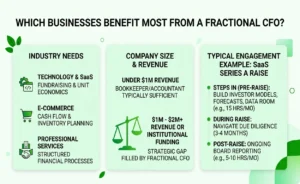
Technology and SaaS companies lean most heavily on fractional CFOs during fundraising rounds, since investors expect the detailed unit-economics models this role is built to produce. For e-commerce businesses, a fractional CFO’s cash flow forecasting is especially useful for navigating seasonal demand swings and financing inventory. Professional services firms tend to gain the most when they move from a founder-led financial process to one that’s structured and predictable.
Does Company Size Matter?
A business earning less than $1 million in revenue a year usually doesn’t need a fractional CFO; a bookkeeper or accountant typically covers its needs. The strategic gap a fractional CFO fills becomes much clearer once revenue reaches roughly $1 million to $2 million, or once a business takes on institutional funding.
What Does a Typical Engagement Look Like in Practice?
Consider a SaaS company preparing for a Series A raise. The founder is focused on product and sales and doesn’t have time to build investor-grade financial models. A fractional CFO steps in at around 15 hours a month, builds a 24-month forecast, organizes the cap table narrative, and assembles the data room investors will expect during due diligence. The engagement typically runs three to four months through the raise, then tapers to 5 to 10 hours a month of ongoing board reporting once the round closes.
Engagement Models: How Fractional CFO Arrangements Work
What Is an Ongoing Monthly Retainer?
A fixed retainer sets aside a defined number of hours each month for continuous financial oversight, covering forecasting, board reporting and cash flow monitoring. This model suits a business that needs sustained, long-term financial direction rather than help with a single event.
What Is a Project-Based Engagement?
A project-based engagement covers one specific deliverable, such as a fundraising round, a financial systems overhaul, or M&A due diligence, with a clear start and end date. It suits a business with a defined, time-bound need rather than an ongoing one.
What Is Interim CFO Support?
Interim support fills the gap between a departing CFO and a permanent replacement, typically as a full-time role for a fixed number of months. This model fits a business that needs daily, continuous leadership through a transition rather than a part-time arrangement.
Find out if your business needs a fractional CFO
When Should You Hire a Fractional CFO?
A company should consider hiring a fractional CFO in five situations:
- The business is scaling rapidly. Financial processes that worked at a smaller size start breaking down once transaction volume and team size outpace a founder’s ability to track them manually.
- The business is preparing to raise capital. Investors expect polished financial models, clear unit economics and organized due diligence materials before they commit funding.
- Financial systems have outgrown the current team. Spreadsheet-based tracking and manual reporting become error-prone once a business operates across multiple products, locations or revenue streams.
- An audit or compliance review is approaching. A CFO organizes documentation and closes compliance gaps well ahead of the audit date, reducing the risk of findings.
- Cash flow has become hard to predict. A business burning cash without a clear forecast benefits from a CFO who can model runway and identify where spending needs to change.
Our Startups service page covers additional financial milestones that typically trigger this kind of hire.
How to Choose the Right Fractional CFO
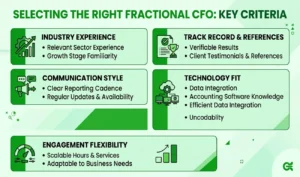
| Selection Criteria | What to Look For |
| Industry experience | A track record with businesses in your specific sector and at a similar growth stage |
| Track record and references | Verifiable results from past engagements; ask for two or three direct references |
| Communication style | A clear reporting cadence and availability that matches your business’s pace |
| Technology fit | Familiarity with your existing accounting and reporting software |
| Engagement flexibility | Ability to scale hours up or down as your needs change, without a rigid long-term contract |
What Questions Should a Business Ask Before Hiring?
Four direct questions give a business a clearer picture of fit: How many other clients are you supporting, and how do you prioritize urgent requests among them? What does reporting look like, and how often does it occur? What happens if our needs change during the engagement? Can you share two examples of businesses at a similar stage to mine? A candidate who answers all four questions concretely is usually a safer bet than one who offers vague reassurances.
Risks and Limitations of a Fractional CFO
What Are the Real Trade-Offs of This Model?
A fractional CFO splits time across several clients, so day-to-day availability isn’t the same as it would be with an in-office, full-time employee. Urgent, same-day financial decisions can take longer to get a response than they would with in-house leadership.
A fractional CFO also has less exposure to company culture and internal dynamics than a full-time executive. That can create friction on decisions that hinge on deep knowledge of team relationships or company history rather than financial data alone.
How Does a Business Reduce These Risks?
A business can manage both risks by setting clear expectations up front: a defined communication plan, a specified response time, a single point of contact, and a regular reporting schedule agreed before work begins. A company planning a major event, such as a funding round or an audit, should confirm the CFO’s availability during that exact window in writing before signing on.
Does Cost Increase as a Business Grows?
Yes, if the scope isn’t defined upfront. When a fractional CFO’s workload grows without a corresponding renegotiation of the retainer, hours and costs tend to rise unpredictably. A written scope agreement, reviewed quarterly, keeps this in check by tying any fee increase to a matching increase in the value delivered.
Fractional CFO Trends for 2026
AI-assisted financial modeling is becoming standard practice. Fractional CFOs increasingly use automated forecasting tools to build and update models faster, allowing them to take on more client engagements without a proportional increase in billed hours.
Demand is shifting toward specialized, industry-specific expertise. Businesses increasingly seek fractional CFOs with direct experience in their exact sector, such as SaaS, e-commerce or healthcare, rather than a generalist, since sector-specific benchmarks speed up forecasting and fundraising.
Hybrid engagements pairing a fractional CFO with controller support are growing. More businesses now combine a fractional CFO’s strategic oversight with dedicated bookkeeping or controller support from the same provider, cutting the coordination overhead of managing separate vendors for each function.
Conclusion
A fractional CFO delivers executive-level financial leadership to a growing business at a fixed cost well below a full-time salary. The right engagement model depends on whether a business needs ongoing strategic guidance, help with a specific project, or transitional leadership. Outsourced Accountants offers a free consultation to help identify the financial leadership model that fits your business today.
Frequently Asked Questions
What is the difference between a fractional CFO and a virtual CFO?
The terms are used more or less interchangeably. Both describe a CFO who isn’t a full-time, in-office hire: “virtual” emphasizes the remote delivery, while “fractional” emphasizes the reduced time commitment.
How many hours does a fractional CFO work each month?
Most fractional CFOs spend 10 to 40 hours a month with a given client, with that time increasing during fundraising, audits or other high-intensity periods.
Is a fractional CFO affordable for a startup?
Yes. Early-stage retainers start around $3,000 a month, far less than the roughly $200,000-plus in total annual compensation a full-time CFO typically commands once bonuses, equity and benefits are factored in. Many startups choose a fractional CFO simply because their transaction volume doesn’t yet justify a full-time hire.
When does a business need a full-time CFO instead?
A company typically moves to a full-time CFO once it’s financially complex enough to need daily, hands-on leadership across multiple entities, a high volume of fundraising activity, or a large enough finance team to warrant direct daily management.
Does a fractional CFO replace an accountant or bookkeeper?
No. A fractional CFO operates above both bookkeeping and accounting, relying on the data those functions produce to inform strategy. Most businesses keep bookkeeping support in place alongside a fractional CFO contract.
Is a fractional CFO worth the cost?
For a business in a growth, fundraising or transition stage, a fractional CFO generally creates value well beyond its cost, through better cash flow management, cleaner financial reporting, and stronger investor readiness.
Can a business have a fractional CFO alongside an existing in-house finance team?
Yes. A fractional CFO typically works with an existing controller, bookkeeper or junior finance staff who handle day-to-day transactional work, while the fractional CFO focuses on strategic oversight.
How quickly can a business bring on a fractional CFO?
Most engagements start within one to two weeks of signing, since a fractional CFO doesn’t require the multi-week recruiting and onboarding process a full-time executive hire does.
Should a business hire an individual fractional CFO or a firm that provides one?
An individual consultant often offers a more personal working relationship, while a firm provides backup coverage if your CFO becomes unavailable. A business with a time-sensitive, high-stakes need, such as an active fundraising round, may find the reliability of a firm-based model worth the trade-off.
Can a fractional CFO become a full-time hire?
Yes, though it isn’t the norm. Some businesses convert a fractional relationship into a full-time offer once revenue and complexity justify the expense. Most fractional CFOs, however, stay independent by choice and continue serving multiple clients.