
The 2025 Paycheck-to-Paycheck Report by LendingClub and PYMNTS reports that 62% of adults in the United States live paycheck to paycheck. A payroll advance is early access to an employee’s unearned wages, which is repaid at a later time via payroll deductions. This guide includes a definition, the legal regulations, payment procedure, and the most suitable options for an employee payroll advance program. Each section has a direct answer to a question, thereby enabling an employer to get a particular answer without having to read the whole page.
What Is a Payroll Advance?
A payroll advance is a temporary sum an employer advances to an employee until the next payday but recovers it later out of one of their paychecks. The employer does not consider the advance as additional income but rather a loan based on unrealized wages. A bonus is different than a salary advance.
A bonus is money the employee keeps. An advance check requires repayment. The employer releases the money, and the employee signs an agreement.The employer then enters the amount as a receivable till the time the employee settles the whole amount.
Employers use several similar terms for early access to money. They may call access to unearned wages a wage advance, paycheck advance, or salary advance. This differs from earned wage access, where an employee receives wages they have already earned.
How Does a Payroll Advance Work?
A payroll advance passes through four steps: request, approval, disbursement and deduction. The employee gives a written request, indicating the amount and reason. The employer checks the request against the company policy.
The employer then approves or rejects the request. If the employer approves it, they pay the funds through an off-cycle payroll, which falls outside the normal pay schedule. The employer subtracts the advance from a subsequent paycheck after signing the repayment schedule.
The process of a payroll advance request begins with documentation. The employee’s written request creates the paper trail.
The signed contract specifies the amount, the date of repayment, and the charges. A lot of employers compute the advance on wages as a net (take-home) amount. This maintains the correctness of tax withholding on the next regular paycheck rather than on the advance itself.
Small business owners often outsource this task because one missed deduction can create a compliance issue. Professional payroll services are also concerned with the calculation, documentation, and timing of tax payments, and thus there is less chance of error reaching the paycheck of an employee.
How Does a Payroll Advance Compare to a Payday Loan and Earned Wage Access?
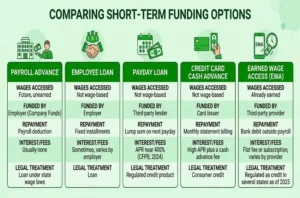
There are three differences between a payroll advance and a payday loan: the source of funding, the interest rate, and legal structure.
An employer provides a payroll advance using company funds. In contrast, a third-party lender finances a payday loan. A 2024 consumer data report by the Consumer Financial Protection Bureau says a typical payday loan has a percentage rate of about 400% annually. By contrast, a payroll advance will have minimal or no interest in most states.
Earned wage access (EWA) is a service that disburses wages earned by an employee but not received. EWA is funded by a third-party financial technology provider and not the employer. The table below tabulates the differences created under five typical short-term funding options.
| Feature | Payroll Advance | Employee Loan | Payday Loan | Credit Card Cash Advance | Earned Wage Access (EWA) |
| Wages accessed | Future, unearned | Not wage-based | Not wage-based | Not wage-based | Already earned |
| Funded by | Employer | Employer | Third-party lender | Card issuer | Third-party provider |
| Typical repayment | Payroll deduction | Fixed installments | Lump sum on next payday | Monthly statement billing | Bank debit outside payroll |
| Interest or fees | Usually none | Sometimes, varies by employer | APR near 400% (CFPB, 2024) | High APR plus a cash advance fee | Flat fee or subscription, varies by provider |
| Legal treatment | Loan under most state wage laws | Loan | Regulated credit product | Consumer credit | Regulated as credit in several states as of 2025 |
The 2025 industry analysis by Chime Enterprise states that regulators in California, New York, Maryland and Connecticut have started to treat earned wage access as a credit product subject to licensing. This move brings the EWA nearer to the treatment of a payroll advance in the eyes of the law, whereas the two products are based on different sources of funds.
The payday loan and payroll advance comparison is most important at the interest rate. The extremely high interest rate on a payday loan, which is nearly 400%, can cause a borrower to become trapped in the cycle of borrowing. Instead, the federal and state wage laws limit the amount an employer can impose on an advance and most impose none at all.
Which Industries See the Most Payroll Advance Requests?
Industries with variable pay and irregular hours produce the most payroll advance requests. The highest in this list are restaurant service and commission-based sales jobs, as per the employer guide to payroll advances by Indeed (2025). The latest May 2024 Occupational Employment and Wage Statistics provided by the US Bureau of Labor Statistics show that food and beverage serving workers receive a median hourly wage of $14.92, with variable tip income usually added on a week-to-week basis. This variability in income leads to more frequent requests for advances than in jobs with predictable salaries.
The same is true of retail jobs and gig-economy jobs. Employees with unstable shifts see more weekly income variation than salaried employees. A documented policy on eligibility for payroll advances is most advantageous to employers in these industries, as the volume of requests is higher and inconsistent handling increases legal risk more rapidly.
What Are the Pros and Cons of a Payroll Advance?
A payroll advance lessens the financial strain in the short term on an employee, yet it increases administration on the part of an employer. There are real costs and benefits on both sides.
Advantages of an employer payroll advance program:
- Workers shun the almost 400% APR of a payday loan (CFPB, 2024).
- North-West University 2015 study of personal financial wellbeing (Faculty of Economic and Management Sciences, n=872) has revealed that financial wellbeing is a direct measure of employee productivity and absenteeism.
- Employers can enhance retention, as 62% of workers already say they are living paycheck to paycheck (LendingClub-PYMNTS, 2025) and appreciate employer assistance during shortfalls.
- The median annual wage disparity between food-service workers and employees demanded by the market (BLS, May 2024) is $34,130, so workers are already at the bottom of the need ladder when it comes to affording an emergency cost with no assistance.
Disadvantages of a payroll advance program:
- The credit risk falls on the employer in case the employee leaves prior to complete repayment.
- The amount that the employer advances is directly absorbed by the employer’s cash flow before the deduction is returned.
- Repeat requests may be addictive; 40.1% of the LendEDU 2025 survey respondents already cannot afford a $1,000 emergency in cash, increasing the risk of repeat requests.
- Each new deduction, tax adjustment, and record-keeping requirement adds administrative work.
Is a Payroll Advance Legal?
Yes, a payroll advance is legal in every US state, but state and federal wage laws limit how an employer structures it. The Fair Labor Standards Act requires the employer to pay a minimum wage of at least the federal minimum of $7.25 per hour, after all deductions, including advance payments, as of 2025. Any deduction that will reduce an employee to a net pay that is below this floor is a violation of federal law, whether signed or not.
Additional restrictions are state laws. Written employee consent is mandatory before any deduction of wages, such as a payroll advance repayment, in California, New York, or Illinois. A number of states limit the interest that an employer can impose. Other states even forbid interest on this kind of advance. The eligibility regulations of payroll advances are specific to the employer; however, the general wage-deduction cap cuts across employers in these states.
The employer does not tax the advance. Instead, the employee repays the advance through a deduction from their next paycheck after the employer applies the usual withholding to their gross income. The most frequent tax management error made by employers with advances is to get the tax withholding order wrong because the deduction must occur after tax withholding and not before it.
How Do You Create a Payroll Advance Policy?
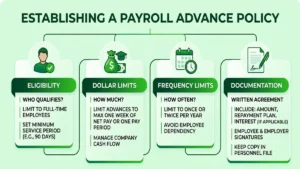
An employer establishes a payroll advance policy by specifying in writing four things, namely: eligibility, dollar limits, frequency limits, and documentation requirements. A written policy establishes expectations prior to the initial request.
Eligibility determines who is eligible for an advance. Most employers limit eligibility to full-time employees or to those employees who have worked a specified period, say 90 days. Minimization and maximization limit the cash flow of the company. An advance is capped by a common range of one week of net pay. Other employers take this limit to an entire period of payment. Dependency is avoided by frequency limits. The majority of employers limit advances to one or twice a year, separated by at least six months.
Documentation supports the paycheck advance policy. The policy explains the procedure in detail, including a written request form and a signed payroll advance agreement. The employer keeps a copy in the employee’s personnel file.
The payroll advance agreement template is available to download, thereby providing an employer with a point of departure with regard to these four elements as opposed to writing the paper personally. The template contains the amount, the repayment plan, the interest rate (where applicable), and the signatures of both parties.
How Do You Process a Payroll Advance Repayment?
When a payroll advance is repaid, an employer makes a deduction against the employee’s next regular paycheck as a post-tax deduction. The employer pays out the advance in the form of a net amount. The same net amount is later recouped by the employer, after normal withholding taxes on the entire paycheck.
The following is an example that is worked out. On a biweekly basis, an employee receives a gross pay of $2,000. The employee requests a $300 advance. The employer pays out $300 in a single net payment without tax deduction at that point in time. The employer deducts the federal income tax, Social Security tax, and Medicare tax on the entire amount of gross wages of $2,000 on the next regular payroll. The net amount is then less the repayment of the $300 by the employer. That single pay period results in the employee receiving a reduced paycheck. The deduction ceases when the balance is zero.
Recording the advance correctly comes down to how debits and credits work on the company’s balance sheet. The employer records the advance as a current asset until the employee repays it. The employer records the cash payment as a receivable. Each payroll deduction reduces the receivable until the employee pays the balance in full. For a full breakdown of how different types of payroll deductions work, see our guide on payroll deductions explained.
Struggling with payroll advances? Let our experts simplify it today.
How Do You Request or Approve a Payroll Advance?
An employee requests a payroll advance by submitting a written form, and an employer approves it by checking the request against company policy before disbursing funds. The following steps apply in payroll systems, irrespective of the software used by the employer.
- The employee fills in a payroll advance application, detailing the amount and purpose.
- The request is compared to the eligibility rules in the written policy by the manager or HR.
- The employer certifies that the amount is not more than the maximum limit of the policy, which is usually one week’s net salary.
- Both groups enter into a payroll advance contract, which specifies the date and amount of repayment.
- The disbursement is processed by the employer and typically done via an off-cycle payroll.
- The employer arranges the deduction on the next regular paycheck of the employee within the six-month frequency window most policies impose.
- The employer documents the transaction and deposits the signed agreement.
The checklist can be used with any process of payroll advance request regardless of whether or not the employer is operating payroll using in-house software or an outsourced vendor.New to managing payroll processes? Our 2026 payroll training guide covers the full payroll cycle step by step.
What Are the Alternatives to a Payroll Advance?
Another way an employee can access early income without the credit risk that a payroll advance gives the employer is through earned wage access, on-demand pay, and financial wellness benefits. Earned wage access provides access to previously earned wages. It is financed by a third-party provider rather than company cash reserves. This eliminates the deduction-to-repayment of the employer payroll process completely, as the third-party provider recovers those funds directly through the employee’s bank account.
On-demand pay is based on the same principle as EWA. It is commonly built into the existing payroll software of the employer, providing employees with a running balance of earned-but-unpaid wages that the employee can draw at any time. Financial wellness benefits are more long-term oriented. Financial counseling, savings programs, and budgeting tools will help to minimize emergency requests in the long run.
For a small business, evaluating these alternatives is often part of a broader financial wellness strategy. A smaller cash reserve makes a direct payroll advance program riskier than it is for a larger employer.
What Do Employers Commonly Ask About Payroll Advances?
How are payroll advances different from payday loans?
A payroll advance is provided by the employer and is normally without interest. A payday loan is provided by a third-party lender and has an APR of about 400%, according to CFPB 2024 data.
Are payroll advances taxable?
No, an employer does not tax the advance when it is disbursed. The employer collects tax on the entire gross amount of wages in the next regular payroll, then subtracts the advance thereof from the net.
Can an employer charge interest on a payroll advance?
Most states do not impose much or any interest on a payroll advance by the employer. This kind of loan is not treated by state wage laws as a consumer credit product. Some states have a complete ban on interest on wage advances.
What happens if an employee quits before repaying?
The signed agreement and the final-paycheck laws of the state would determine whether the employer would recover the balance. In certain states, the employer is permitted to offset the outstanding amount on the final paycheck. This practice is limited in other states.
How much can be deducted from a paycheck for repayment?
The deduction is not allowed to bring the employee’s pay below the federal minimum wage of $7.25 per hour or the state minimum wage that is higher than the federal rate after the deduction.
Can part-time or new employees request an advance?
Eligibility depends solely on the written policy of the employer. Most employers limit eligibility for payroll advances to full-time workers or to full-time workers who have passed a predetermined minimum time of tenure.
How often can an employee ask for an advance?
The majority of employer policies restrict requests to one or two times annually, with at least six months between. This minimizes addiction and management overhead.
What’s the difference between a payroll advance and a bonus?
A payroll advance is a loan on future earnings that the employee pays back. A bonus is extra pay that the employee retains without owing it back.
Does a payroll advance affect an employee’s credit score?
No, a payroll advance will not show up in a credit report or have any impact on a credit score. It is not part of the system of consumer lending.
Can an employer deny a payroll advance request?
Yes, an employer may reject a request when it is not subject to either the eligibility rules or dollar limits or frequency limits in the written policy.
Does a payroll advance count as income?
No, the IRS does not consider the advance itself as income at disbursement. It has already been paid to the employee in terms of future wages.
What documentation does an employer need to keep?
The signed payroll advance agreement, the written request, the schedule of repayment, and a record of all the deductions are kept in the employee’s personnel file by an employer.
What Is the Bottom Line on Payroll Advances?
A payroll advance provides an employee with quick access to uncollected wages. The employer recovers itself by a planned payroll deduction that is in compliance with federal and state wage laws. The administration and the risk of repayment are assumed by the employer. The employee does not incur high-interest debt due to a payday loan or cash advance on his/her credit card. The program is kept within the bounds of the first request to the last deduction with a written policy, signed agreement, and the right timing of paying taxes.
When an advance date falls within a pay period, the 2026 payroll calendar for weekly, biweekly, and monthly payroll can be used to chart precise pay dates on each of the three schedules. Clean books are also important in getting the timing of the deduction right. Proper bookkeeping ensures that the advance is maintained from disbursement to final repayment. Outsourced Accountants offers payroll advances, deductions, and compliance information to employers who would rather not include the process in their own payroll department.