
Every accurate financial statement begins with a single skill: recording debits and credits correctly. A debit is an entry on the left side of an account. A credit is added on the right-hand side. Make a mistake in this area, and it will be reflected in your balance sheet, income statement, and tax filings. This guide divides the subject into three sections: the rules that govern all accounts, journal entries that document all transactions, and real-world examples that demonstrate the system in action.
What Is a Debit and What Is a Credit?
Debit increases asset and expense accounts and decreases liability, equity, and revenue accounts. A credit works the opposite way: it increases liability, equity, and revenue accounts and decreases asset and expense accounts. It is the only rule that regulates all the transactions a business records.
Bookkeepers record this in two columns: a left column (debit) and a right column (credit). This system is known as double-entry bookkeeping, and it dates back to 1494, when it was written by the Italian mathematician Luca Pacioli in Summa de Arithmetica, published in Venice. It was not new when Pacioli wrote his book, as Venetian merchants had been practicing it for more than 100 years. But his book codified it, and it remains used by businesses to this day, 500 years later, in the same left-right arrangement.
Banking language is a typical place of confusion. When the bank increases your balance, it credits your account; when it decreases, it debits your account. This isn’t a different rule; it’s the same rule from the bank’s side. Your balance is a liability on the bank’s own books, like money it owes you, so it follows the liability rule: credits increase it, debits decrease it. As soon as you take out the personal banking language and explain debit and credit in ledger accounting, it becomes much more predictable.
Quick Reference for a Debit and a Credit
| Element | Debit (Dr) | Credit (Cr) |
| Position in the ledger | Left side | Right side |
| Increases | Assets, Expenses | Liabilities, Equity, Revenue |
| Decreases | Liabilities, Equity, Revenue | Assets, Expenses |
| Example transaction | Buying office equipment | Taking out a business loan |
Debit & Credit Rules
A standard chart of accounts has five types of accounts: assets, liabilities, equity, revenue, and expenses. They both have a set normal balance, such as the position where the balance lies naturally, and the debit and credit rules apply, and have nothing whatsoever to do with industry or company size.
What Rules Govern Each Account Type?
Assets and expenses carry a natural debit balance. Cash, inventory, equipment, and rent expense all increase with a debit and decrease with a credit. Liabilities, equity, and revenue carry a natural credit balance. Accounts Payable and Owner’s Equity increase with a credit and decrease with a debit. Sales Revenue, which works the same way, increases with a credit and decreases with a debit.
The same structure is followed by a retail store, a law firm, and a software company. The names of the accounts are modified only; a law firm may have a large expense account titled Legal Research Subscriptions rather than Cost of Goods Sold, but the location on the debit side remains the same.
Normal Balance by Account Type
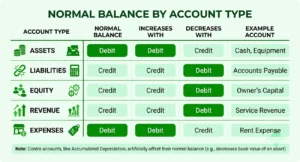
| Account Type | Normal Balance | Increases With | Decreases With | Example Account |
| Assets | Debit | Debit | Credit | Cash, Equipment |
| Liabilities | Credit | Credit | Debit | Accounts Payable |
| Equity | Credit | Credit | Debit | Owner’s Capital |
| Revenue | Credit | Credit | Debit | Service Revenue |
| Expenses | Debit | Debit | Credit | Rent Expense |
This table is memorized and will resolve approximately 90% of daily bookkeeping decisions. The other cases are generally contra accounts, accounts that artificially offset their normal balance, like Accumulated Depreciation. This decreases the book value of a given asset, although it is actually located in the asset category.
How Do You Remember the Rules?
A simple mnemonic condenses all five categories into two words. Accounts increase with a debit. Spell DEAL: Dividends, Expenses, Assets, Losses. Accounts, which grow with a credit spell: GIRLS: Gains, Income, Revenues, Liabilities, Stockholders’ Equity. Both mnemonics have been used in accounting classrooms for decades as they transform an abstract rule into something that a new bookkeeper can remember at a glance, even in the middle of a transaction.
Counting five types of accounts by hand through dozens of transactions every day is prone to errors. This is why most growing businesses combine these rules with specialized bookkeeping software that executes the logic behind the scenes. The rules do not change; it is just software eliminating the manual risk of entering on the wrong side.
Why Does Double-Entry Bookkeeping Require Two Sides?
The concept of double-entry accounting is that all transactions involve transferring value between two locations; that is, value never just exists. Money entering a cash account must come from somewhere: a loan, a sale, or an owner’s investment. That source is the second half of the entry.
This is to maintain the accounting equation in balance:
Assets = Liabilities + Equity
All the transactions recorded should make both sides of this equation equal. When cash, an asset, is increased by a $5,000 loan, Notes Payable, a liability, must also be increased by $5,000. This is because the two sides are always dollar-value-identical, even when they are touching on entirely different account types.
This is not just a theory. Small-business bookkeeping industry reports indicate that companies lose an average of $3,000 annually due to entry errors, and nearly 38%- 40% of small businesses report accounting variances linked to incorrect record-keeping. The reason is that double-entry bookkeeping was developed to ensure such errors are detected at an early stage. An out-of-balance trial balance indicates a problem that is not the result of a tax return or an investor’s desk.
Single-entry bookkeeping, in contrast, records only one side of a transaction, such as a check register. It is effective for very small operations; it cannot detect errors that are automatically caught by double-entry, nor can it generate an actual balance sheet. A convenient guideline: after a business reaches about $50,000 to $100,000 in annual income and hires a contractor or opens a business credit line, the two-sided system becomes mandatory rather than optional.
Debits and Credits Journal Entries
All transactions are initially documented in a journal entry and then transferred to separate ledger accounts. This part will discuss the structure, elements, and maintenance of entries.
How Do You Format a Journal Entry?
There are four rules to a properly formatted entry:
- The date is first.
- The amount and the account to which the amount is being debited appear on the top line.
- The line below shows the account and the amount to be credited, indented slightly.
- Total debits should be equal to total credits, and no exceptions.
This format is called a general journal entry, and every accounting journal entry system, whether a paper ledger or cloud software, follows the same four-part structure within its interface.
Anatomy of a Journal Entry
| Field | Purpose | Example |
| Date | When the transaction occurred | 03/04/2026 |
| Account Debited | Where value increases, or a liability/equity/revenue decreases | Cash |
| Account Credited | Where value decreases or a liability/equity/revenue increases | Notes Payable |
| Amount | Dollar value, identical on both sides | $5,000 |
| Memo/Description | Brief note explaining the transaction | Loan proceeds received |
What Belongs in a General Journal?

All business transactions are to be entered in the general journal: sales, purchases, payroll, loans, and month-end adjustments. Credit and debit entries form the audit trail that allows an accountant, auditor, or tax examiner to trace all the dollars in the financial statements to their original entries. One of the quickest reasons a small business raises a red flag for an audit is missing or incomplete entries.
Special attention should be paid to adjusting entries. A typical example is prepaid insurance: a company that pays $1,200 in January for a full year of coverage should not charge the full amount in January, as this would overstate January’s costs. Rather, $100 moves from Prepaid Insurance to Insurance Expense every month. Depreciation is no different; a $12,000 delivery van does not incur a $12,000 expense on the first day. Instead, the cost of the van is expensed over the years; the van actually generates revenue by moving about $200 from its book value to Depreciation Expense each month.
How Do You Fix Missing or Late Entries?
When you have fallen behind on your journal, a common situation with growing businesses is balancing sales, payroll, and vendor payments. Bookkeeping catch-up services can recreate months’ worth of missing entries in your books and get the general ledger up-to-date before filing deadlines set in. Delaying the issue only makes it worse, as every unrecorded transaction makes month-end reconciliation more difficult and increases the likelihood that a genuine error will go undetected.
Debit and Credit Examples
Rules and formats only really click once you see them put into action. This section takes you through typical transactions, an entire month of business, and how entries change by industry.
What Are Common Transaction Examples?
These entries can be learned most easily by going through transactions that a real business handles each week. Five of the most common will be listed below as completed debit-and-credit pairs (journal entry debit and credit pairs).
Sample Journal Entries
| Transaction | Account Debited | Account Credited | Why |
| Cash sale of $2,000 | Cash | Sales Revenue | Asset increases, revenue increases |
| Bought $500 of supplies on credit | Supplies | Accounts Payable | Asset increases, liability increases |
| Took a $5,000 bank loan | Cash | Notes Payable | Asset increases, liability increases |
| Paid $800 in rent | Rent Expense | Cash | Expense increases, asset decreases |
| The owner invested $3,000 | Cash | Owner’s Equity | Asset increases, equity increases |
Notice the pattern. Each debit has an equivalent, offsetting entry on the other side. The debit of $2,000 to Cash is matched by an entry in Sales Revenue of $2,000—never half, never an adjustment. When the columns do not balance, there is an error in all entries, and the variance must be corrected before posting to the ledger.
The placement of the debit side and credit side comes after the type of account each time. Cash is an asset; hence, it increases on the debit side. Revenue is Sales Revenue, and thus it increases on the credit side. When you learn this pairing logic rather than committing the single transactions to memory, new types of transactions are much easier to get right on the first try.
What Does a Full Month of Transactions Look Like?
Take a case of a freelance web design company during its first month. On the first day, the owner puts $10,000 of personal savings into the new business account: Cash increases by $10,000 on the debit side, and Owner’s Equity increases by $10,000 on the credit side.
On day five, the owner buys a $2,000 laptop with cash. On the credit side, cash decreases by $2,000; on the debit side, Equipment increases by $2,000. However, the value has not changed; it has merely repositioned the accounts.
On the 12th, the business finishes a $ 1,500 project and sends the bill to the client, with 30 days to pay. Under accrual-basis accounting, Accounts Receivable increases by $1,500 on the debit side, and Service Revenue increases by $1,500 on the credit side, as revenue is recognized when earned, not when cash is received.
Cash increases by $1,500 on the debit side, and Accounts Receivable decreases by $1,500 on the credit side. The receivable is cleared, and the cash is deposited in the bank. The receivable is cleared, and the cash is deposited in the bank.
There are four transactions, four pairings of accounts, and one constant rule: the two sides always balance. At the end of the month, the trial balance adds up all the entries on the debit side to get the total debits and all the entries on the credit side to get the total credits, and both should be equal. This one test can highlight most bookkeeping errors before they escalate into larger issues. Companies contracting this service note a significantly lower number of mistakes, as the bookkeeping outsourcing services use uniform, scrutinized procedures for each entry rather than relying on a single individual to identify their own errors by the end of the month.
How Do These Entries Differ Across Industries?
The general principles that govern all industries do not change, but the individual accounts involved vary depending on how a business earns and spends money.
Debit and Credit Entries by Industry

| Industry | Typical Debit Entry | Typical Credit Entry |
| Retail | Inventory purchase | Accounts Payable |
| Service business | Accounts Receivable | Service Revenue |
| SaaS / Subscription | Cash (received upfront) | Unearned Revenue |
| Construction | Work-in-Progress Asset | Accounts Payable |
| Restaurant | Food & Beverage Inventory | Cash or Accounts Payable |
An example of a SaaS company that sells yearly subscriptions is why account selection is important even beyond the fundamental principles. When a customer enters into a 12-month plan at a fixed cost of $1,200, the company increases Cash by $1,200 on the debit side but cannot increase Revenue at the same time, as the service has yet to be provided. Rather, it records Unearned Revenue, a liability account, on the credit side and slowly transfers $100 per month of Unearned Revenue to Revenue as the subscription is fulfilled. The two-step treatment is seldom necessary in the retail and service business, as goods or services are generally supplied near the point of payment.
The same wrinkle can be found in construction. Instead of recording costs as expenses, a contractor on a six-month project would debit a Work-in-Progress asset account as costs accumulate during the project. Instead of expending material and labor on the spot, the value will not be billed out until the client is invoiced at project milestones.
What Mistakes Do Businesses Make With These Entries?
The entry is the most frequent error, either entering a debit instead of a credit or vice versa. This one-line mistake disorients all the reports below, the trial balance to the tax return, and is not even noticed until later on when it gets caught by the reconciliation.
The second common error is recording only one side of a transaction. This is normally prevented by software, as most platforms will not allow an entry until both sides are balanced, whereas no such protection exists in manual spreadsheets.
The third error is to classify an expense as an asset or vice versa. Purchasing a $3,000 laptop ought to be recorded in an asset account, not an expense account, because the laptop provides value that extends beyond the current period. The accrual of the same as an expense understated assets and misstated the profit for that month.
A fourth error is failing to perform monthly reconciliation at all. Industry data reveals that 44% of small businesses anticipate that their bookkeeping costs will increase in the next year, in part due to small errors that go unnoticed in the balances and become difficult to unravel later than they would have been difficult to identify in the first place.
The fifth error, which is most frequently observed in the case of sole proprietors and new members of LLCs, is the confusion of personal and business transactions within the same account. This results in disorganized books, reduced liability protection, and complicates filing the tax form when the IRS or a state agency requires supporting documentation.
What Is a Trial Balance and Why Does It Matter?
A trial balance is a report of all accounts and balances, arranged in two columns: one for debit balances and one for credit balances. It is not that complicated: the sum of the two columns should be equal to allow a business to create financial statements.
Accountants typically run a trial balance at the end of each month, right after posting adjusting entries. When the columns are not equal, the difference typically indicates a transposed number, a missing record, or a record recorded on an incorrect account. Since the search space is small, detecting the imbalance in this case saves a lot of time compared to identifying it after the financial statements have been prepared.
A trial balance is not a financial statement itself, and it is a working checkpoint. When the two columns are equal, the numbers are transferred to the income statement, balance sheet, and, in most cases, the statement of cash flows. Skip this checkpoint, and small mistakes made early in the month get carried straight through to year-end reports
Master debits and credits today, and your books deserve accuracy.
Key Takeaways
A debit is on the left side of an account, adding assets and expenses. A credit on the right side increases liabilities, equity, and revenue. Each transaction involves at least one entry on each side of equal value, a structure that has existed since 1494, when Pacioli wrote it down. Any entry is controlled by five account types with a fixed normal balance that does not change depending on the type of transaction. The audit trail is formed by journal entries underlying all financial statements, and the most common bookkeeping mistake small businesses make is getting the pairing wrong.
This dual-entry system is not just an academic exercise; it is the basis upon which any true financial statement is constructed. Outsourced Accountants help small and medium-sized businesses across the USA get that foundation right, whether that means catching up on a few months of missed entries, setting up the right software, or managing the entire bookkeeping process.
Frequently Asked Question
How can we most easily remember which side to use?
On the debit side, there are increases in assets and expenses, and on the credit side, there are increases in liabilities, equity, and revenue. Learn this one sentence, and all the rest of the rules can be deduced from it.
Is a debit necessarily an increase?
No. A debit increases assets and expenses and decreases liabilities, equity, and revenue. This is all a matter of the type of account, rather than the word debit.
What is a normal balance in accounting?
Normal balance is the side (debit or credit side) on which the balance of an account is expected to be. There must be a normal debit balance for assets and expenses, and a normal credit balance for liabilities, equity, and revenue.
Is it possible to have a transaction between more than two accounts?
Yes. Multifaceted transactions, such as a sale including sales tax and cost of goods sold, are usually three or more line items across multiple accounts. When involving more than two accounts, the total on the debit side must still equal the total on the credit side.
What is the difference between banking terms and accounting terms?
The addition of money to your account is a credit from the bank to add money, and the removal of money is a debit because, in the eyes of the bank, what you deposited with the bank is a liability owed by the bank to you. In business accounting, the same words are used to describe the company’s own books, where cash is an asset that increases with a debit.
Are the expenses debits or credits?
Expenditures have a debit balance. Each dollar of rent, salaries, or supplies increases the corresponding expense account on the debit side and indirectly decreases owner’s equity by reducing net income.
Which software is used to automatically apply these rules?
The majority of new accounting systems, such as QuickBooks, Xero, and Wave, automatically apply debit-and-credit logic once a transaction is classified, eliminating the need to manually decide which side each entry should be on.