
A distinction that many business owners frequently confuse is the line between bookkeeping and accounting. Bookkeeping is the record of financial transactions. Accounting interprets them. Data, software, and even a job title are common to the two functions. They vary in purpose, skill level, legal authority, and timing.
This guide describes every role, follows one of the $5,000 invoices through each, and compares the roles, qualifications, and legal restrictions of a bookkeeper and an accountant. The article covers the cost breakdown, outsourcing options, and how to choose between the two later.
Quick answer: The distinction between bookkeeping and accounting is intent. Bookkeeping records financial transactions and files them in the general ledger. Accounting then analyzes these records to prepare financial statements, tax filings, and forecasts that support business decisions. Bookkeeping records the financial data, while accounting interprets it.
How Do Bookkeeping and Accounting Differ at a Glance?
Bookkeeping is administrative and continuous, and accounting is periodic and analytical. Bookkeepers record daily transactions. The accountants analyze such data monthly, quarterly, or annually and transform it into statements, tax returns, and advice.
Accounting vs Bookkeeping at a Glance
| Factor | Bookkeeping | Accounting |
| Focus | Administrative | Analytical |
| Purpose | Keep accurate, organized records | Interpret records and guide decisions |
| Core tasks | Data entry, categorizing, reconciliation, invoicing, payroll | Financial statements, tax planning, forecasting, audits, compliance |
| Timing | Daily or weekly | Monthly, quarterly, annually |
| Who performs it | Bookkeeper, clerk, or owner | Accountant, CPA, controller |
| Typical education | Some college or on-the-job training | Bachelor’s degree in accounting or finance |
| License required | No | No for the title; yes for CPA |
| Tools | Ledger software, bank feeds, spreadsheets | Reporting, tax, and forecasting software |
| Output | Ledgers, reconciled accounts, basic reports | Statements, tax returns, budgets, advice |
| Median U.S. wage | $50,670 | $83,680 |
| Best for | Daily transaction accuracy | Strategy, tax, and compliance |
The wage row uses data from the closest matching BLS occupations. According to the U.S. Bureau of Labor Statistics, the median annual wage for bookkeeping, accounting, and auditing clerks is $50,670 as of May 2025. In May 2025, the median wage for accountants and auditors was $83,680, according to BLS OEWS data.
What Is Bookkeeping?
Bookkeeping involves documenting, categorizing, and balancing a business’s financial transactions. A bookkeeper records all sales, purchases, payments, and payroll transactions in the general ledger according to double-entry bookkeeping rules. The result is a complete, precise record relied upon by the accountant or tax authority.
What Does a Bookkeeper Do?
The bookkeeping functions are in a repetitive cycle:
- Record sales, purchases, deposits, and payments.
- Sort out each transaction to the appropriate account.
- Balance entries by posting debits and credits.
- Send invoices and follow up on accounts receivable.
- Pay accounts payable and bills.
- Balance the ledger to bank and credit card statements.
- Process payroll and withholdings.
- Close in-month and prepare simple statements.
What Does Bookkeeping Track?
Bookkeepers classify each transaction into one of five account categories, which follow the accounting equation: Assets = Liabilities + Equity.
| Account type | What it holds | Examples |
| Assets | Items the business owns | Cash, inventory, equipment |
| Liabilities | Amounts the business owes | Loans, unpaid bills, payroll taxes |
| Equity | Owner’s net value | Owner contributions, retained earnings |
| Revenue | Income from sales | Service fees, product sales |
| Expenses | Costs of operating | Rent, wages, utilities |
Which Records Does Bookkeeping Keep?
Each entry has a source document maintained by bookkeeping: receipts, invoices, bills, bank statements, and canceled checks. The IRS needs documents that justify income and deductions. It typically recommends a 3-year retention period following filing and a 6-year period for returns that exclude more than 25% of gross income. The employment tax records must be at least 4 years old.
Businesses typically use cloud-based applications like QuickBooks or Xero to manage bookkeeping, while very small businesses may use spreadsheets. Some businesses handle bookkeeping in-house. Other people hire professional bookkeeping services.
What Is Accounting?
Accounting is the art of examining, interpreting, and presenting financial information. Accountants prepare financial statements, use accounting principles including GAAP, plan taxes, and predict performance. The resulting financial information helps owners, lenders, investors, and tax authorities make informed decisions.
What Does an Accountant Do?
The ledger stops where the accounting functions commence:
- Check the bookkeeper’s books.
- Make the adjusting entries for items that have not yet been recorded, such as accrued expenses.
- Prepare income statement, balance sheet, and cash flow statement.
- Analyze costs, margins, and trends.
- Prepare forecasts and budgets.
- Prepare and file tax returns.
- Conduct audits and compliance audits.
- Assess financial risk.
Which Metrics Do Accountants Analyze?
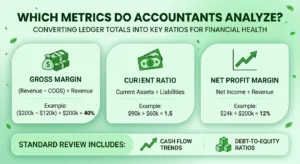
Accountants convert ledger totals into ratios to reflect financial health.
| Metric | Formula | Example |
| Gross margin | (Revenue − Cost of goods sold) ÷ Revenue | ($200,000 − $120,000) ÷ $200,000 = 40% |
| Current ratio | Current assets ÷ Current liabilities | $90,000 ÷ $60,000 = 1.5 |
| Net profit margin | Net income ÷ Revenue | $24,000 ÷ $200,000 = 12% |
The standard review is comprehensive, analyzing cash flow trends and debt-to-equity ratios.
Which Accounting Standards Apply?
The rules are provided by GAAP in the US. The Financial Accounting Standards Board (FASB) issues GAAP, which the SEC requires publicly traded companies to follow. The International Accounting Standards Board (IASB) issues IFRS, which publicly traded companies must follow in more than 140 jurisdictions.
What Is the Difference Between Cash and Accrual Accounting?
Cash accounting records the income and expenses as money flows. Accrual accounting records revenue when businesses earn it and expenses when they incur them, regardless of when they receive or pay cash. The IRS limits the cash method to certain larger businesses based on average annual gross receipts. The following section demonstrates how the decision varies for one invoice.
How Does One Transaction Move Through Both?
A single $ 5,000 invoice generates two jobs. The bookkeeper documents the sale, follows up on the receivable, and reconciles the payment. The accountant uses the entry to report revenue, estimate tax, and project cash.
Illustrative scenario: Harbor Design LLC bills a customer $5,000 on a March 3 net-30. The client makes payments on April 2.
What Does the Bookkeeper Record?
| Date | Action | Entry |
| March 3 | Issue invoice #1042 | Debit Accounts Receivable $5000 and Credit Service Revenue $5000 |
| April 2 | Receive payment | Debit Cash $5000 and Credit Accounts Receivable $5,000 |
| April 5 | Reconcile | Match the $5000 bank deposit to invoice #1042 |
What Does the Accountant Do With It?
- Revenue timing. Under accrual accounting, March records $5,000 in revenue. April does so under cash accounting.
- Tax planning. The invoice increases the tax liability by $1,250 at a representative combined rate of 25%. The reserve is established by the accountant.
- Cash flow. The March balance sheet records receivables of $5,000, yet none of it is held by the bank for more than 30 days. The accountant projects payroll and bills against that gap.
- Reporting. The invoice is entered into the income statement, balance sheet, and cash flow statement.
How Do Bookkeeping and Accounting Work Together?
Bookkeeping feeds accounting, and bookkeepers record and match transactions. Accountants use the reconciled ledger to prepare financial statements, tax returns, and forecasts. Any error in the ledger can affect every report based on it.
What Is the Financial Cycle?
- Transactions occur
- Bookkeeper records them in the ledger
- The bookkeeper balances accounts to bank accounts
- Books close: books shut down
- The accountant prepares adjusting entries and financial statements
- The accountant analyzes results and plans tax
- Reports are used by the owner to make decisions
Where bookkeeping ends, accounting begins.
What Do the Two Functions Share?
- Both rely on complete, accurate records.
- Compliance. Both uphold tax laws and reporting regulations.
- Financial statements. The bookkeepers keep the inputs, and the accountants finalize and interpret the outputs.
- Both facilitate everyday cash management and long-term planning.
What Happens When Bookkeeping Is Wrong?
Bad reports result from bad inputs. For example, the bookkeeper allocates a personal expense of $2,000 as a business expense. Taxable income decreases by $2,000. Tax is underpaid by $500 at an assumed rate of 25%. A 20% IRS accuracy-related penalty, plus interest. The accountant’s statements appear clean but are based on a faulty ledger.
What Is the Difference Between a Bookkeeper and an Accountant?
Bookkeepers record and reconcile transactions. Accountants analyze the data, prepare financial reports and tax returns, and provide guidance to support business decisions. Neither title requires a federal license. Licensed CPAs issue audit opinions, while CPAs, enrolled agents, and attorneys with unlimited representation rights can represent taxpayers before the IRS.
How Do the Roles Compare?
| Bookkeeper | Accountant | |
| Responsibility | Accurate daily records | Analysis, reporting, tax, advice |
| Decision role | Supplies data | Advises on decisions |
| Key skills | Attention to detail, software fluency, organization | Analysis, tax law, communication |
| Typical titles | Bookkeeper, bookkeeping clerk and accounting clerk | Staff accountant, management accountant, tax accountant and internal auditor |
| Reports to | Accountant or owner | Owner, CFO, or client |
CPA firms often delegate ledger work to junior staff or outsourced bookkeeping services, freeing licensed accountants to focus on analysis and advisory work.
What Education and Credentials Do They Hold?
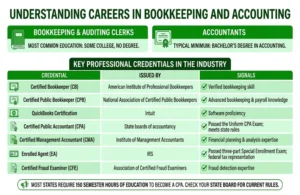
According to the BLS, the most common entry-level education level of bookkeeping, accounting, and auditing clerks is some college with no degree. Accountants usually require a bachelor’s degree in accounting or a similar area.
| Credential | Issued by | Signals |
| Certified Bookkeeper (CB) | American Institute of Professional Bookkeepers | Verified bookkeeping skill |
| Certified Public Bookkeeper (CPB) | National Association of Certified Public Bookkeepers | Advanced bookkeeping and payroll knowledge |
| QuickBooks certification | Intuit | Software proficiency |
| Certified Public Accountant (CPA) | State boards of accountancy | Passed the Uniform CPA Examination; meets state education and experience rules |
| Certified Management Accountant (CMA) | Institute of Management Accountants | Financial planning and analysis expertise |
| Enrolled Agent (EA) | IRS | Passed the three-part Special Enrollment Examination; federal tax representation |
| Certified Fraud Examiner (CFE) | Association of Certified Fraud Examiners | Fraud detection expertise |
The majority of states require 150 semester hours of education to become a CPA. Check your state board for current rules.
What Are the Legal Limits?
- Audit and attest reports can be signed only by licensed CPAs and CPA firms.
- Preparation of federal returns: Paid tax preparation: anyone who prepares federal returns to receive a fee must be assigned a PTIN by the IRS.
- IRS representation: CPAs, EAs, and attorneys may represent their clients on any tax issue. Other preparers have restricted rights.
Check these against existing IRS and state regulations before using them.
Where Do Controllers, CFOs, and Tax Preparers Fit?
An operations controller monitors financial reporting and accounting. CFO establishes financial strategy. That is the part of the strategy offered by a fractional CFO. A tax preparer submits returns and need not have any degree in accounting.
Is a Bookkeeper an Accountant?
Bookkeepers record transactions, while accountants analyze them. One person can perform both roles, and many small businesses combine these responsibilities. The term “accountant” refers to analysis and reporting tasks. The CPA title indicates state licensure.
Which Do You Need: A Bookkeeper, an Accountant, or Both?
Use a bookkeeper when bookkeeping is straightforward, and the primary requirement is proper, up-to-date records. Select an accountant when taxes, fundraising, payroll, or growth complicates things. Most growing businesses employ two people: a bookkeeper to keep daily records and an accountant to review, file taxes, and plan.
| Business stage | Start with | Add an accountant when |
| Freelancer or sole proprietor | Software or a part-time bookkeeper | Quarterly estimated taxes get complicated |
| Early-stage startup | Bookkeeper or founder-managed books | You prepare to raise capital |
| Ecommerce seller | Bookkeeper with inventory experience | Sales tax spans multiple states |
| Small business with employees | Bookkeeper | Payroll, entity structure, or lender reporting grows |
Six situations signal it’s time for outside help:
- Your books run more than a month behind
- You hired your first employee
- You are applying for a loan or investment
- You don’t know how to record a transaction
- Your tax situation changed after growth or a new entity
- You are making a major purchase
Need accurate books and clear financial reports? Talk to pros
Should You Do It Yourself, Hire or Outsource?
Do it yourself when volume is low, and your books stay current. Recruit internally when financial work is required daily and is full-time. Outsource when you require professional accuracy but no pay. All options have varying costs, levels of control, and capacities.
| Option | Best for | Advantage | Drawback |
| DIY with software | Low volume, simple finances | Lowest cash cost | Costs your time; errors go unseen |
| In-house hire | High volume, daily needs | Direct control | Salary, benefits, and training |
| Freelancer | Part-time needs | Flexible hours | Single point of failure |
| Outsourced firm | Growing businesses, CPA firms | Team coverage, scalable | Requires vetting and clear handoffs |
Can a Founder Handle Their Own Books?
Yes, when four things are true: the volume of transactions remains small, there is a system, you possess the hours, and you know the fundamentals. Time has a price. Assuming that the time spent on reconciliation is 5 hours per month and your time is valued at $75 per hour, DIY would be $375 per month. It is a representative number, though it is above the bottom range of average professional charges.
What Can Software and AI Handle?
Bank feeds, transaction categorization proposals, receipt capture, and match reconciliation are automated. Exceptions, gray areas, discretion in taxes, and responsibility for the final figures are still handled by humans. Automation minimizes data input. It does not supersede review.
How Much Do Bookkeeping and Accounting Services Cost?
Small businesses usually spend between $300 and $ 1,500 a month on bookkeeping, depending on volume and complexity. Accountants charge more, usually between $150 and $400 per hour or more. Prices vary based on the number of transactions, software, location, and credentials, and the books should be cleaned up initially.
| Service | Typical price |
| Bookkeeping (monthly) | About $300; packages from $200 to $700+ |
| Bookkeeping (growing business) | $300 to $1,500 per month |
| Freelance bookkeeper | About $43 per hour on average |
| Accountant (hourly) | $150 to $400+ per hour |
| Accountant (monthly retainer) | $300 to $2,500+ |
How Do the Three Staffing Models Compare?
The previous BLS median wage for a clerk, $50,670 per year, translates to approximately $4,223 per month in wages alone, not including benefits or payroll taxes. At $43 an hour with 10 hours of work, a freelancer would cost $430 a month. Outsourced vendors range from $300 to $1,500. Offshore teams are even cheaper in labor; cost savings of offshore bookkeeping services vary with scope and team composition.
Which Pricing Model Fits?
- Monthly retainer: predictable cost for ongoing work
- Hourly: suits cleanup, consulting, and irregular needs
- Project fee: suits tax returns, audits, and one-time setup
What Common Mistakes and Myths Hurt Business Finances?
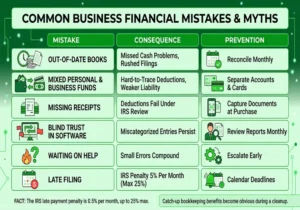
The worst errors include failing to keep books up to date, mixing personal and business funds, and destroying records. All of them manipulate the figures accountants use. The majority are inexpensive to prevent and costly to fix.
| Mistake | Consequence | Prevention |
| Out-of-date books | Missed cash problems, rushed filings | Reconcile monthly |
| Mixed personal and business funds | Hard-to-trace deductions; weaker liability protection | Separate accounts and cards |
| Missing receipts | Deductions fail under IRS review | Capture documents at purchase |
| Blind trust in software | Miscategorized entries persist | Review reports monthly |
| Waiting on help | Small errors compound | Escalate early |
| Late filing | IRS penalty of 5% of unpaid tax per month, capped at 25% | Calendar deadlines |
The late payment penalty set by the IRS is 0.5% per month, up to a maximum of 25%. The key benefits of catch-up bookkeeping become obvious quickly when you explore how a cleanup works if your books are months behind.
Which Myths Should You Drop?
- “Software replaces both roles.” Software records and suggests. It doesn’t judge or advise.
- “My accountant does my bookkeeping.” Many don’t. Confirm scope in writing.
- “A bookkeeper can file my taxes.” Only if they hold a PTIN and the skill; representation rights stay limited.
How Do You Choose a Bookkeeper or Accountant?
Check credentials, software proficiency, security practices, and request references. Find the right professional for your needs: bookkeeping, accounting, tax, and strategy. Most disputes are avoided by having a clear scope of work.
Questions to ask:
- Which software do you use, and do you work in mine?
- What does a month-end close include, and how long does it take?
- Who reviews your work?
- Which industries do you serve?
- How do you handle errors you discover after closing?
Verification: check CPA licenses through your state board or NASBA’s CPAverify, and enrolled agents through the IRS directory. Tax preparers must also protect client data under the FTC Safeguards Rule, so ask about multi-factor authentication, access controls, and a written security plan.
Red flags: no written scope, no references, unwillingness to explain methods, requests for unrestricted account access, and promises of guaranteed refunds.
Which Career Offers Better Prospects: Bookkeeper or Accountant?
Accounting has faster development and higher compensation. According to the BLS, employment for accountants is projected to grow at an above-average rate of 5% between 2024 and 2034. Employment of bookkeeping clerks is expected to decrease by 6% between 2025 and 2035, resulting in approximately 85,600 job losses.
The median wage rate difference above is $33,010, or about 65%. According to the BLS, accountants can employ AI and robotic process automation to increase productivity. Clerks who further their education can find employment in accounting, and a bookkeeping job is commonly the first step toward that goal.
Key Takeaways
- Bookkeeping records financial transactions; accounting interprets them.
- Accuracy in the ledger decides the quality of every report built on it.
- Licensure matters at the CPA level, not at the bookkeeper or accountant title.
- Choose by complexity, not company size.
- Costs vary widely, so confirm scope before comparing quotes.
- Software reduces data entry but doesn’t replace review.
Conclusion: Bookkeeping Records, Accounting Interprets
Financial transactions are recorded in bookkeeping. Accounting interprets them. The first step is to have proper records in a business, and the second step is to analyze these records to make decisions, file taxes, and make predictions. Assign roles based on complexity, verify qualifications, and document scope in writing.
When comparing support services, check out the best outsourced accounting services for CPA firms and growing companies.
FAQs
What is the difference between bookkeeping and accounting?
The purpose is the difference between bookkeeping and accounting. Bookkeeping records transactions; accounting analyzes them to generate statements, tax filings, and forecasts.
Is bookkeeping the same as accounting?
No. Bookkeeping provides the records. They are interpreted and reported in accounting.
What can an accountant do that a bookkeeper can’t?
Accountants interpret outcomes, prepare tax returns, and give advice. Audit reports can also be signed by licensed CPAs.
Is it possible to have an accountant be a bookkeeper?
Yes, with the education to become a CPA and the licensure. Many bookkeepers are promoted to accounting roles.
Should I have a bookkeeper and accountant?
Not at first. Simple finances are handled by bookkeeping. Include an accountant to plan taxes, raise funds, or expand.
Is a license or certification required of bookkeepers?
No license is needed. The CB and CPB are certifications that indicate ability.
Are bookkeepers and accountants being replaced by AI?
AI automates the process of matching and entering data. People are still required for judgment, exception handling, and tax advice.
What is the cost of a bookkeeper in relation to an accountant?
Bookkeeping typically costs $300 to $1,500 per month. Accountants bill $150 to $400+ per hour, per the ranges above.
Which should I hire first?
Get a bookkeeper on board initially in case the issue is records. Hire an accountant for tax or growth strategy.
Is it possible to have one individual who does both?
Yes, in small enterprises. The more volume and complexity, the better it is to separate the roles to enhance accuracy.