
What is the process to start a small business? On the first day, you research the market, write a plan, choose a legal structure, raise funds, register the business, and establish bookkeeping. According to the US Small Business Administration Office of Advocacy, 33.2 million small businesses are present in the United States as of 2024. These businesses are 99.9% of all US businesses, and they hire over 61.7 million Americans. It is not difficult to begin one with a clear procedure. In this guide, you will receive the precise sequence of steps, expenses, and figures to start up a small business properly, beginning with your brainstorm to your first year of accounting.
The first question that most founders ask is: Where do I start? Research comes before registration. The majority of failed businesses skip this step and compensate for it in the future.
Table of Contents
- What Is a Small Business?
- How Much Does It Cost to Start a Small Business?
- How Do You Start a Small Business in 10 Steps?
- What Mistakes Do New Business Owners Make?
- What Are the Latest Small Business Statistics?
- How Long Does It Take to Start a Small Business?
- Frequently Asked Questions
What Is a Small Business?
A small business is an independently owned, for-profit company that operates below an employee or revenue limit set by the SBA. Most companies with fewer than 500 employees are considered small businesses by the SBA, but the threshold depends on the industry.
The US economy is run by small businesses. According to the US Census Bureau (2023), one of the most common types of small businesses is those that have fewer than five employees. The size of this scale is important: it demonstrates that the size of a business does not prevent anyone from starting one.
How Much Does It Cost to Start a Small Business?
The low cost of starting a small business is dependent on the nature of the business; a small business can start with as little as $2,000 to $500,000. A restaurant is much more expensive than a home-based service business. This will depend on your industry, location, and staffing plan.
There are three types of startup costs: one-time costs, monthly costs, and reserve capital. Early separation of these categories assists founders in circumventing the setback of cash flow issues that doom most new ventures.
Estimated Startup Costs by Business Type
| Business Type | Estimated Startup Cost | Primary Cost Drivers |
| Home-based service business | $2,000–$10,000 | Software, licensing, marketing |
| Online or e-commerce store | $5,000–$15,000 | Inventory, platform fees, ads |
| Retail storefront | $20,000–$50,000 | Lease, buildout, inventory |
| Restaurant or food service | $100,000–$500,000+ | Equipment, permits, staff |
| Franchise | $50,000–$250,000+ | Franchise fee, royalties |
A 2023 report by the SCORE Association indicated that 82% of small business failures are caused by poor cash flow management, but not because of a lack of demand. This one statistic indicates why it is important to keep track of finances rather than having an excellent product. Average sales and good bookkeeping will keep a business alive longer than a business that has good sales and no financial system.
How Do You Start a Small Business in 10 Steps?
To start a small business, a person needs to test an idea, create a plan, raise capital, start a business, and establish a functional financial system. These 10 steps are applicable in any industry, from consulting to retail.
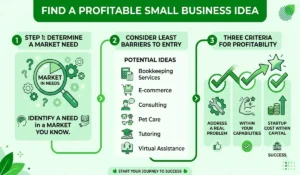
Step 1: How Do You Find a Profitable Small Business Idea?
You find a profitable business concept by determining a need in a market that you already know. Small business ideas with the least barriers to entry include bookkeeping services, e-commerce, consulting, pet care, tutoring, and virtual assistance.
There are three criteria for a profitable idea: It must address a real problem, it must be within your current capabilities, and the startup cost must remain within your potential capital. Those ideas that do not pass any of these three tests seldom make it through the first year.
Step 2: How Do You Conduct Market Research for a New Business?
You do your market research by researching competitors, target customers, and existing demand data before writing a single business document. Research in the market mitigates risk. It substitutes assumptions with figures.
These four areas are key to well-conducted market research: market saturation, competitor pricing, customer demographics, and average startup cost in their industry. According to SCORE (2024), 79.6% of new businesses are still in operation after the first year and 50.6% after the fifth year; not doing the research places a business on the side of failure.
Step 3: How Do You Create a Business Plan?
A business plan is a document that outlines your mission, target market, financial projections, and funding requirements. Either a conventional plan or a one-page plan on lean paper can be used to construct an effective one.
Traditional vs. Lean Business Plan
| Feature | Traditional Plan | Lean Plan |
| Length | 10–30 pages | 1 page |
| Best for | Bank loans, investors | Fast-moving startups |
| Core content | Full financials, market analysis, appendix | Key metrics, high-level summary |
| Update frequency | Annually | Monthly or quarterly |
A business plan is not just a source of money. It makes founders ask tough questions at an early stage: What is your mission? Who is your customer? On what basis does the business generate money? Not doing this step will result in answering these questions in the future, when under pressure, and without an idea of how to make the decision.
Step 4: Which Business Structure Should a New Business Choose?
A new business chooses a structure depending on its tax objectives and liability requirements, normally a sole proprietorship, partnership, LLC, S corporation, or C corporation. Each structure varies in the way the business reports taxes and the degree of protection of personal liability the owner enjoys.
Business Structure Comparison
| Structure | Liability Protection | Taxation | Best For |
| Sole Proprietorship | None | Personal income tax | Solo freelancers |
| Partnership | Shared, unlimited | Pass-through | Co-owned businesses |
| LLC | Yes | Pass-through or corporate | Most small businesses |
| S Corporation | Yes | Pass-through, avoids double taxation | Profitable growing businesses |
| C Corporation | Yes | Corporate tax + dividend tax | Businesses seeking outside investors |
According to IRS business entity filing information (2024), LLC is the most frequent new small business filing because it offers both protection of liability and simplicity of taxation.
Step 5: How Do You Register a Small Business and Get an EIN?
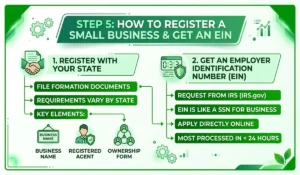
To start a small business, you file formation documents with your state and request an Employer Identification Number (EIN) with the IRS. The EIN acts as a Social Security number for your business.
The registration requirements differ by state, but three documents seem to be present nearly everywhere: the name of the business, the registered agent, and the ownership form. When applied directly via IRS.gov, most states process the EIN application in less than 24 hours.
Step 6: How Do You Fund a New Small Business?
You finance a new small business by bootstrapping, small business loans, angel investment, crowdfunding, or a grant. Both decisions alter the degree of control that you retain and the degree of risk that you assume.
Bootstrapping, also known as self-funding, has the least amount of personal risk but demands less ownership. Small business loans require a business plan and financial forecasts. Usually, investors who require equity, such as angel investors or venture capital firms, will require representation on the board in exchange for capital.
Extrinsic finance also influences the extent of financial reporting required by your business at the start. Clean, audit-ready financial records are necessary to release funds to investors and lenders, and to do so, it is worth considering Accounting Services for Small Business early.
Step 7: How Do You Open a Business Bank Account and Set Up Bookkeeping?
To open a business bank account, you need to present your EIN, formation documents, and identification, and then keep business activity and personal expenditure separate. This one step averts most of the ills that new owners encounter during tax time.
You should begin your bookkeeping on the first day and not on the tax day. A single bookkeeping system tracks income, costs, and taxes in real time, enabling founders to have precise data to make all funding or pricing choices. Choosing the right Bookkeeping Software for Business from the start keeps records organized and cuts the manual work required during tax season.
When founders come to the question, they need a bookkeeper or not. Most businesses will say yes. What Does a Bookkeeper Do? explains this in more detail: a bookkeeper records the daily transactions and reconciles them, and an accountant analyses that information to draw conclusions on tax strategy and business decisions. Companies that make less than 50 transactions per month can usually manage their bookkeeping, and companies with more than 50 transactions per month require professional assistance.
Step 8: What Licenses, Permits and Insurance Does a Small Business Need?
A small business needs licenses, permits, and insurance based on its industry, location, and number of employees. Federal licenses include industries such as agriculture and broadcasting, while construction, food service, and retail are usually licensed by state and local authorities.
Common Small Business Insurance Types
| Insurance Type | What It Covers |
| General liability | Accidents, injuries, negligence claims |
| Professional liability | Errors and omissions for service businesses |
| Workers’ compensation | Employee injury or illness, mandatory in most states |
| Commercial property | Fire, theft, and storm damage |
| Business Owner’s Policy (BOP) | Bundled liability and property coverage |
State labor department filings as of 2024 indicate that 49 states have workers’ compensation insurance requirements for any business with employees; Texas is the only state that does not mandate workers’ compensation insurance. Lacking such coverage is a direct legal and financial penalty to the business.
Step 9: How Do You Build a Small Business brand and Online Presence?
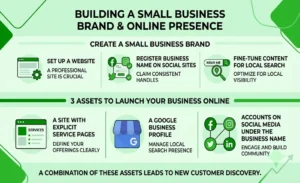
You create a small business brand by setting up a website, registering your business name on social sites and fine-tuning content for local search. A company that does not have an online presence is not visible to its rivals who are already on the first page of search results.
Three assets are needed to launch a small business online: a site with explicit service pages, a Google Business Profile, and accounts on social media under the business name. A combination of these three assets contributes to the majority of new customer discovery of local small businesses.
Step 10: How Do You Launch and Scale a Small Business?
You launch a small business by servicing customers and keeping track of all transactions in relation to your original financial projections. Scaling commences as soon as the data on real revenue takes the place of guesswork.
Long-term business success depends on post-launch financial tracking rather than on the launch. With the increase in the volume of transactions, a significant number of owners choose to use AI Bookkeeping for Small Businesses to automate the reconciliation process, reduce the number of manual data entries, and identify discrepancies before they develop into more serious tax or cash flow issues.
Ready to launch smarter? Let our experts handle your books.
What Mistakes Do New Business Owners Make?
Startup costs are most commonly underestimated, market research is not conducted and personal and business funds are combined by new business owners. Most of the failures of small businesses can be attributed to these three errors.
- Underestimating costs: Founders who do not have a contingency fund run out of funds in six months.
- Omitting research: Companies that enter without doing research on competitors usually get into markets that already have superiorly capitalized alternatives.
- Commingling funds: It is difficult to file taxes, and legal liability may be lost even in the case of LLC owners, because accounts are mixed.
- Delaying bookkeeping: Founders who postpone the preparation of their books until they have to prepare tax returns incur greater accounting charges and are at increased risk of audit.
- Loss of cash flow forecasting: A profitable business on paper may fail when the cash flow is less than the bills.
What Are the Latest Small Business Statistics?
According to the SBA Office of Advocacy (2024), 99.9% of the total businesses in the US are small businesses and 61.7 million employees are employed in them. These statistics affirm that the creation of small businesses is still the main source of employment in the private sector in the US.
Small Business Statistics (2024–2026)
| Data Point | Figure |
| Total US small businesses | 33.2 million |
| Share of all US businesses | 99.9% |
| Workers employed by small businesses | 61.7 million |
| Businesses that survive year one | Approximately 80% |
| Businesses that survive year five | Approximately 50% |
| Leading cause of business failure | Cash flow mismanagement (82%) |
These statistics are based on the SBA Office of Advocacy and SCORE Association (2023-2024) research. Founders with such knowledge prior to launch are able to prepare based on true risks rather than responding to them when they arise.
How Long Does It Take to Start a Small Business?
It usually takes three to six months, including the time spent conducting the preliminary research, to establish a small business. This schedule can be divided into four quantifiable periods.
Small Business Launch Timeline
| Phase | Typical Duration |
| Market research | 2–4 weeks |
| Business plan development | 2–4 weeks |
| Legal registration and EIN | 2–6 weeks |
| Funding, setup, and launch prep | 4–8 weeks |
Businesses involving a physical location or special licensing are slow to start compared to home-based or online businesses, which can be operational in as little as four to six weeks.
Final Thoughts
The small business can be initiated using a repeatable process: research, write the plan, select the structure, raise the money, and open with adequate financial tracking. The ones that make it through are the ones that follow all the dollars all the way through.
No single factor that contributes to the survival of a new business is as powerful as financial accuracy. Using Outsourced Accounting Services provides founders with clean books, tax-ready reports, and financial transparency without the need to create a complete internal finance team. Knowing the Advantages of Outsourcing Accounting can help new business owners determine when it is worth paying a professional to maintain the accuracy of the numbers as the business grows.
Frequently Asked Question
How can I cheaply start a small business?
The least expensive method to start a small business is a home-based service business, which may only need $2,000-$10,000 because it will not incur the cost of leasing, inventory, and equipment.
Will a business plan be necessary to start a small business?
Yes. Even a self-funded business requires a business plan to make decisions, target the market, and be able to raise capital in the future.
What is the amount of money that I have to start a small business?
The typical startup costs of a small business are $2000-$50,000, depending on the industry.
Is it possible to establish a small business without an accountant?
Yes. The initial costs do not require an accountant to start a small business, but it is worth considering hiring a professional when monthly transactions become too complicated to manage by hand.
How is the LLC different from a sole proprietorship?
The LLC isolates personal liability from business liability, whereas in a sole proprietorship the owner is personally liable for all business liabilities and legal actions.