
Owners of businesses throughout the US are reevaluating the way they allocate their resources. By 2026, the increasing salaries, cost of software subscriptions, and growing compliance requirements will make in-house finance teams a significant burden on the budget. Startups are not the only ones that are now discussing the outsourced accounting cost conversation: mid-sized companies and developing enterprises are also raising the same question: should the switch be made?
A 2025 Deloitte survey of outsourcing reveals that more than 37% of finance and accounting tasks are now delivered by a third-party provider, compared to only 28% in the three years prior. That change is happening rapidly. Financial management has never been more affordable and accessible in its history, thanks to automation, cloud platforms and fractional hiring models.
Then, how much does outsourced accounting cost in 2026? The truthful response: it is a matter of fact. However, when you get the pricing models, the levels of service and the actual cost driver, then you will be able to fit the correct solution to your specific business requirements and prevent overpaying on both.
Average Outsourced Accounting Cost in 2026
The following are the minimum price ranges that most businesses have to deal with before getting into the thick of things. These numbers are representative of the existing market in the US and are considered the reason behind the growth in demand for cloud-integrated and real-time financial services.
2026 Outsourced Accounting Pricing at a Glance
| Service Tier | Business Type | Monthly Cost | Typical Scope |
| Basic Bookkeeping | Small Business | $500 – $1500 | Transactions and reconciliation |
| Full-Service Accounting | Mid-Sized / Growth | $1500 – $4500 | Reports, payroll and tax prep |
| Fractional CFO & Advisory | Enterprise / Complex | $4500 – $12000+ | Strategy, forecasting and M&A |
The most popular service packages are found within these ranges. Transaction volume, industry complexity, and the frequency at which you need to report will determine your actual price. At the low end is a solo e-commerce brand whose transactions per month are 200. A construction company that handles numerous project budgets and progress bills accumulates a lot higher.
Calculate Your Outsourced Accounting Costs Today
Key Factors That Influence the Cost to Outsource Accounting
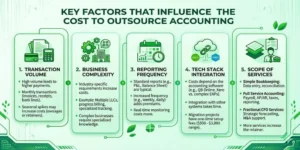
There are a number of variables that drive your price either up or down. Knowing them will make you budget properly and can negotiate a package that matches your actual workload not a template.
1. Transaction Volume
All invoices that are processed, all receipts that are classified, and all bank lines that are reconciled are time-consuming. Providers charge for their services partly depending on the volume. A company with 500 transactions each month has a higher payment than one with 100. When your volume of transactions is seasonal during a holiday sale or tax season, providers will either impose overage charges or demand a volume-sensitive retainer.
2. Business Complexity
Costs are fuelled by industry-specific requirements. Outsourced accounting for small businesses that have a single source of revenue. However, a real estate company that runs several LLCs, a construction company with progress billing and a new start-up with equity compensation and investor reporting. All of these would need specialized knowledge, which would cost more.
3. Reporting Frequency
The balance is standard monthly financial statements like P&L, balance sheet and cash flow. You will pay a premium in case you require weekly cash-flow dashboards, real-time KPI monitoring or daily reconciliations. Most providers have monthly reports as part of their base package and add-on fees to increase the frequency of deliverables.
4. Tech Stack Integration
Your accounting software is important. It is common to work with the standard and fairly inexpensive platforms, such as QuickBooks Online or Xero. However, when your business has a complex ERP such as NetSuite, SAP or a custom-built system, the integration takes more time and expertise and it reflects in the cost. Migration projects that are changing platforms also have one-time setup costs of about 500 to 3,000.
5. Scope of Services
Simple bookkeeping includes data entry and reconciliation. Full service accounting includes payroll processing, accounts payable and receivable, tax preparation and planning, and financial reporting. Fractional CFO services pricing goes a step further to include strategic forecasting, cash-flow modeling, board reporting and M&A support. The bigger the scope the higher the monthly retainer.
Common Outsourced Accounting Pricing Models
There are a number of ways that providers set their fees. There is no need for you to get a shock on your invoice after knowing which model most suits your situation.
Hourly Rates
The hourly rate for outsourced accountant services is likely to cost between $50 and $175 per hour in 2026. It depends upon the location of the provider, the area of specialization and the level of experience among others. Bookkeepers tend to charge $50-$80/hr. CPAs and senior accountants cost between $100 and $175/hr.
Hourly billing is effective when it comes to single projects, a financial cleanup, a historical audit, or a single tax filing. Continuous work is costly within a short period, as there is no limit and your bill may fluctuate significantly each month.
Fixed Monthly Retainers
And there is a good reason why this is the prevailing pricing model in 2026. A consistent monthly retainer provides you with predictability in budgeting, scope of work, and a team that is knowledgeable about your business. Most outsource accounting services pricing plans involve this approach which combines bookkeeping, reconciliation, financial statements and even payroll into one monthly payment.
The disadvantage: when your requirements increase dramatically in the middle of the contract, you can reach the scope constraints and have to discuss an upgrade. Enter into a clear service agreement in the beginning to determine exactly what is involved.
Value-Based / Tiered Pricing
Other providers are also going to charge depending on the amount of revenue or the complexity of your company, instead of hours or tasks. A company that generates $500K per year is charged a different rate than a firm that generates $5M. This model is used to align the compensation of the provider to the value of their delivery, and is generally a more inclusive package of services without itemized billing.
Tiered pricing also appears as packaged plans, namely Starter, Growth and Enterprise in which a certain number of services are bundled at a flat rate. This allows you to shop with ease and allows you to scale up without having to restart negotiations.
In-House vs. Outsourced Accounting: A True Cost Comparison
Most companies take in-house accounting as just an extra expense of a single salary. That is not true and can be very expensive.
Annual Cost Breakdown: In-House vs. Outsourced
| Cost Factor | In-House Accountant | Outsourced Accounting |
| Annual Salary | $55000 – $85000 | Included in retainer |
| Payroll Taxes & Benefits | $15000 – $25000+ | $0 |
| Recruitment & Onboarding | $3000 – $8000 | $0 |
| Accounting Software | $1200 – $5000/yr | Often included |
| Training & Development | $1500 – $3000/yr | $0 |
| Estimated Annual Total | $75000 – $126000+ | $6000 – $54000 |
The statistics speak volumes. One in-house bookkeeper or a junior accountant in the U.S. is between $75,000 and $126,000 a year including salary, benefits, payroll taxes, recruitment, and software. In comparison, a complete full-service accounting cost package with an outsourced company costs between $6000 and $54,000/year, and you get a whole team not an individual.
The Hidden Costs of In-House Staff
In addition to the figures in the table above, in-house accounting has exposures that are not reflected in a spreadsheet. As soon as your accountant goes on PTO, becomes ill or quits, your financials come to a standstill. Replacement recruiting is an average of 45-60 days and exposes a company to thousands of dollars in job board fees, recruiter commission, and lost productivity.
Knowledge silos are also formed by in-house teams. Your books are handled by one individual who, when he leaves, carries institutional knowledge with him.
The Outsourcing Advantage
When you contract Outsourced Accountants, you will have a team of three organized people: a bookkeeper, a senior accountant and a CPA operating with documented procedures. There’s no single point of failure. You do not need to worry about sick days, vacations or turnover affecting your reporting cycle.
You also have 24/7 access to current accounting technology, compliance and best practices in the industry without the need to purchase training or certifications. The benefits of outsourcing bookkeeping have much more to offer than the dollar saved line on your P&L.
ROI Calculation
Take the case of an e-commerce company that is expanding and is paying a current accounting department of $90000/year. They will save $54000 every year by changing to a full-service outsourced plan at $3,000/month ($36000/year). The fact that the free capital can be used to finance a marketing campaign, extra stock or a new employee in a revenue-generating position. It is not cost-cutting that is strategic redistribution.
Red Flags: When Is a Low Price Too Good to Be True?
The virtual accounting services cost market has become a boom and not all providers offer the same quality. Serious problems can be covered with a low monthly price tag.
Automated-Only Services With No Human Oversight
Other low-cost vendors automate all of it, including the categorization of transactions, the reconciliation and even the creation of reports with little human intervention. Automation is an assistant and not a substitute for judgment. Miscategorized transactions, omissions of deductions and compliance mistakes go away without a trained accountant examining the output. The mistakes are costly adjustments when tax time comes around.
Hidden Fees to Watch For
Always insist on a comprehensive list of services and a fee schedule to sign. The most typical hidden fees are:
- Billed fees charged separately from the monthly retainer are tax preparation and filing fees.
- End close charges- extra reconciliation and audit preparation.
- Software charges in case the provider charges you for platform licenses.
- The extra fee is charged when the number of transactions is more than the plan limit.
- Fees to onboard or set up costs between $200 and $2000.
An open provider displays all possible charges in advance. A contract that is left open is a red flag.
Data Security and Compliance
Your financial information is confidential. A provider who deals with your books should have a high level of security measures, including encrypted data transmission, secure cloud storage, role-based access controls, and unambiguous policies of data retention. Inquire about SOC 2 compliance, two-factor authentication, and what will become of your data in case of contract termination.
Do not sacrifice data security at the cost of a lower price. A data breach or compliance breach is much more expensive than the few hundred dollars you are saving by switching to a less expensive provider. The cost of outsourcing accounting should always include the value of airtight data protection.
Lack of Industry Experience
Basic cash-basis accounting can be done by a generalist bookkeeper in the case of a freelancer. However, when you manage a medical practice, a construction company or a SaaS business where subscription recognition of revenue is required. You should have a provider with firsthand experience in the industry. Request case studies and customer references within your industry before investing.
Outsourced Accounting Costs by Business Type
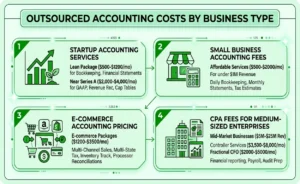
Startup Accounting Services Cost
New startups generally require minimal bookkeeping, clean financial statements to investors and monthly reporting of burn rates. A lean package will cost between $500 and $1200/month. When you are close to Series A and require GAAP-compliant financials, revenue recognition policies and cap table management, the cost increases to $2,000-4,000/month.
Small Business Accounting Fees
The affordable outsourced accounting services charged between $500 and $2000/month are used by most small businesses whose annual revenue is less than $1M and which include daily bookkeeping, monthly financial statements and quarterly tax estimates. This spectrum comes with the availability of a bookkeeper and a reviewing CPA which would be much more expensive in-house.
E-Commerce Accounting Pricing
There is a special complexity of e-commerce companies: they operate in a multi-channel structure like Amazon, Shopify, Etsy and their sales are taxed in many states. They have to keep track of inventory costs and their payment processors need to be reconciled like Stripe, PayPal, and Square. These companies usually spend between $1200 to $3500/month on special e-commerce accounting pricing packages that support these systems inherently.
CPA Fees for Medium-Sized Enterprises
Mid-market businesses earning between $5M and $25M per year require instead of bookkeeping. They need financial controller services, multi-department reporting, payroll management and regular audit preparation. Outsourced CPA fees. The fees of medium-sized companies in an outsourced model are usually in the range of $3,500-$8,000/month and on top, it comes with the services of a fractional CFO between $2000-$5000/month.
Conclusion: Treat Outsourced Accounting as a Growth Investment
The cost to outsource accounting is not only a line on your expenses list. It is a good move that will liberate your staff to concentrate on growth, minimize compliance risk and substitute a brittle, one-person reliance with an expert and scaled finance department.
Companies that view financial management as a core competency, rather than a secondary activity, perform better than others in 2026. Regardless of whether you pay $600/month to have clean books as a solopreneur or spend $8,000/month on a fractional CFO and full accounting team as your business scales and professional financial management always pays off.
The correct initial action? Check up on your existing financial arrangements. Estimate the real cost you are paying in terms of salary, software, time, and errors and compare it to an open quote of outsourcing. You can break even with the switch in the first quarter.
In the case of Outsourced Accountants, we develop tailored accounting packages based on the real business requirements. We are also open with prices, scope and we are all about enabling you to scale up with financial confidence. Request your custom quote now and find out your specific outsourced accounting cost.
Frequently Asked Questions
What is the price of outsourced accounting to a small business?
The average cost of outsourced accounting by small businesses is between $500 and $2000 monthly. The price will be determined by the number of transactions, the level of services (bookkeeping or full-service) and the complexity of your industry. With small financials and minimal numbers of transactions and businesses find themselves in the low end of that range.
Is it cheaper to outsource accounting than to employ in-house?
Yes in the majority, far otherwise. A full-time in-house accountant will cost you $75,000-$126,000 per annum including salary, payroll tax, benefits, software and recruitment. A contracted firm that delivers the same services would cost on average between $12,000-$36,000 a year with no secret HR overhead and potential turnover.
What is a fixed monthly retainer of outsourced accounting?
Typical categories of transactions covered within a standard fixed monthly retainer are the categorization of transactions, bank reconciliation, accounts payable and receivable, monthly financial statements (P&L, balance sheet, cash flow summary) and access to a specific accounting team. Add-ons are typically tax preparation, payroll, and fractional CFO services.
What factors increase the cost of outsourcing accounting?
The core drivers of costs are large volume of transactions, complicated business models (entities or locations), industry specific needs (construction billing, inventory accounting, SaaS revenue recognition), regular reporting requirements beyond monthly reports, and integrating with complex ERP systems. All these factors increase time and experience to the work – and hence price.
What can I do to select the appropriate outsourced accounting provider?
Begin by assessing three factors: experience in the industry (do they work with companies like yours?), pricing transparency (are all the fees documented?) and technology compatibility (do they work with your accounting software?). Before signing any contract, ask the client to provide references, a sample financial report, and ensure that their data security practices are in place. You can also test the quality through a trial month or short-term engagement to evaluate before committing a long-term engagement.