When recruiting your next employee, there is only one choice: 1099 vs. W2. Any error will cost you back taxes, interest and fines that the IRS, the Department of Labor or a state agency will write you a bill for, and that is far bigger than whatever you would have saved. Get it right and you get a workforce that fits, indeed, fits your budget and your growth plan.
The State of Independence report by MBO Partners indicates that over 72.9 million Americans are now working independently. However, the number provided by the federal government is a more limited narrative. As of July 2023, according to the Contingent Work Supplement compiled by the Bureau of Labor Statistics and released in November 2024, there are 11.9 million formally identified independent contractors in the US and this is only 7.4% of the total employment in the US. That difference between the two figures is because independent workers and 1099 contractors are not synonymous in the eyes of the law and employers that cross the line pay the price.
This guide disaggregates the distinction between a 1099 contractor and a W2 employee. Also, how the IRS decides between the two and what each classification actually costs, the cost of misclassification accumulation, and how to address the decision as your business expands.
What Is a 1099 Contractor?
A 1099 contractor is a self-employed employee who operates his or her own business and receives payment without any tax deduction from his or her paycheck. It is named after the 1099 tax form that the IRS requires businesses to issue only after they pay a non-employee at least $600 in a calendar year.
It is Form 1099-NEC also known as Nonemployee Compensation. It took the place of the older 1099-MISC when used to pay contractors in 2020 but 1099-MISC remains to be used to report other forms of income such as rent or prize money. The contractor and IRS should receive Form 1099-NEC that is sent by the businesses by January 31 of the next year.
Contractors working under a 1099 form their own hours, own their own equipment and usually serve more than one client at a time. They also determine the way to accomplish the work and the business can determine the result, but not the means.
Common 1099 Contractor Examples by Industry
Contract work manifests itself in various ways depending on the discipline:
- Creative and marketing: Project to project freelance writers, graphic designers, social media managers and video editors.
- Technology: Software developers and IT consultants hired to do a specific build or migration.
- Professional services: Accountants or bookkeepers on retainer with several small companies at a time.
- Logistics and delivery: Gig platform drivers and last mile delivery workers.
- Construction: Specialty subcontractors such as electricians or HVAC technicians are contracted for a one time job.
The similarity in all the above is autonomy. It is up to each of these workers to determine how the job will be done, not the company paying the invoice.
What Is a W2 Employee?
A W2 employee is a worker under the payroll of an employer and whose hours, equipment and daily activities are directly controlled by the employer. The employer deducts income tax, Social Security and Medicare out of each paycheck and submits the amounts at the end of the year.
That is the W2 tax form also referred to as the IRS Form W-2. It displays the taxable wages, federal and state withheld tax, and social security and Medicare contributions during the year. It is used by employees to submit personal tax returns on an annual basis, in the spring.
Common W2 Employee Examples by Industry
Status W2 is prone to adhere to roles that are continuous and strictly controlled:
- Retail and hospitality: Hourly cashiers, servers and shift managers on a fixed schedule
- Healthcare: Nurses and administrative staff employed directly by a clinic or hospital
- Corporate and administrative: Full-time and in-house managers, accountants, and customer care staff.
- Government: The great bulk of federal, state and local government employees.
- Manufacturing: Line workers and those in maintenance who work with equipment provided by the employer on a regular schedule.
Almost everybody who has an employer who determines the time of day or night in which the work is going to be done is in this category.
1099 vs W2 Employee: What’s the Actual Difference?
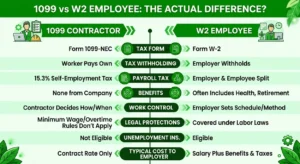
The difference between 1099 and w2 boils down to control and risk. A 1099 employee takes charge of the way the task is done and has their own financial risk. A W2 employee is subordinated and gets a consistent payment irrespective of the performance of the business within the month.
The difference between 1099 vs W2 employee status can be seen in a side-by-side view:
| Factor | 1099 Contractor | W2 Employee |
| Tax form issued | Form 1099-NEC | IRS Form W-2 |
| Who withholds taxes | Workers pay their own | Employer withholds and remits |
| Payroll tax rate | 15.3% self-employment tax | 7.65% withheld; employer matches 7.65% |
| Benefits provided | None from the hiring company | Health insurance, retirement, and PTO are common |
| Work control | Contractor decides how and when | Employer sets schedule and methods |
| Legal protections | Minimum wage and overtime rules don’t apply | Covered under FLSA and state labor law |
| Unemployment insurance | Not eligible | Eligible |
| Typical cost to the employer | Contract rate only | Salary plus roughly 20–30% in taxes and benefits |
Why the “Total Cost” Number Often Surprises Employers
A $70000 salary rarely costs $70000. The figure increases by approximately $5355 with the addition of the 7.65% employer FICA match. Unemployment insurance, workers compensation premiums and a small benefits package in a layer form, and the result is usually between $84,000 and $91,000 the 20-30% loaded-cost band.
A 1099 contractor who charges the same amount of project fees (equivalent to $70,000) will simply cost the business the same amount of $70,000. No match, no insurance, no benefits administration. That tradeoff is instead reflected on the other side of the worker as such a contractor pays the entire 15.3% of self-employment tax instead of sharing it with an employer.
How Do 1099 and W2 Workers Pay Taxes?
W2 workers have taxes automatically deducted at each pay period. The process is left to 1099 workers, working at their own pace.
Employer Tax Responsibilities for W2 Employees
Employer payroll taxes paid by businesses include a 7.65% Social Security and Medicare match, federal and state unemployment insurance and workers’ compensation premiums. These expenditures come irrespective of how the employee would perform during the specific quarter, and this is one of the reasons why full-time employment would come with high fixed overhead as compared to contract employment.
Quarterly Estimated Taxes for 1099 Contractors
Contractor tax obligations of 1099 workers comprise all 15.3% of the self-employment tax: half of Social Security and half of Medicare that would otherwise be divided by a W2 arrangement. Now, also, the quarterly estimated payments are filed by contractors on Form 1040-ES, not in April, as nothing is withheld on behalf of an employer. The failure to meet a quarterly deadline can result in an underpayment penalty despite paying up the entire balance by tax time.
There’s a partial tradeoff for contractors. The higher tax rate is moderately cushioned by the fact that they are allowed to deduct business expenses, such as home office expenses, mileage, equipment, and software subscriptions, which employees typically cannot do.
What Benefits Do W2 Employees Get That Contractors Don’t?
W2 employee benefits usually involve health insurance, retirement, paid time off and occasionally life insurance, none of which a 1099 contractor is provided by the company that hires them.
When comparing employee benefits vs contractor benefits, the idea of total compensation figures being deceptive is easy to understand. The limits of the benefits are usually around 30% of the total compensation of W2 employees, according to the Employer Costs of Employee Compensation data supplied by the Bureau of Labor Statistics, updated on a quarterly basis. The majority of it is driven by health insurance for W2 employees, employer-provided retirement and paid leave accrual.
Instead, contractors construct a safety net on their own. A SEP-IRA or Solo 401(k) is used by many to save towards retirement and keeping up with the 401K Contribution Limits keeps both W2 employees and self-employed contractors at the limit of tax-advantaged savings under the IRS regulations each year. An uninsured contractor, too, is also likely to purchase individual health insurance, a consideration that contributes to the high rates most contractors charge in contrast to the same hourly wage to an employee.
How Does the IRS Decide Worker Classification?
The IRS makes a decision on the worker classification based on three factors: behavioral control, financial control, and the type of relationship. None of these alone decides the case; the agency balances all three in combination, and a worker can lean towards the employee on one factor and lean towards the contractor on the other.
Behavioral Control
This aspect inquires who dictates how the work is to be done. Essential training, elaborate guidelines, and the hours are all geared towards employee status. A company that merely tells the worker the final product but does not prescribe the process is more of a contractor.
Financial Control
This aspect poses the question of who incurs financial risk. Employees who invest in their own gear, pay their own costs, and can earn or lose cash according to their efficiency in operating resemble more of a contractor. Employees are usually reimbursed for the costs and paid a certain amount irrespective of the outcome of the work.
Type of Relationship
This aspect poses the question of the work being in progress and being the core of the business. A long term position that is at the core of day-to-day functioning is oriented towards employment, although the employee may be an hourly paid employee rather than a salaried employee. A specified project with an exact termination date is a tilt towards the opposite.
The IRS worker classification rules are comprised of these three categories, and the businesses that cannot make a confident application can file Form SS-8 to seek an official determination, although it may take months to receive a response.
State-Level Tests: The ABC Test
Some states exceed the federal law. The ABC test used in California, New Jersey, and Massachusetts entails that a worker must fulfill the three following criteria to be considered a legitimate contractor:
| State | Classification Test Used |
| California | ABC test (strictest standard) |
| New Jersey | ABC test |
| Massachusetts | ABC test |
| Texas | Federal common law / economic reality test |
| Most other states | IRS common law or economic reality test |
The issue concerning the independent contractor classification depends on facts and not paperwork. Any contract that declares a person a freelancer is no different, even though the working relationship between the two parties resembles the employment one – the courts and state agencies do not see past the label each time. This is the gist of the independent contractor vs employee dilemma that even seasoned hiring managers fall into the trap of: the words on the contract will never outweigh the real-life functioning of the job. The same rationale applies to the employee classification rules more generally; regulators are concerned with content, rather than the headline on a contract.
1099 or W2: How to Decide Who to Hire
The choice between W2 or 1099 is determined by three factors: the duration you require the individual, the amount of control you require over the individual, and the importance of the role to your key operations.
Select a W2 employee when the position is permanent, the position will need close supervision, or be at the center of daily activities – consider customer service, in-house finance, or doing core production work. Select a 1099 contractor when you require specialized skills to carry out a specific project, anticipate the project has an end or want the option to upscale or downscale without a long-term obligation.
This employee vs contractor ruling has an added weight to companies that have a long-term plan. A company that considers the long-term changes in ownership should consider hiring decisions to be part of its overall Business Succession Planning, because institutional knowledge is likely to remain in W2 employees, those who develop with the company, instead of contractors who switch between clients.
When determining the difference between a 1099 contractor vs W2 employee when it comes to a leadership-track position, retention should be considered, not only the cost of payroll this quarter.
When a Hybrid Workforce Makes Sense
It is common to see many businesses operating both models simultaneously. A hybrid workforce involves pairing W2s to core functions with 1099 workers to overflow, seasonal surges, or higher-skill project work that does not warrant a full-time position.
This is well depicted in ecommerce brands. A company that may be expanding to meet the holiday season may also seek contract labor to do the task or customer-service assistance instead of permanent employment, then reduce the staffing level once the season ends. That flexibility, coupled with a strict eCommerce Financial Metrics tracking, makes profit margins visible, despite the changes in headcount by the month, as labor costs are reduced more in a hybrid model than under a fixed W2 staffing plan.
What Happens If You Misclassify a Worker?
Misclassification initiates punishments among several agencies simultaneously, and none of them is insignificant. The IRS may also seek back payroll tax, along with interest and penalties related to the accuracy, in case it finds a worker was improperly classified as a contractor. Liability for unpaid overtime may be imposed by the Department of Labor under the Fair Labor Standards Act, occasionally doubled as liquidated damages. States stack up individually. California, as an example, permits fines of up to $25,000 each violation of its labor code in a willful misclassification.
Common Misclassification Mistakes Employers Make
Some trends are apparent in enforcement cases:
- Assuming remote work automatically means contractor status. Location bears no relation to the classification tests; a distant worker remains a W2 worker when the company dictates their schedule and ways.
- Treating a signed agreement as full protection. A contract that refers to the person as a 1099 contractor does not have any legal impact when the working relationship is in reality a form of employment.
- Letting a short-term contractor role quietly extend indefinitely. Three months project, which becomes three years of permanent, exclusive work, begins to resemble employment despite the initial purpose of the project.
- Providing company equipment and detailed training to a “contractor.” These two actions drive the relationship to the behavioral-control factors that determine employee status.
Even more stringent scrutiny is made on regulated industries. The airtight classification of financial advisory practices in specific is why layering the ownership transition over such advisory precedes reading up on Succession Planning for Financial Advisors before finalizing how a new advisor comes on board as an employee to build to the partnership or as a contractor hired to work on a single engagement.
The federal regulations on contractor classification have changed previously and continue to be a vibrant point of policy discussion. Employers ought to verify up-to-date DOL directions rather than utilizing outdated overviews to make a final decision.
Can You Convert a 1099 Contractor to a W2 Employee?
Yes, and it is frequent as a business relationship grows. When the workload of a contractor becomes more of a full-time, continuing position, it is safer to make them a W2 employee so that, by the time an audit reveals the problem, the business is not put at risk of being misclassified.
The conversion process usually entails gathering a new Form W-4, as opposed to W-9, establishing payroll withholding, and establishing a formal termination of the 1099 arrangement, as opposed to combining the two. Attempting to pay an individual on a 1099 and a W2 separately and concurrently for identical work in the same position is one of the quickest methods to attract regulatory focus, as it indicates to the business that it is already aware that the position has changed to employment status.
1099 vs W2 Classification Checklist
Consider the following questions before deciding on how to bring someone on:
- Does the business regulate where, when, and how the work occurs?
- Is the position a continuing position not a project-specific one?
- Does the worker operate company-supplied tools and equipment?
- Is the individual part and parcel of core, day-to-day activities?
- Is this the only company that the worker serves?
- Will the business have training or step-by-step instructions?
The response to the majority of these aspects is yes, which is indicative of W2 employment. No answer on the board is indicative of a valid 1099 arrangement.
Conclusion
This choice of 1099 vs. W2 affects not only your tax payment, but also your risk in terms of liability, and the way your team actually works daily. Compare the description to the actual working relationship, not the name on the contract and reconsider that decision as tasks change and turn silent, as the duties of a contractor may gradually become a lot more like employment. One of the few Best Accounting Industry Trends that determines the way businesses are creating their teams in the future is staying ahead of these changes well into the year 2026.
The payroll research team at Outsourced Accountants has kept this breakdown up to date to ensure that employers remain up to date with the changes in the rules of worker classification.
Frequently Asked Questions:
What does W2 mean?
It is a statement of IRS wage and tax that is issued by employers annually in January to give information about the salary of an employee and the tax on the same that has been deducted by the employer.
What qualifies someone as a W2 employee?
What is the basis of w2 employee? It applies to any individual whose time, equipment and modes of work the business has direct control over, irrespective of the job position.
Is it possible to have a single worker as a 1099 and a W2 of a single company?
Yes, under the condition that the two roles are really separate. An example of a maintenance technician as a W2 employee during the week could also operate a separate contracting business installing equipment by the same employer on unrelated projects, provided that the two arrangements do not conflict in their responsibilities.
Do 1099 contractors get overtime pay?
No. The overtime requirements in the Fair Labor Standards Act are only applicable to employees and not to independent contractors; therefore, 1099 workers do not qualify to receive time-and-a-half pay, no matter the number of hours worked.
What will be the consequences of classifying a W2 worker as a 1099 contractor?
The company will face unpaid payroll taxes, possible penalties against the company by DOL because of not paying overtime, state fines, and potential litigation initiated by the misclassified employee against the company on reimbursement of back payments and benefits.
But what classification test should I use in my state?
See the advice of your state labor department too, because the more conservative ABC test is used on top of federal IRS rules in such states as California, New Jersey and Massachusetts, and the majority of states use the federal common law test alone.
Would it cost less to employ a 1099 contractor than a W2 employee?
Typically, on a bare cost-per-hour basis, the business avoids payroll taxes and benefits. But contractors can mark up their rates to cover their own tax bill and the savings can only be maintained when the classification is in fact correct; misclassification penalties can wipe out years of savings in one audit.
Which type of form is completed by a new 1099 contractor?
A Form W-9, which gathers the tax details of the contractor to enable the business to submit a correct Form 1099-NEC at the end of the year. This is independent of the Form W-4 that new W2 workers fill out to have withholding on their payroll.