
Your salary has just received an increase directly through the IRS. For 2026, the agency bumped the employee deferral limit to $24500 up from $23500 in 2025. It is a $1000 increase or about 4.3% annualized growth, which has been steadily increasing since 2023 when the cap was at only $22500. Combine employer matching with it, and you are now free to make contributions as high as $72000 in a year. Your retirement is working harder on that.
Nevertheless, the limit is only the headline. This guide simplifies all the other things you should know: the new catch-up contribution rules that apply to workers over age 50, income levels that influence your plan and a new mandatory Roth catch-up rule that will strike high earners beginning this year. Knowing your 401K Contribution Limits now will mean retaining more of what you will make in the future.
What Are 401K Contribution Limits?
Imagine it as a savings speed limit. Each year, the IRS places a limit on the amount you can put in your 401K that is your annual 401K contribution limit. It includes two things: the amount you personally contribute with your check, and the amount you and your employer can contribute jointly.
The bare bones version is as follows. The IRS 401k contribution limits are in place to ensure that tax-favored savings are fair and sustainable. The unlimited income of the high earners could be tax-free. Thus, the IRS will create a line and will shift the line each year with inflation.
This is why the figure continues to increase. Prices increase, and your savings cap increases as well. It’s cost-of-living math, not a random decision.
Two limits matter most:
- Employee deferral limit: what you contribute out of your salary.
- Combined limit: the sum of what you contribute plus your employer match.
What Are the 401(k) Contribution Limits for 2025?
We should take a one-year break before leaping into 2026. The 2025 employee 401(k) contribution limits are capped at $23,500 for workers under 50, a full thousand less than you can contribute today.
Here’s how 2025 broke down:
- Employee deferral limit: $23500
- Standard catch-up (age 50+): $7,500, bringing your total to $31,000
- Super catch-up (ages 60–63): $11,250, pushing your total to $34,750
- Combined employer + employee limit: $70,000
- Combined limit with standard catch-up: $77,500
Notice a pattern that is already developing. The brackets, including regular, catch-up and super catch-up, are layered on top of the previous ones. A 62-year-old who has maxed out all possibilities would have the ability to save $34,750 in personal contributions alone before an employer match had even been considered.
401(k) Contribution Limits for 2026
The 401k contribution limit for 2026 stands at $24500 a $1000 jump from the prior year. It is that figure that shows in all the headlines this season, and it is the figure that you will actually apply in determining your payroll deductions this year.
The entire 2026 breakdown is as follows:
- Employee deferral limit: $24,500
- Standard catch-up (age 50+): $8,000, bringing your total to $32,500
- Super catch-up (ages 60–63): $11,250, pushing your total to $35,750
- Combined employer + employee limit: $72,000
- Combined limit with standard catch-up: $80,000
- Combined limit with super catch-up: $83,250
2025 vs. 2026 Contribution Limits
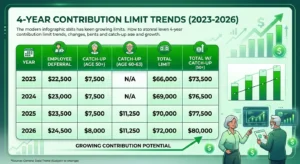
The majority of the sites present two years of data. That hardly suffices to identify a trend. There is the complete four-year picture, so you may see where these numbers are going.
| Year | Employee Deferral Limit | Catch-Up (Age 50+) | Catch-Up (Age 60–63) | Combined Employer + Employee Limit | Combined w/ Catch-Up (50+) |
| 2023 | $22,500 | $7,500 | N/A | $66,000 | $73,500 |
| 2024 | $23,000 | $7,500 | N/A | $69,000 | $76,500 |
| 2025 | $23,500 | $7,500 | $11,250 | $70,000 | $77,500 |
| 2026 | $24,500 | $8,000 | $11,250 | $72,000 | $80,000 |
Not only the bump of last year, but look at the four-year arc here. The total amount that the employee deferral limit increased reached approximately 8.9% in 2023, whereas the combined contribution ceiling increased approximately 9.1% during the same period.
Catch-Up Contributions for Age 50+
There is one unappreciated benefit of 50: the IRS allows you to save more. Quite a lot more, in fact. Your full potential of maximum 401(k) contribution is possible here, and most individuals leave this money unclaimed just by virtue of ignorance of the rules.
The Standard Catch-Up: $8,000
After turning 50 you can contribute an additional 8000 to your regular employee 401K contribution limit. That takes your personal total from $24500 to $32500 in 2026. No particular forms and no additional documents. All that your plan administrator has to do is to have your age on file.
The Super Catch Up: $11250 for Ages 60–63
This is the part that hardly anyone discusses. SECURE 2.0 workers aged 60, 61, 62 or 63 qualify for an even bigger catchup: $11,250 instead of $8,000. That adds up to making your overall employee contribution at the end of the year to be $35750.
Turn 64? You fall to the regular $8,000 catch-up. This is a slender window, and when you are in it, take advantage.
Who Actually Qualifies?
Check through the following before you think you are qualified:
- Are you 50 or older this calendar year? If yes, you qualify for at least the standard $8000 catch-up.
- Will you turn 60, 61, 62 or 63 by December 31? If yes, you qualify for the $11250 super catch-up instead.
- Did you earn $150,000+ in FICA wages last year? If yes, your catch-up contributions must go into a Roth account, not a pre-tax account.
- Do your employers plan to offer catch-up contributions? Not all plans do, and check your plan documents first.
That third question is the most high-earner stumbling block among all the rules in this guide. Not having it doesn’t only cost you a tax break. It may cause IRS correction penalties if your plan records the contribution incorrectly.
The decision path can be followed in brief as illustrated below:
NEW: Mandatory Roth Catch-Up Rule for High Earners in 2026
It is here that the change is catching thousands of high earners off guard this year. New Catch-Up Rules become effective starting January 1, 2026, under SECURE 2.0, and where your additional retirement savings can legally be held.
Your catch-up contributions can no longer be held in a pre-tax 401(k) if you are 50 or over and received over $150,000 in FICA wages last year with your current employer. Instead, they have to deposit them in a Roth 401(k). It is not a box you can check when enrolling. It is compulsory, and mistakes in it are subject to corrections by the IRS.
How the New Catch-Up Rules Actually Work
These Catch-Up Rules have a simpler mechanism behind them than they may be made to sound by the language of the law. The IRS considers only a single number: your FICA wages on your Box 3 W-2 of last year, that is, on your current plan sponsor.
Cross $150,000 in 2025? Any catch-up dollars you will put in 2026 will be subject to tax in Roth rather than when you retire. Remain below that level? You still have the ultimate choice of pre-tax or Roth, as before.
The One-Year Lookback Trap
Here, job switchers find the Catch-Up Rules interesting. The lookback just considers those wages that are earned with your current employer. Join the company in July with no prior FICA earnings and this company, and you will not be subject to the requirement that year, no matter what your salary that year is.
Take a 62-year-old earning $250,000 who joins a new company in mid-2026. Since such an employer contributed nothing to their account in 2025, the Roth requirement is not applicable until 2027, when a year of full wages has been established.
When Your Plan Doesn’t Offer Roth
It is the fact that causes more people to become confused than any other aspect of these Catch-Up Rules. When your employer does not even offer the Roth option in his or her 401(k) plan, then high-earning employees who are required to take this option cannot make any catch-up contributions at all. Not defaulted to pre-tax. No more entry, no entry.
Why Payroll Accuracy Matters More Now?
Just as the IRS uses the Catch-Up Rules to ensure that the right people contribute the right amount at the right time, businesses that are lagging on their own records may require a Catch-Up Bookkeeping to be implemented before the year-end filings come. The fact is that messy payroll records make these rules even more difficult to implement properly, and a single misclassified contribution can create costly corrections in the future.
Your Future Starts with 401k Contributions Today
401(k) and Roth 401(k) Contribution Limits
Here is one of the confusions that even seasoned savers confuse. There are no two buckets of Roth and traditional with two different limits. They have a single ceiling. The first fact you need to know about the 401k and Roth 401 k contribution limits is this: no matter how you divide your funds between the two types of accounts, the IRS limits you to $24,500 to contribute to either account by 2026.
One Limit, Two Tax Treatments
How you split your contributions does not matter to your employee elective deferral limit. Put $15,000 in Roth and $9,500 in traditional, and you’ve hit your full $24,500. Place in a single account all of the 24,500, and the same. It is the total, not the split, that is followed by the IRS.
The difference is actually when you pay taxes and not the amount you can save.
Traditional 401(k): Pay Later
The traditional 401(k) contribution limit works on a pretax basis. Money flows in before taxes, reducing your taxable income today. You will pay income tax in the future when you draw money in old age. This is most effective when you are anticipating a reduced tax bracket upon retirement.
Roth 401(k): Pay Now
The Roth 401k contribution limit reverses that schedule. You are contributing after-tax funds now, thus no initial tax credit. But tax-free, growth included, qualified withdrawals in retirement are withdrawn in full. Roth can frequently triumph in the long run when you are still in the workforce and pay a reduced tax rate now than you will pay in the future.
Splitting Your Contributions Strategically
Too many savers do not choose only one. One popular strategy: Make adequate pretax contributions to reduce your current tax rate, and then transfer the remainder to a Roth to grow tax-free. It is only necessary to remember that both streams use the same $24,500 pool, so have a close look at the amount contributed to both streams.
Combined Employer + Employee Contribution Limits
The majority of the population just monitors their deductions in paychecks. You are wrong, since the IRS actually puts a limit on something larger: the total amount of money into your account from all sources put together. This employer + employee contribution limit is $72, 000 in 2026, and this includes all of your salary deferrals, employer contributions, profit-sharing, and after-tax contributions.
What Actually Counts Toward the $72,000 Cap?
That is only a portion of your employee deferral, which is $24,500. At the top of the list comes employer contributions:
- Your regular deferral (pretax or Roth)
- Employer matching contributions
- Employer profit-sharing contributions
- After-tax (non-Roth) contributions, if your plan allows them
Sum it all up and you have a limit of $72,000. Enter into the catch-up zone, and then it is $80,000 or $83,250, respectively, based on your age group.
Income Limits & Highly Compensated Employees (HCEs)
Make more money, and the regulations surrounding your 401(k) begin to change. The IRS refers to this as the highly compensated employee (HCE) classification because retirement plans shouldn’t be disproportionately funded by top earners. Just as Catch-up Bookkeeping Services for Small Businesses help business owners keep their finances accurate and compliant, understanding these 401(k) rules can help you maximize retirement savings while staying within IRS guidelines.
Who Actually Qualifies as an HCE
You are an HCE in 2026, when either of the following applies:
- You earned more than $160,000 in FICA wages during 2025 (the prior-year lookback applies here too)
- You owned more than 5% of the business at any point during the current or preceding year, regardless of income
People can fall victim to that ownership test. A part-time worker who has a family business with 6% ownership and an annual salary of $60,000 is still classified as an HCE.
Why Does Nondiscrimination Testing Exist?
Actual Deferral Percentage (ADP) and Actual Contribution Percentage (ACP) tests are conducted yearly. Simply put, these tests put the contribution made by HCEs on par with the contribution made by everybody else. In case HCEs save significantly higher than non-HCEs do, the plan fails the test.
Failed tests have real ramifications. The excess contributions can be refunded to HCEs, in some cases, half-yearly, which can ruin the savings plan the HCEs had.
The $360,000 Compensation Cap
In addition to the HCE classification, the IRS also limits the number of units of total compensation that will be counted in determining contributions. For 2026, that limit is $360,000. Earn more than that, and your employer has a legal obligation not to base your contribution to a match or profit-sharing on income beyond the cap, even when your actual salary is greater.
A surprisingly frequent payroll mistake is to get the HCE classifications wrong, particularly when the business is expanding. Firms that are cleaning up years of misreported compensation records commonly resort to Effortless Catch-Up Bookkeeping to get the records up to date before an audit uncovers the difference.
Solo 401k and Self-Employed Contribution Limits
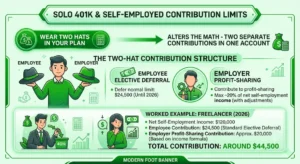
Self-employed? You have a chance to wear two hats in your own retirement plan and that alters the math. A solo 401k also allows you to make two separate contributions in one account, as an employee and as an employer.
The Two-Hat Contribution Structure
You, as the employee, can defer to the normal limit of $ 24,500 until 2026 just like anyone. However, as the employer, you are also permitted to contribute to profit-sharing, usually to a maximum of 20% of your net self-employment income, with some adjustments.
Worked Example: Freelancer Earning $120,000
Assume that in 2026, you are a freelance consultant with net self-employment income of $120,000.
- Employee contribution: $24,500 (the standard elective deferral)
- Employer profit-sharing contribution: approximately $20,000 (roughly 20% of adjusted net self-employment earnings, though the exact formula factors in your self-employment tax deduction)
- Total contribution: around $44,500
What Happens If You Over-Contribute?
The amount that exceeds the deferral limit of $24,500 is considered excess deferral by the IRS. Until April 15 of the next year, you have time to withdraw the excess and any earnings, or you will be subject to double taxation: one at the time of the contribution, and another at the later time of withdrawal in retirement.
How to Maximize Your 401(k) Contributions in 2026?
To reach the entire $24,500 limit, one has to do it by choice rather than by chance. The following is how to get there.
Start Contributing Early in the Year
Make contributions in advance, where possible. The January investment of money has eleven additional months to appreciate in comparison to the December investment. This timing difference grows into real dollars over a 20-year horizon.
Capture the Full Employer Match First
Eat a free lunch. Contribute at least that 6% even when your employer matches half up to 6% of that salary. It is the most prevalent retirement-planning error: to skip the match.
Increase Your Rate by 1% Annually
Increase your contribution percentage by only 1% annually, preferably with an increase so that you never notice the difference in your take-home pay. This incremental method takes the majority of savers to the maximum limit in between five and seven years without strains of money.
Track Old 401(k)s From Previous Employers
The old job forgotten accounts are not included in your current contribution limit, but they do have an impact on your retirement image. Combine them with a direct rollover to make it easier to trace them and prevent duplication of fees.
Stack an HSA on Top
In case you are on a high-deductible health plan, an HSA presents triple tax benefits: pretax, tax-free savings, and tax-free withdrawals in the event of medical expenses. In 2026, your HSA limits are independent of your 401k limit, providing you with an additional tax-favored allocation to fund.
Explore Mega-Backdoor Roth and Solo 401k Options
When you get the option to make after-tax contributions in your plan, consider the mega-backdoor Roth strategy discussed earlier in this guide. If you’re self-employed and earn additional income, a Solo 401(k) lets you contribute as both an employee and an employer, significantly increasing your overall contribution limit. For personalized retirement and tax planning, Outsourced Accountants USA can help you choose strategies that align with your financial goals.
Frequently Asked Questions
How much is the 401k contribution limit in 2026?
The employee deferral limit is $24,500, up $1,000 from $23,500 in 2025.
What is the 401k catch-up contribution limit for 2026?
Employees aged 50 and above will be able to add an amount of $8,000, which will make their total to $32,500.
What is the super catch-up of age 60-63?
Workers turning 60, 61, 62, or 63 this year get an $11,250 catch-up, totaling $35,750.
Is the same limit of Roth and traditional 401(k) contributions?
Yes. They both have a common limit of the same employee deferrals of $24,500, no matter how you divide it between the two.
What is the income limit of mandatory Roth catch-up contributions?
Have wages of over 150 in FICA in the previous year, your catch-up contributions will be Roth beginning in 2026.
What is the scenario in case I add up to more than the 401(k) limit?
You will need to remove the surplus as well as the earnings before April 15 of the next year or you will be taxed twice on the surplus.
Are self-employed individuals able to make greater contributions to a solo 401(k)?
Yes. Self-employed people pay as an employee to a maximum of $24,500 and as an employer (profit-sharing), and in many cases, significantly more than the normal deferral limit.