

Each paycheck has two stories: the amount an employee gets paid and the amount that gets deposited into their financial account. Payroll deductions fill that gap. Even one paystub usually contains six or seven individual withholdings before the final deposit. Some of them are required by federal law and employers provide others as benefits. This blog disaggregates what an employee is deducted, the reason behind the deductions and the underlying calculations, using more recent figures of 2026 rather than the old estimates.
What Are Payroll Deductions?
Payroll deduction is a deduction made by an employer from the gross salary of the employee before issuing a paycheck. There are four main reasons why employers do not deduct payroll deductions: taxes, court orders, retirement savings and insurance premiums. The gross pay is the amount on an offer letter; the net pay is what actually gets to a checking account. The gap between gross pay vs net pay will be determined solely by the number of deductions to be paid on that employee.
Deduction is divided into two types in the law and any business must know both:
- Mandatory deductions: required by federal, state or court law.
- Voluntary deductions: at the discretion of the employee typically based on benefits.
Each deduction required or optional also qualifies under one of the tax-timing categories: pre-tax or post-tax. That difference alters the amount of money an employee really owes to the IRS, a breakdown of which is detailed in the following section.
What’s the Difference Between Mandatory and Voluntary Deductions?
They are required to make mandatory deductions out of all paychecks and voluntary deductions can only be made out of all paychecks when the employee agrees to them on paper. This one rule distinguishes the two payroll deduction types and confusion between them is the biggest source of most small-business compliance errors.
Mandatory Deductions (Taxes You Can’t Skip)
Federal and state programs are financed by mandatory deductions and employers are liable to legal action when they are incorrect. Federal income tax, state and local income tax, Social Security tax, Medicare tax and court ordered garnishments are the five typical types of mandatory payroll deductions.
Social Security tax deduction remained at 6.2% in 2026 but the taxable wage base did not. The Social Security Administration raised the 2026 wage base to $184,500 up from $176,100 in 2025 and a 4.8% jump in a single year. When the amount of the annual wages earned by an employee exceeds that amount, a withholding in Social Security ceases throughout the remaining calendar year.
Medicare tax operates differently. Employers do not pay 1.45% of all earnings but do not limit the amount of wages. With a total of 7.65% of gross wages, Social Security and Medicare comprise the payroll tax deduction called FICA and employers must contribute the same sum on a dollar-to-dollar basis. There is one more layer to the high earners: when the amount of wages exceeds $200,000 single filer or $250,000 jointly with the spouse, the IRS adds 0.9% Medicare Tax. Employers withhold this extra amount but don’t match it.
Federal income tax withholding follows seven tax brackets in 2026: 10%, 12%, 22%, 24%, 32%, 35% and 37%. The highest rate is on only taxable income exceeding $640600 in single filers and 768600 in married couples who are jointly filing their income tax returns. The majority of employees have never reached that income level.
The amount of income tax withheld by the state differs by place and not only by tax bracket. Eight states do not collect state income tax at all like Alaska, Florida, Nevada, New Hampshire, South Dakota, Tennessee, Texas and Wyoming. The rest of the states have their own rates which can be either a straight percentage or a graduated system resembling the federal one.
2026 Mandatory Payroll Tax Rates
| Deduction | Rate | Wage Base or Threshold | Who Pays |
| Social Security | 6.2% | $184,500 | Employee + employer match |
| Medicare | 1.45% | No cap | Employee + employer match |
| Additional Medicare Tax | 0.9% | Over $200K single / $250K joint | Employee only |
| Federal Income Tax | 10%–37% | Based on the income bracket | Employee |
| State Income Tax | 0%–13%+ | Varies by state | Employee |
Mandatory garnishments are completed by court-imposed garnishments. Whenever an order is issued by a court or agency, employers are compelled to withhold wages on unpaid child support, defaulted student loans, alimony or federal tax debt. The Consumer Credit Protection Act restricts the creditors’ claim on a single paycheck, and it guarantees employees against dismissal due to one garnishment.
Get accurate payroll deductions handled and talk to us.
Voluntary Deductions (Benefits Employees Choose)
Deductions made voluntarily never withdraw any paycheck without the written permission of the employee. Health, dental and vision insurance premiums; 401(k) or IRA retirement contributions; Health Savings Account and Flexible Spending Account contributions; union dues and commuter benefits are all common voluntary payroll deductions. Employees choose them upon open enrollment or onboarding, and employers are required to show each deduction, as well as the amount deducted so far, on every paystub.
Companies that do this manually can easily lose hours of their time to reconcile elections with paychecks per pay period. Affordable Payroll Services for Small Businesses has automated that reconciliation so that nothing gets through in the open enrollment season.
Which Deductions Apply to Employers vs Employees?
Deductions are calculated, withheld and paid by employers and the employees only see the end product in their pay stub. Employee payroll deductions lower take-home pay by direct reduction whereas employer payroll deductions are the independent duty of the employer to contribute equal FICA taxes. In addition to providing unemployment insurance over and above the wages of an employee, which the employee does not see taken out of their own paycheck.
This difference is important to budgeting. The employer who pays a $50,000 salary does not necessarily pay out $50,000 in salary but they must also pay about 7.65% in matched FICA tax, as well as federal and state unemployment insurance. Companies that lose sight of this latter layer will find themselves with shortfalls only after the Financial Statement & Tax Preparation work shows the difference between them at the end of the year.
What’s the Difference Between Pre-Tax and Post-Tax Deductions?
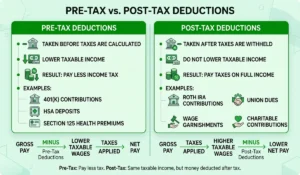
Pre tax deductions are calculated first and then the taxes are calculated then post-tax deductions are calculated last. That one sequencing choice is altering the tax bill of an employee on an annual basis.
Pre tax payroll deductions lower the taxable income prior to the IRS calculating the federal, state or FICA tax. A 401 (k) contribution, an HSA deposit or a Section 125 health premium are all qualifiers. Since these amounts are never taxed as taxable wages, an employee with a pre-tax contribution of $5,000 who makes a pre-tax income of $60,000 only pays income tax on $55,000. Pre tax deductions also reduce the federal and state unemployment tax that an employer is liable to, as they are computed using the same reduced wage base.
The deductions after taxes are opposite. Contributions to Roth IRA, union dues, wage garnishments and charitable contributions are all excluded after taxes are withheld. Hence would not impact taxable income but would lower net pay.
Pre-Tax vs Post-Tax Deductions
| Category | Examples | Lowers Taxable Income? | Employee Can Decline? |
| Pre-Tax | 401(k), HSA, FSA, Section 125 premiums, commuter benefits | Yes | Yes, except statutory items |
| Post-Tax | Roth IRA, union dues, garnishments, charitable donations | No | Yes, except garnishments |
What Order Do Deductions Come Out In?
The steps of deductions are strictly followed by the law and it is dangerous to omit a step. The order in which employers withhold is as follows: mandatory taxes, court-ordered garnishments, voluntary pre-tax deductions, and voluntary post-tax deductions. The order is necessary since federal and state tax liabilities will always prevail over the personal election of an employee and garnishment orders are legally binding, whereas voluntary benefits are not.
How Do You Calculate Payroll Deductions?
Payroll deductions are computed by beginning with gross pay then subtracting each compulsory or voluntary amount in this order until the net pay. The following is a real-world example with 2026 tax rates of an employee who will earn $3,000 a month, paid biweekly.
Sample Paystub and $1500 Gross Biweekly Pay
| Line Item | Amount |
| Gross Pay | $1,500.00 |
| Social Security (6.2%) | –$93.00 |
| Medicare (1.45%) | –$21.75 |
| Federal Income Tax (per W-4) | –$135.00 |
| 401(k) Contribution (5%, pre-tax) | –$75.00 |
| Net Pay | $1,175.25 |
The employer of this employee remits taxes of $249.75 to the federal and state agencies and deposits $75 in a retirement account, all of which the employee does not even see the rest of the $1,175.25. Companies fixing years of wrongly calculated withholdings on behalf of their employees can hardly fix the issue with a single paycheck. They usually require complete catch-up bookkeeping to match all of the previous pay periods with what the IRS actually demanded.
What Mistakes Do Employers Make With Payroll Deductions?
The most common failure by employers is to provide the pre-tax benefits that do not comply with the Section 125 requirements, fail to make the garnishment payments on time or neglect to obtain written permission regarding voluntary deductions. All the mistakes have varying consequences yet they all expose the IRS.
The greatest threat is payroll withholding which is collected by an employer but not paid. The act 26 U.S.C. § 7202 provides that an employer who fails to willfully collect or remit payroll tax is guilty of a felony, which is subject to a fine and up to five years of imprisonment. In addition to criminal exposure, the IRS may impose the Trust Fund Recovery Penalty, which would impose personal liability on the individuals who are responsible for the 100% payment of the amount. Companies that have to manage multi-state compliance usually combine Sales Tax Advisory Services with payroll management to ensure that all tax returns, not only payroll, are submitted properly and timely.
What Do Paystub Deduction Abbreviations Mean?
Paystub abbreviations are the use of a few letters to represent a complex tax term for which most employees are never told what they represent.
Common Paystub Abbreviations
| Abbreviation | Meaning |
| FICA | Federal Insurance Contributions Act (Social Security + Medicare) |
| FIT / Fed W/H | Federal Income Tax Withheld |
| SIT | State Income Tax |
| SUI | State Unemployment Insurance |
| Sec125 | Pre-tax Section 125 cafeteria plan deduction |
| YTD | Year-to-Date |
Which Payroll Deductions Are Mandatory?
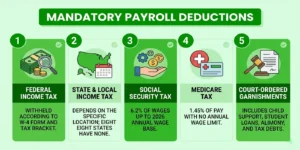
The law mandates deductions, which are mandatory and taken out of each paycheck, whether the employee agrees or not. Five common types are:
- Federal income tax: withheld according to W-4 and tax bracket of 2026 (10%-37%) of the employee.
- State and local income tax: depends on the state; eight states have none now.
- Social Security tax: 6.2% of wages up to the 2026 wage base of $184500
- Medicare tax: 1.45% of pay and no annual limit.
- Court ordered garnishments: include child support, defaulted student loans, alimony or unpaid federal tax debt.
Any employer that omits or calculates incorrectly any of these is personally liable for the difference. Therefore accuracy cannot be compromised at any given pay period.
How Do Payroll Deductions Affect Take-Home Pay?
Payroll deductions help to calculate the precise difference between gross and net pay and that difference increases with each withholding. The employee with a monthly salary of $1,500 would be deprived of $93 to Social Security, $21.75 to Medicare and about $135 to federal income tax before voluntary benefits could ever come into play. Add a 5% 401(k) contribution, and take-home pay drops to $1,175.25, a 21.6% reduction from gross wages.
Clearly explaining this breakdown to the employees would allow the employers to help the employees plan their budgets with little surprises and the number of payroll disputes would be reduced due to misunderstandings in the paystub math.
Conclusion
Each paycheck is an embodiment of dozens of minor court rulings that occur way before the check is cashed. Knowing every payroll deduction safeguards the employee who reads their paystub and the employer who pays the correct amount in the paystub. Companies that desire precision processing, tax withholding to benefit choices and use Payroll Management Services of Outsourced Accountants to maintain all deductions in compliance, per pay period.
Frequently Asked Questions:
What are payroll deductions?
Payroll deductions are sums of money an employer removes from the gross wages of an employee to pay either taxes, benefits or ordered payments of a court but does not give out a paycheck.
Whats the difference between pre-tax and post-tax deductions?
Pre tax deductions are calculated before taxes are due and reduce taxable income then post-tax deductions are calculated after taxes are withheld and only decrease net pay.
Is it possible to make an employee choose that no payroll deductions be made?
No. Employees may refuse voluntary payments such as retirement funds or additional insurance but they must pay the mandatory taxes and garnishments ordered by the court whether they want to or not.
What is the wage base of the 2026 Social Security?
The Social Security wage base in 2026 will be $184,500 which is an increase of 4.8% compared to $176,100 in 2025 stated in Social Security Administration.
Are tax deductions and payroll deductions the same?
No. Payroll deductions are taken out of a paycheck at the end of every pay period whereas tax deductions are later on top of an annual tax filing to reduce taxable income.
What will occur when an employer makes the wrong deduction amount?
The employer is liable for the shortfall, and habitual or intentional mistakes may result in IRS penalties, such as the Trust Fund Recovery Penalty for trust fund tax nonpayment.







One Response