

The Annual Gift Tax Exclusion 2026 is $19000 per person or $38000 in the case of married couples who divide gifts. That one figure provides an answer to the question that all people ask every year in January: how much cash can you give a child, grandchild or friend without the involvement of the IRS?
This guide breaks down what is the annual gift tax exclusion for 2026, how the limit operates and where it fits within the larger lifetime exemption framework.
What Is the Annual Gift Tax Exclusion?
What Is the Annual Gift Tax Exclusion? It refers to the amount of money that one can give to another every year without submitting a gift tax form or using up his lifetime exemption. IRS considers a gift tax exclusion to be different than a gift tax exemption. An exclusion has an expiry date of January 1. An exemption is a cumulative amount that is not refunded. Congress is making the exclusion related to inflation and as such, the figure can only change when inflation adjusts it beyond a mark of $1,000. This threshold was not achieved and the number remains at $19000 in 2026 which is the same as in 2025.
This difference is important with regard to financial planning. The same parent provides a transfer of $19,000 to three children, taxes of $57,000, spends a year and claims nothing to the IRS. This could be repeated annually by the same parent, without filing Form 709, transferring a substantial amount of wealth out of a taxable estate.
What Is the Gift Tax Limit 2026 for Individuals and Couples?
Gift Tax Limit 2026 is, as one may see, $19000.00 per individual and per beneficiary. Married couples who choose to split gifts can pool their exclusions and transfer $38,000 to one person without any tax impacts. This is regardless of whether the couple transacts in cash, stock, real estate or other property, as long as the aggregate value does not exceed the threshold.
The following table illustrates the trend of this number in the past five years and it provides a good context for those who compare this year’s limit with the past planning decisions.
| Tax Year | Individual Annual Exclusion | Married Couple (Split Gifts) | Lifetime Exemption | Non-Citizen Spouse Limit |
| 2022 | $16,000 | $32,000 | $12.06 million | $164,000 |
| 2023 | $17,000 | $34,000 | $12.92 million | $175,000 |
| 2024 | $18,000 | $36,000 | $13.61 million | $185,000 |
| 2025 | $19,000 | $38,000 | $13.99 million | $190,000 |
| 2026 | $19,000 | $38,000 | $15 million | $194,000 |
The annual exclusion has climbed from $14000 in 2013 to $19000 in 2026. It is a 35.7% growth in about ten years and is almost entirely inflation adjustment under the Internal Revenue Code Section 2503b. The lifetime exemption tells an even larger story: it increased to 173%, growing to $15 million in 2026, the first due to the Tax Cuts and Jobs Act and the second to the One Big Beautiful Bill Act signed in July 2025.
How Does the 2026 Gift Tax Annual Exclusion Work?
The 2026 gift tax annual exclusion applies on a per recipient basis and not on a per giver basis. A ten-grandchild donor gives each child $19,000 and transfers a total of $190,000 tax-free without any filing with the IRS. The exclusion has no limit on the number of people that a donor may give to; it simply has a limit on the amount per capita, per year.
The gift tax annual exclusion 2026 covers cash, publicly traded stock, real estate equity and most other types of property and is determined at fair market value on the transfer date. There is a wrinkle to gifts of appreciated stock, which is that the recipient will inherit the original cost to the donor, or the so-called carryover basis, but not the value at the time of the gift. The stock purchased at $50,000 and given to an individual at $250,000 transfers to the beneficiary at $50,000 basis.
When such a recipient sells immediately, he/she has to pay capital gains tax on the appreciation of $200,000 of such capital gains, subject to rates as high as 20%, with an additional potential liability of 3.8% Net Investment Income Tax. Property bequeathed by death, by contrast, gets a step-up to fair market value, and that built-in gain is wholly eliminated. This difference in basis is frequently important to the overall tax bill of the family in comparison to the gift tax exclusion itself.
What Is the Annual Gift Tax Limit for Married Couples?

The annual gift tax limit doubles for married couples by a process called gift splitting. The spouses will have to agree, and the couple has to submit a joint Form 709 in a bid to elect the split officially even in the event that no tax is due. This provision allows for the entire gift of $38000 funded by one of the spouses using a personal account yet credit the use of their personal exclusions is given to both spouses.
In community property states, such as Texas, California and Arizona, couples frequently receive split-gift treatment by default, as community property is already viewed as property jointly owned. In separate-property states, couples should have the formal election on Form 709 to attain the same outcome.
How Does the Annual Exclusion Relate to the Lifetime Gift Tax Exemption?
Gifts will not create an immediate tax on gifts in excess of the annual exclusion. Rather, the excess cuts the lifetime gift tax exemption of the donor, which is a unified credit between gift tax and estate tax. The lifetime estate and gift tax exemption will be $15 million apiece in 2026, and it implies that a donor can transfer that amount during their lifetime or at death without incurring any federal transfer tax.
| Gift Given in 2026 | Annual Exclusion Applied | Taxable Excess | Remaining Lifetime Exemption |
| $250,000 | $19,000 | $231,000 | $14,769,000 |
| $500,000 | $19,000 | $481,000 | $14,519,000 |
| $1,000,000 | $19,000 | $981,000 | $14,019,000 |
When the gift is given to more than one person and the gift is above $19,000, then the donor should file Form 709 by April 15 of the following year. To file is not to pay. The IRS merely follows up on the amount of the lifetime credit of $15 million that has been used. The Tax Policy Center estimates that less than 0.2% of estates in the United States pay any federal estate tax at the current exemption levels. It indicates how infrequently this system actually creates a tax bill for an average family.
What Gifts Are Exempt from the Gift Tax?
Various transfers are not subject to the gift tax system at all and do not come in contact with the annual exclusion or the tax-free gift limit. These include:
- Beauty and an infinite gift to a spouse who is a U.S. citizen.
- Paying tuition to a school rather than to an individual student.
- Healthcare costs that are paid to a hospital, physician or insurance company.
- Giving to qualified 501(c)(3) organizations as a charity.
- Campaign or committee’s political contributions.
The direct-payment rule is important in this case. A grandparent who sends a university $40,000 in tuition, who sends it directly to the bursar’s office of the school, makes no use of the annual exclusion. The same $40,000 given to the grandchild initially, followed by giving to the school, is considered a 100% taxable gift. The IRS gift tax rules approach these two dealings in totally different ways, although the funds are deposited in the same location.
Gifts to a spouse not a U.S. citizen are not subject to the unlimited spousal exclusion. They are instead subject to an additional annual ceiling of $194,000 in 2026, compared with 190,000 in 2025, due to non-citizen spouses not being automatically subject to the U.S. estate tax and may instead transfer wealth outside the system.
Superfunding of 529 plans provides education savings with a special boost. By completing an election on Form 709, a donor can front-load five years of annual exclusions in a single contribution to the maximum in 2026 which is $95000 per beneficiary. The donor is not allowed to make that beneficiary more annual exclusion gifts within five years without tapping into the lifetime exemption.
Annual Exclusion vs. Lifetime Exemption: What Is the Real Difference?
The annual exclusion and the lifetime exemption address two distinct issues and mixing them up results in needless Form 709 filings or lost planning opportunities. The two mechanisms are divided in the table below.
| Feature | Annual Exclusion | Lifetime Exemption |
| 2026 Amount | $19,000 per recipient | $15 million per donor |
| Resets Yearly? | Yes, every January 1 | No, cumulative over a lifetime |
| Filing Required? | No, if gifts stay under the limit | Yes, once the annual limit is exceeded |
| Shared with Estate Tax? | No | Yes, one unified credit |
| Number of Recipients | Unlimited | Applies across all recipients combined |
The annual exclusion is automatically used each year by a donor and requires no paperwork. The lifetime exemption is not applicable until a single gift to an individual goes over the mark of $19,000. Conflating the two limits leads to two fallacies: one making a filing of Form 709 when a gift has not exceeded $19,000, when it should not have been; and the other assuming that a large one-time gift is tax-free because gifts are not subject to tax, when such an assumption actually harvests the $15 million lifetime credit, not the 19,000-limit credit.
Common Mistakes to Avoid When Using the Annual Gift Tax Exclusion
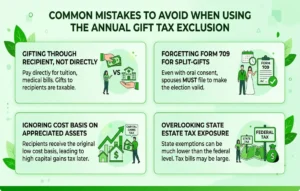
The most frequent way families lose value by planning is by making avoidable mistakes and not by the complexity of tax law. There are four recurring errors:
- Gifting through the recipient instead of directly. Any gift to a grandchild of $30,000 to cover his tuition will be considered a full gift that is taxable. Using the university directly will not involve the gift, however many it might be.
- Forgetting to file Form 709 after a split-gift election. Even married couples that orally consent to divide an amount of $38,000 as a gift must have the joint filing in order to have the election valid in the eyes of the IRS.
- Ignoring cost basis on appreciated assets. The transfer of stock or real estate that has appreciated in value significantly as a gift transfers the original cost of the purchase to the recipient, which can leave a bigger future capital gains bill than anticipated by the family.
- Overlooking state estate tax exposure. Even with a donor who is comfortable with a federal exemption of less than $15 million, the state estate tax bill may still be approximately an amount of $1 million to $2 million.
Why Did the IRS Gift Tax Exclusion Limit Change for 2026?
The IRS gift tax exclusion limit as of 2026 remained the same as that of 2025 but the federal gift tax limit on lifetime transfers increased drastically. The exclusion was at $19000 according to IRS Revenue Procedure 2025-32 which was issued in October 2025 and the annual figure was not increased beyond its next increment of $1000 due to inflation.
The federal gift tax exclusion of a lifetime transfer was treated differently since the One Big Beautiful Bill Act, signed into law in July 2025, permanently increased the base exemption and eliminated the sunset that the exemption was previously facing, potentially reducing the exemption by roughly half by 2025.
This leaves an odd planning climate. The exemption of the gift tax exemption of 2026 which was $15 million now has no expiry date and remains indexed with inflation in the future. Donors who rushed big donations in 2025 to avoid an anticipated cap will now be able to make gifts with a longer deadline without the same urgency, but state-level regulations still exist. Eleven states and the District of Columbia have their own estate tax, much lower in exemption levels than the federal amount and sometimes as low as $1 million to $2 million. Citizens of those states cannot believe that federal numbers cover them on the state level.
Start your 2026 gift tax planning today!
How Should You Plan Around the Annual Gift Tax Exclusion Limit 2026?
The annual gift tax exclusion limit for 2026 is effective as a disciplined approach to a repeat strategy and not a one-time transfer. Gifting families that do so annually shrink a prospective taxable estate and help their children and grandchildren through their working or school years when the money is most needed.
Some of the habits that work better are:
- Gift funds early in the calendar year instead of in December; therefore, the cash has a longer period to grow outside the estate.
- Record all gifts on paper, the recipient, date and fair market value to prevent confusion when filing.
- Give a much larger estate, as the annual gift tax exclusion limit is directly interrelated with the wills, trusts, and business succession plans.
- Review the plan yearly, since the annual tax-free gift amount and tax-free gift limit 2026 can shift with inflation or new legislation.
It is particularly important to keep records when a family transfers business interests or real estate and does not transfer cash. Knowing the distinction between a Controller vs Bookkeeper assists families in determining who is best to track these transfers within the organization. A controller usually monitors the type of strategic reporting a multi-year gifting plan needs, whereas a bookkeeper would be the one who records the entries of the transactions on a daily basis.
Because gift tax rules 2026 intersect with income tax, estate tax and sometimes state tax simultaneously, many families bring in outside expertise rather than handling filings alone. Tax Management Services can track lifetime exemption usage across multiple years, prepare Form 709 accurately and flag when a gift strategy risks pushing a donor toward the $15 million lifetime ceiling. Firms offering Outsource Accounting Services also help families separate personal gifting records from business books which matters when gifted assets include partnership interests or company shares.
Conclusion
The Annual Gift Tax Exclusion 2026 provides an easy, repeatable transfer of wealth free of federal taxation, provided that gifts do not exceed the $19000 per recipient cap or the $38000 married-couple cap. Whoever intends to do larger transfers ought to be mindful of lifetime exemption utilization and verify state specific regulations prior to deciding how to finalize the yearly gifting approach. Having a team such as Outsourced Accountants ensures that annual gifting, tax returns and long-term estate objectives are aligned on a single coordinating plan.
Frequently Asked Questions
What is the gift tax exclusion amount per year in 2026?
The maximum amount is $19000 per recipient or $38,000 to married couples who share the gifts. This value has remained constant since 2025 due to the fact that inflation has not hit the next adjustment level.
Is the IRS annual gift tax exemption on a per-recipient or a donor basis?
It is used on a per-recipient basis. An example is the case of a donor who is able to provide a donation of up to $19,000 to an unlimited number of individuals within the same year without submitting a gift tax filing.
What is the federal gift tax limit if I exceed $19,000 to one person?
The surplus value lessens the lifetime exemption of $15 million for the donor. There is no tax payable until it runs out of that lifetime exemption.
Are contributions made to 529 plans subject to the tax-free gift limit?
Yes. The contributions to a 529 plan are considered gifts, but there is a five-year superfunding election that permits up to $95 000 per beneficiary in one year.
Does the lifetime gift tax exemption equal the estate tax exemption?
Yes. The gift tax and the estate tax have one common exemption of $15 million per capita in 2026. Gifts that are taxable in life deplete the amount of gifts that can be given at death.
Can grandparents and parents both give the same child $19,000?
Yes. The exclusion is on a donor-by-donor basis, recipient-by-recipient basis. Each parent and each grandparent can give a child up to $19,000 in the same year and no gift tax return is needed by any of the parents or grandparents.
What will be the case when a gift is not reported and it exceeds $19,000?
An audit or a settlement of an estate may still reveal unreported gifts, as large transfers are likely to show up in bank records, property deeds, or brokerage accounts. Submission of Form 709 on or before the deadline prevents fines and maintains the lifetime exception tracking up-to-date.







One Response