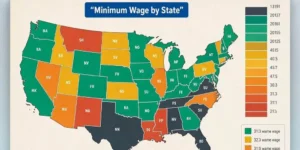
A single missed update of the rate costs businesses thousands in back pay. Minimum Wage By State adjustments for the minimum wage have occurred in 22 states this year in total. The differences between the lowest and highest rates now span more than $11 an hour, with a spread between $7.25 in Alabama and $18.40 in Washington, DC. Payroll teams can no longer afford to guess their way across that gap. This guide includes the 2026 rates for all states, who is raising wages next and what exact compliance will require now, with no airs.
What Employers Need to Know About Minimum Wage by State in 2026?
34 states Washington DC and some US territories will need higher than the federal minimum of $7.25 an hour by July 2026. Two-thirds of the nation is paying over the legal minimum and the figure is steadily increasing each year. The guide breaks down Minimum Wage By State by all 50 states plus DC and the specific rate of this wage in 2026.
Twenty-two of the states are to have an increase in force this year, a figure which most guides cover three pages to bury, had they any reference to it. That timing matters. The rate change you snatch in January is not the same as the rate change you snatch after a payroll run has been dispatched. All businesses that monitor their pay across state borders must have a clear understanding of where their requirements begin and end on a state-by-state basis before the next increment hits.
What Is the Minimum Wage by State in 2026? Federal vs State Baseline
What Is the Federal Minimum Wage in 2026?
The federal minimum wage is $7.25 per hour. That rate was established by Congress in 2009 and there has been no change since that time 17 years without a single change. It is not touched by any inflation formula. It can only be raised by a new law, which has not been passed.
That flat rate is a floor and not a ceiling. States superstructure it and the majority of them go far above it.
When Does a State Minimum Wage Override the Federal Rate?
A state minimum wage of over $7.25 replaces it. The greater of these, thus, becomes due to the employers, full stop; federal law never permits a state rate of dropping pay, but only raises it to the national floor.
This isn’t a minor technicality. According to NCSL, thirty-four states, Washington D.C., and various U.S. territories have a rate higher than the federal minimum. Indeed, the majority of working Americans are already making over $7.25 by law, prior to any employer deciding to pay above the minimum personally. Looking up the current minimum wage rates per state is no longer optional but a minimum compliance test that every multi-state employer runs at least once per pay period.
Which States Have No Minimum Wage Law?
Five states do not have a state minimum wage law like Alabama, Louisiana, Mississippi, South Carolina and Tennessee. Employees in that area just go bankrupt at the federal rate of $7.25 because the state has no law specifying otherwise.
Three additional states make the situation even more complicated. Georgia, Oklahoma and Wyoming do have minimum wage laws on their books but the figures are smaller than those allowed by federal law. Georgia and Wyoming set $5.15. Oklahoma sets $2.00. Both figures apply to any employer within the scope of the Fair Labor Standards Act but are overridden by federal law, meaning that employees in all eight of these states continue to receive the minimum wage of $7.25. The distinction between no law and a lower law that does not apply is important to compliance. It is the type of nuance most guides omit altogether and it is precisely what employers can fall victim to.
See your state’s 2026 minimum wage now.
Minimum Wage by State: Full 2026 Table
There are 50 states, a single district and 51 various responses to the same question. And all the rates are in a single place below, so you never have to go hunting all through 51 government pages to locate yours.
The rates below are based on state minimum wage legislation as of July 1, 2026 and are obtained based on the data provided by the US Department of Labor and the National Conference of State Legislatures.
| State | 2026 Minimum Wage | Notes |
| Alabama | $7.25 | No state law; federal rate applies |
| Alaska | $14.00 | Effective July 1, 2026 |
| Arizona | $15.15 | Indexed annually |
| Arkansas | $11.00 | Indexed annually |
| California | $16.90 | Indexed annually |
| Colorado | $15.16 | Indexed annually |
| Connecticut | $16.94 | Indexed annually |
| Delaware | $15.00 | — |
| District of Columbia | $18.40 | Highest rate in the U.S. |
| Florida | $14.00 | Rising to $15.00 on Sept. 30, 2026 |
| Georgia | $7.25 | State law is $5.15; federal rate applies |
| Hawaii | $16.00 | Rising to $18.00 by Jan. 1, 2028 |
| Idaho | $7.25 | — |
| Illinois | $15.00 | — |
| Indiana | $7.25 | — |
| Iowa | $7.25 | — |
| Kansas | $7.25 | — |
| Kentucky | $7.25 | — |
| Louisiana | $7.25 | No state law; federal rate applies |
| Maine | $15.10 | Indexed annually |
| Maryland | $15.00 | — |
| Massachusetts | $15.00 | — |
| Michigan | $13.73 | Rising to $15.00 by Feb. 21, 2027 |
| Minnesota | $11.41 | Indexed annually |
| Mississippi | $7.25 | No state law; federal rate applies |
| Missouri | $15.00 | Indexed annually |
| Montana | $10.85 | $4.00 for very small businesses under the FLSA threshold |
| Nebraska | $15.00 | — |
| Nevada | $12.00 | Indexing was removed in 2022 |
| New Hampshire | $7.25 | — |
| New Jersey | $15.92 | $15.23 for small/seasonal employers |
| New Mexico | $12.00 | — |
| New York | $17.00 / $16.00 | NYC, Nassau, Suffolk & Westchester vs. the rest of the state |
| North Carolina | $7.25 | — |
| North Dakota | $7.25 | — |
| Ohio | $11.00 | For employers with gross receipts of $405,000+ |
| Oklahoma | $7.25 | State law is $2.00; federal rate applies |
| Oregon | $15.55 | $16.80 Portland metro; $14.55 non-urban counties |
| Pennsylvania | $7.25 | — |
| Rhode Island | $16.00 | — |
| South Carolina | $7.25 | No state law; federal rate applies |
| South Dakota | $11.85 | Indexed annually |
| Tennessee | $7.25 | No state law; federal rate applies |
| Texas | $7.25 | — |
| Utah | $7.25 | — |
| Vermont | $14.42 | Indexed annually |
| Virginia | $12.77 | Indexed annually |
| Washington | $17.13 | Highest state-level minimum wage |
| West Virginia | $8.75 | — |
| Wisconsin | $7.25 | — |
| Wyoming | $7.25 | State law is $5.15; the federal rate applies |
Bookmark this page because we update it every time a state legislature or ballot initiative changes a rate.
What Stands Out in the 2026 Numbers
20 states remain at the same spot on the federal floor at $7.25, and have not changed since 2009. There are 29 others, including DC who earn more than $10 and 19 of them earn more than $15 an hour without question. That’s not a rounding difference, but rather a range between $7.25 and 18.40. A difference between the minimum and maximum legal wage in the country is a $11.15 chasm, and it is why a payroll system designed to work with one state nearly never transfers to three or four.
States Increasing Minimum Wage in 2026
By 2026, 22 states in the United States have passed increases in minimum wages, with Michigan increasing the minimum wage by leaping to $13.73 and Washington increasing the minimum wage to $17.13. That almost doubles the number of pay floors adjusted in one year in half the country.
Here is every state on the list:
- Alaska
- Arizona
- California
- Colorado
- Connecticut
- Florida
- Hawaii
- Maine
- Michigan
- Minnesota
- Missouri
- Montana
- Nebraska
- New Jersey
- New York
- Ohio
- Oregon
- Rhode Island
- South Dakota
- Vermont
- Virginia
- Washington
Why So Many States Are Raising Wages at Once
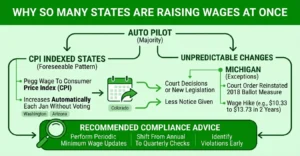
The majority of this minimum wage increase 2026 wave is not a new bill; it’s an automatic pilot. Other states such as Arizona, Colorado, and Washington, peg their rate on Consumer Price Index; thus, the figure automatically increases without voting each January. Michigan is an exception: the increase in its price by $10.33 to $13.73 in two years was not the result of normal indexing but the result of a court decision that reinstated a 2018 ballot measure.
Such a difference is important to anyone who follows state labor laws in more than one place. A scheduled state transition on a foreseeable pattern that you can schedule. A state acting via a court order or by new legislation can change with much less notice. The periodic minimum wage updates to a quarterly compliance check, instead of annual, helps identify both categories of minimum wage violations before they become a payroll issue.
Employer Compliance Requirements for Multi-State Businesses
Multi-state employer compliance is a complex process when trying to keep up with city ordinances and state law. Three rate schedules, three states and a few city minimums were superimposed upon that that’s a typical Tuesday in any business with locales in at least two places.
Which Rate Do You Actually Pay?
You pay the highest amount that can be applied to the physical location of the employee, federal, state or local which prevails. An employee in Denver adheres to the rate of Denver, rather than the statewide rate in Colorado although both are technically applicable. The most prevalent underpayment made by businesses unknowingly is by skipping this check.
How Do Overtime Triggers Change by State?
The majority of states compensate overtime beyond 40 hours per week. California does not wait so long, it goes to overtime after 8 hours in one day, irrespective of the number of hours worked in a week. That difference alone can put a payroll system, based on a 40-hour national default, off.
Do Gross Receipts Change the Rate You Owe?
Yes, in some states. In Ohio, the pay rate that employers are required to pay is $11.00 per hour when they have over $405, 000 gross receipts annually, and $7.25 when the gross receipts are under $405, 000 annually. Montana maintains a nearly identical split: $10.85 to most employers, but $4.00 to very small businesses not subject to FLSA. The employer wage requirements change when your business crosses such lines and therefore, revenue growth will silently alter the amount of money you owe.
What Subminimum Wage Exemptions Still Apply?
There are three categories with lower rates, including student learners in certified programs, workers with disabilities under certain certificates, and new hires under 20 within 90 days of training. The tipped employees introduce a fourth level, the federal law permits a tipped wage of $2.13 when totals with tips reach $7.25 but many states insist on the full minimum wage before any tip credit is taken.
When all four of these types are taken into account, and in all the states you have operations, labor law compliance becomes a significant number of moving parts in one payroll cycle. The state employment regulations do not take a growth break, nor does the audit risk associated with an absence of a threshold. The rate tracking in all of your states, manually, is precisely the type of monotonous payroll compliance task that Professional Payroll Services with Outsourced Accountants is designed to take off of your hands.
Wage and Hour Law Basics: Overtime, Tipped Wages, and Exemptions
The base rate is not the only wage and hour law. The entire picture consists of three parts, namely, the minimum wage itself, the overtime wage, and the exemptions that reduce or eliminate the standard rate of certain workers.
How Does Overtime Interact With Minimum Wage?
Overtime pays 1.5 times the regular rate once an employee crosses a set number of hours. Most states use a 40-hour weekly trigger. California and Colorado break from that model; California requires overtime after 8 hours in a single day and Colorado adds a 12-hour daily trigger on top of its weekly one. An employee working four 10-hour shifts hits overtime in California well before hitting it anywhere else, even at the same weekly total.
How Does the Tipped Minimum Wage Work?
Federal law sets the tipped minimum at $2.13 an hour, as long as tips bring total pay up to $7.25. States are divided into halves by this rule. In California, Washington, and Minnesota, the entire hourly minimum wage must be paid before any tip credit is taken into account and the employers are not allowed to consider the tips at all in relation to the base rate. The other states are based on the federal tip-credit model but establish their own tipped floor, which is higher than that of the federal tip-credit model which is $2.13; hence, it all depends on the state.
Which Workers Fall Under a Subminimum Wage Exemption?
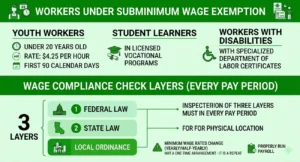
There are three groups with a reduced legal rate. The federal law permits workers who are below 20 years to work at a rate of $4.25 per hour in the first 90 calendar days of the job, which is a full three dollars under the normal federal minimum. The remaining exemptions include student learners in licensed vocational programs, workers with disabilities receiving specialized Department of Labor certificates, each with their own paperwork and eligibility requirements.
Wage compliance right involves inspection of three layers every pay period, namely, federal, state and any local ordinance applicable to the physical location where the employee works. Move it over a layer, and the math appears okay until it is discovered by an audit. Having minimum wage rates by state changing at varying rates (some every year, others half-yearly), that three-layer check isn’t a one-time arrangement. It is a repeat of how to properly run payroll.
How Small Businesses Can Stay Compliant
Small companies that remain alive and well in compliance make it an annual check more of a quarterly routine. State legislatures do not wait until January, a mid-year ballot measure or a court decision can alter a rate with little notice and a business with last year’s figures on its books will not notice until an employee or an auditor does.
Audit Payroll Every Quarter, Not Once a Year
Carry out a rate check not once but four times per year. Whatever workers are paid must be compared to the existing state wage laws wherever they are actually working, not the state where the company is incorporated. A quarterly cycle captures mid-year raises, which then become weeks of undercompensation.
Subscribe to State Labor Department Alerts
Register as a direct subscriber to all state labor departments in which you conduct business. Minimum wage laws do not announce themselves with a press release that most businesses read. They appear in state bulletins, agency mailings and legislative tracking websites but none of them automatically cross post to each other.
Let Software Catch What Manual Tracking Misses
The automatic payroll software that identifies below-minimum pay bridges the gap that a spreadsheet can’t. Manual review-based payroll compliance requires an individual to remember to check and software will verify against the current rate every run against the current location of each employee.
Smaller teams without a dedicated HR department often get the most value from the Best Online Payroll Services for Small Business, since automated rate updates remove the guesswork entirely.
What Happens If You Don’t Pay Minimum Wage? The Real Cost of Getting It Wrong
Minimum wage payment not only increases the wage disparity but it doubles it. The Fair Labor Standards Act allows the Department of Labor to collect all back wages and the same amount of liquidated damages, such that a $10,000 underpayment would become a $20,000 bill before any penalty is added to it.
How Much Can the DOL Fine an Employer?
Between $2,515 per violation, starting in 2026, for a repeat or willful minimum wage violation is found. That number is adjusted each year to inflation according to federal law, and it is per employee, not per case. The business that paid less than it was legally required to pay 15 workers in six months is not facing a $2,515 fine. It is considering 15 individual ones, which are in addition to the back pay and liquidated damages already due.
How Far Back Can an Employee Claim Unpaid Wages?
Two years, generally. That is a three-year window, should the violation be considered to be willful, i.e. the employer was aware of the underpayment or had a careless attitude to whether the underpayment was legal. States frequently go much further, with California and New York both permitting employees to recover back pay as far as three years (or more) back, far beyond the federal minimum period.
Do Most Employers Actually Get Fined?
Rarely and that is the very reason why it is worth watching. A study by the Peterson Institute of International Economics concluded that 4% of closed cases of minimum wage underpayment in the period 2005 to 2021 incurred a civil monetary penalty most of the violations were by first-time offenders or non-willful violators, who must pay back wages and liquidated damages but not the added penalty. That statistic is encouraging until you realize what it entails: 96% of cases still offered full back pay with doubled damages. The exception is the fine. The obligation to pay back is rare.
Minimum Wage by State: What to Do With This Information
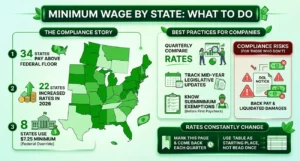
The federal floor is paid above in thirty-four states. In 2026 alone, 22 states increased their rate. Eight states continue to use the bare minimum of $7.25, either by no state law or a lower one federal rules override. All the compliance story is in those three numbers, and none of them remain constant.
The companies that do this well do not take it as an annual search. They compare location rates each quarter, keep an eye on mid-year legislative developments and can tell precisely which of the four subminimum exemptions could be in effect before a first paycheck is issued to a newly hired employee. The companies that do not get it right do not generally discover the error until back pay, enhanced by liquidated damages, sprouts on a DOL notice.
Rates will continue to change state to state, city to city and year to year. Mark the page and come back each quarter before it ends and use the table above as a starting place, not a read once only.
Frequently Asked Questions
What is the federal minimum wage in 2026?
The minimum wage in the United States is $7.25 an hour on a federal level. It has not been altered since 2009 -17 years without any increase as only Congress has the power to increase it.
What is the minimum wage in the highest state in 2026?
Washington has the highest state rate of $17.13 an hour. Washington DC, has a higher total expenditure of $18.40, but since it is a District and not a state, Washington remains at the top of the actual states.
What states do not have a minimum wage?
There is no state minimum wage law on the books in Alabama, Louisiana, Mississippi, South Carolina, and Tennessee. Employers in the five states default to the federal rate which is $7.25.
What number of states will have increased minimum wage in 2026?
In 2026, a minimum wage rise is planned in 22 states with most being automatically inflation-indexed, but not newly enacted.
Do all employers have to pay the state minimum wage?
Generally, yes. Small employers who have gross receipts below the gross-receipts level of a state and some work not subject to the FLSA and certain subminimum groups such as student learners or trainees in a training program, are exceptions.
What is the minimum wage of tipped employees?
Federal minimum wage is the tipped minimum of $2.13 an hour, provided that the total compensation does not exceed $7.25. Most states have a higher tipped floor than the federal floor and others such as California and Washington, do not have the tip credit at all but impose a full minimum wage before any tips are counted.
Is there an automatic increase in the federal minimum wage?
No. It needs Congressional action to increase it and none has done so since 2009. Some states operate in different ways. They base their rate on the Consumer Price Index and therefore increase each year, without the need to pass new laws.