
Payroll training is provided to employees, HR staff, and business owners on how to compute wages, withhold taxes, and submit payroll reports to the relevant authorities. Mistakes in payroll cost companies money, trigger IRS fines, and destroy trust among employees. This guide will include the certifications, costs, skills, and career paths that will characterize payroll training in 2026.
What Is Payroll Training?
Payroll training is formal training that teaches people how to process employee compensation accurately. It includes gross pay computations, tax deductions, benefit deductions, and compliance reporting. There are two types of payroll training: general skills training and formal training.
General courses impart practical payroll skills without requiring an exam. Certification programs, on the other hand, require a candidate to pass a proctored exam and, in most cases, meet experience requirements. Payroll certification attests to a particular level of competency that employers can verify, whereas payroll training does not.
Payroll crosscuts with more extensive financial activities within a firm. Knowledge of the Top 10 Functions of a Bookkeeper helps clarify where payroll processing fits within routine bookkeeping tasks, as payroll data directly enters the general ledger and financial statements.
Why Does Payroll Training Matter in 2026?
Payroll training is important in 2026 because payroll laws change annually, and untrained personnel incur high expenses due to errors. Federal, state, and local payroll regulations change every year, and companies that do not adjust to them face fines, penalties, and disputes with employees.
The payroll profession is also growing. According to Bureau of Labor Statistics data cited by career training providers, business and financial careers are expected to create approximately 942,500 average annual job opportunities through 2034. This expansion indicates the increasing demand for professionals who can handle compensation, benefits, and tax compliance correctly.
A certification has a quantifiable financial payback. PayrollOrg, the primary accrediting body in the field, reports that over 70% of payroll department workers have a Certified Payroll Professional (CPP) in their department, with those with this certification earning about $10,000 more per year than their non-certified counterparts. This wage premium makes certification an investment in itself, not a resume gimmick.
What Are the Types of Payroll Training and Certifications?
There are four types of payroll training: basic certification, professional certification, vendor-specific certification, and state compliance training. Each category serves a specific purpose at different stages of a payroll career.
What Is the Fundamental Payroll Certification (FPC)?
The Fundamental Payroll Certification (FPC) is an entry-level qualification that requires no prior experience. PayrollOrg administers the FPC exam and assesses candidates’ baseline payroll competency in wage calculation, tax basics, and recordkeeping. The exam is appropriate for payroll clerks, salespeople in the payroll industry, and systems analysts in payroll software.
What Is the Certified Payroll Professional (CPP) Certification?
Certified Payroll Professional (CPP) is a high-level qualification for seasoned practitioners. Applicants must satisfy one of three eligibility routes: three years of payroll practice in the last five years; FPC certification with 18 months of payroll work experience and coursework; or PayrollOrg coursework plus 24 months of payroll work experience. The CPP exam includes 190 questions, and candidates have four hours to complete them.
What Is a Vendor-Specific Payroll Certification?
A vendor-specific payroll certification attests to knowledge of a single payroll software platform, not to the theory of payroll in general. The certifications are appropriate for practitioners who need to demonstrate the ability to operate a particular system used by their employer. Vendor certifications are less significant in the job market than FPC or CPP but shorten onboarding time for software-specific jobs.
What Is State-Specific Payroll Compliance Training?
State-specific payroll compliance training educates practitioners about wage garnishment, final paycheck, and unclaimed wage provisions, which differ by state. Federal certifications such as the FPC and CPP do not address the nuances of state laws in detail; thus, this training is a mandatory addition for multi-state employers.
Payroll Certification Comparison
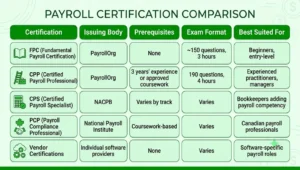
| Certification | Issuing Body | Prerequisites | Exam Format | Best Suited For |
| FPC (Fundamental Payroll Certification) | PayrollOrg | None | ~150 questions, 3 hours | Beginners, entry-level payroll staff |
| CPP (Certified Payroll Professional) | PayrollOrg | 3 years’ experience or approved coursework | 190 questions, 4 hours | Experienced payroll practitioners, managers |
| CPS (Certified Payroll Specialist) | NACPB | Varies by track | Varies | Bookkeepers adding payroll competency |
| PCP (Payroll Compliance Professional) | National Payroll Institute | Coursework-based | Varies | Canadian payroll professionals |
| Vendor Certifications | Individual software providers | None | Varies | Software-specific payroll roles |
What Are the Best Payroll Training Courses in 2026?
The best payroll training in 2026 will blend self-paced flexibility with certification exam preparation. The quality of courses depends on the depth of the curriculum, instructor access, and adherence to the PayrollOrg exam content outline.
Good programs include 15 to 25 lesson modules on worker classification, the Fair Labor Standards Act, federal employment taxes, fringe benefits, gross-to-net calculations, and payroll system administration. Those programs that incorporate a capstone project in payroll provide learners with practical experience beyond multiple-choice testing.
Online retailers and other businesses handling specialized transaction volumes usually require payroll procedures that differ from typical in-house training models. Automated Payroll Services for Ecommerce handle repetitive, high-volume payment cycles more efficiently than a single in-house employee trained through traditional payroll courses.
How Much Does Payroll Training Cost?
The cost of payroll training can be as low as $300 per self-paced course, or as high as $2,700 in the complete certification package. The price varies depending on the course duration and the instructor’s availability, and it includes the certification examination fee.
The courses covering entry-level preparation for the FPC exam generally last four to eight weeks and cost $300 to $700. At the professional level, programs that qualify students to take the CPP exam take three to six months and cost between $1,500 and $2,700, as they cover more in-depth material and may include instructor support. Exam fees range from $150 to $650, depending on the certifying body and membership level.
Payroll Training Cost Breakdown
| Training Type | Typical Price Range | Typical Duration |
| Entry-level self-paced course | $300 – $700 | 4–8 weeks |
| Professional certification bundle | $1,500 – $2,700 | 3–6 months |
| Certification exam fee only | $150 – $650 | N/A |
| Corporate/team training package | $2,500+ per group | Custom timeline |
With membership, PayrollOrg members receive a discount of over 20% on the FPC exam fee and 30% on the CPP exam fee, making membership affordable for anyone intending to obtain both credentials in the long run.
What Skills Does Payroll Training Teach?
Payroll training covers gross-to-net pay, tax withholding, benefits, and compliance reporting. All payroll certification exams test these four skill areas.
Gross-to-Net Pay Calculation
Gross-to-net pay calculation converts an employee’s earnings into take-home pay after taxes and deductions. This begins with gross wages, then deducts mandatory taxes, then voluntary and involuntary deductions, and the result is the final paycheck. Payroll training programs teach this calculation as a core skill because all other payroll skills build on it.
Tax Withholding
Tax withholding means employers deduct taxes from individual paychecks according to federal, state, and local tax rules. Payroll practitioners compute withholding for income tax, Social Security, and Medicare on a per-pay-cycle basis. Wrongful withholding makes both the employer and the employee liable, which is why this skill has been a central concern on all certification exams.
Wage Garnishment Processing
Employers process wage garnishments under legal orders for child support, debt recovery, or tax collection while protecting employees’ legal rights. Federal law limits the amount of disposable income an employer can garnish, and state law usually imposes additional limitations. Payroll training trains practitioners to use these limits effectively and prevent legal liability.
Fringe Benefit Administration
Fringe benefit administration is the management of health benefits, retirement contributions, and deferred compensation in accordance with IRS rules. Payroll staff should also correctly apply annual 401(k) contribution limits, as incorrect contributions can result in a tax penalty for both the employer and the employee.
Worker Classification
Worker classification helps determine whether someone is an employee or an independent contractor, which has a significant impact on taxes. Misclassification leads to back taxes, penalties, and lawsuits. This addresses the IRS test and criteria for making this determination correctly.
Payroll Recordkeeping
Payroll recordkeeping maintains records of earnings, tax returns, and audit documentation for legally required periods. The federal law specifies the minimum number of years employers must keep payroll records, and certain states go a step further. It educates on the documentation requirements to pass an audit without a fine.
Payroll Software Proficiency
In addition to regulatory education, most payroll training courses today include a unit on payroll software skills, as almost all current payroll processing occurs in a digital environment rather than on a calculator. This involves creating new employee records, establishing tax jurisdictions for multi-state employees, processing off-cycle payroll to correct errors or issue bonuses, and producing standard reports such as quarterly tax filings. When practitioners understand the payroll math behind the scenes and the automated software, they are much less likely to accept an erroneous system output and miss the error.
How Do You Choose the Right Payroll Training Program?
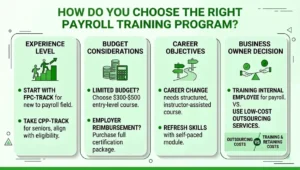
Select a payroll training program based on experience level, budget, and career objectives. Those new to the payroll field ought to start with FPC-track coursework. Seniors should take CPP-track courses that align with their eligibility requirements.
Financial limitations are also important. Candidates with limited budgets can start with a $300–$500 entry-level course and pay the exam fee separately, while candidates who receive employer reimbursement can purchase a full certification package directly.
Career goals determine how urgently candidates need the certification. Someone making a career change into payroll benefits with a structured, instructor-assisted course, and someone who only needs to refresh current skills, can get by with a self-paced module. Owners of small businesses considering whether to train an internal employee or use low-cost payroll services must compare these options. The costs of outsourcing can sometimes be lower than the costs of certifying and retaining an employee to handle payroll.
Payroll Training vs. Outsourcing Payroll: Which Is Better?
Payroll training is appropriate for businesses that want long-term, in-house control of payroll. Outsourcing is appropriate for businesses that want to eliminate compliance risk now. Neither alternative is always superior; the company should choose the appropriate course of action based on its size and payroll complexity.
Training an employee costs $300 to $2,700 in initial and continuing education, yet the internal expertise the company gains will be permanent. Outsourcing eliminates training expenses and shifts the burden of compliance to a third-party broker, though it creates a dependency on that broker.
Firms with workforces of fewer than 20 employees and simple pay structures tend to find outsourcing less expensive than certifying employees. Companies with complex multi-state payroll, frequent contractor arrangements, or high transaction volumes should maintain an internally trained team. Businesses exploring the outsourcing route can review Low Cost Payroll Services to compare pricing against internal training costs before deciding.
What Are State-Specific Payroll Compliance Requirements?
Payroll compliance requirements, which cover wage garnishments, final paychecks, and unclaimed wage handling, are state-specific. These variations are not fully covered by any federal certification examination, as the FPC and CPP focus primarily on federal law.
States have a higher garnishment cap than the federal Consumer Credit Protection Act. The deadline for final paychecks also varies: some states require employers to issue payment immediately after termination, while others require payment on the next regular payday. Multi-state employers must follow these requirements separately in each state where they employ workers because federal certification does not necessarily ensure state compliance.
Unclaimed wage regulations are another thorn in the flesh. States require employers to report and eventually remit unclaimed paychecks to a state unclaimed property fund after a specified dormancy period, which varies widely across states. Payroll practitioners operating in more than one state usually have some sort of compliance reference sheet or subscribe to a service that keeps them abreast of changes in the law, as it is virtually impossible to keep track of dozens of changing requirements manually without an automated system.
What Mistakes Should You Avoid When Choosing Payroll Training?
The three most prevalent payroll training errors include selecting outdated content, omitting accreditation tests, and underestimating study hours. These errors can be avoided, thereby saving money and labor.
The worst error is using outdated course material, as payroll regulations such as tax brackets, contribution caps, and minimum wage levels change each year. A course based on the figures of the previous year will teach a learner to compute withholding incorrectly without the knowledge of either party. Before taking a course, always ensure that it has been updated to the current year’s tax rules.
The second error is the failure to use accreditation checks. Not all of their payroll certificates are weighted by employers. Those courses that train the candidate to a recognized credential, like the FPC or CPP via PayrollOrg, are much more marketable than a generic certificate of completion by an unaccredited provider. This trap is avoided by ensuring that a course actually maps to a recognized exam.
Lack of study time leads to most candidates failing on their first attempt at the exam. The CPP exam, specifically, is based on real-life payroll situations that encourage practical experience rather than memorization. A second attempt at the exam increases the cost, and certification delays are more likely for candidates who complete a three- to six-month course as a background activity rather than through regular weekly study hours.
What Continuing Education Is Required to Maintain Payroll Certification?
Payroll certifications are not a one-time exam but a continuing education program. PayrollOrg requires FPC and CPP to earn recertification credits (RCHs) within a specified renewal period, or retake the exam if credits are not earned.
Typical sources of continuing education include PayrollOrg-approved webinars, conferences, in-house training, or further study. Typically, the number of credit hours required of the practitioner is amassed over a multi-year period, and credits are recorded and self-reported using the PayrollOrg member portal.
This is because payroll law changes every year, and a qualification obtained five years ago does not ensure that one will be up to date without continuous learning. This structure is also advantageous to employers, as it implies that a certified employee’s knowledge would be up to date without the company having to create its own compliance training program afresh each year. Recertification is a mandatory part of the payroll career, not an optional add-on. It requires spending a little money and time annually to recertify.
Start your payroll training today and build career success.
What Is the Payroll Career Outlook and Salary in 2026?
Payroll Salary Snapshot
| Role | Average Annual Salary | Typical Range |
| Payroll Specialist | $58,993 | $47,871 – $70,381 |
| Payroll Administrator | $62,502 | $50,600 – $71,739 |
| Payroll Manager | $111,514 | $89,895 – $130,212 |
Conclusion
Payroll training develops technical competency and compliance expertise to accurately process employee pay in 2026. The route starts at the entry-level FPC and goes all the way to the advanced CPP, costing between $300 and $2,700 depending on the depth and format. There is a quantifiable salary premium due to certification, and payroll occupations are expanding as business and financial jobs grow.
Regardless of whether a business opts to train employees or consider outsourced accounting services options, these are the basics of payroll training that will help them achieve accurate, compliant payroll processes.
Ready to Get Payroll Right the First Time?
Whether you’re training an in-house team or just looking for the right moment to outsource payroll to the experts, it is better to get it right than to get it fast. Explore outsourced payroll services that are created to support businesses of all sizes and have a team handle the tax filing, tax due dates, and state-related laws on your behalf to avoid the certification process and compliance risk altogether.
Frequently Asked Question
Will payroll training be worthwhile in 2026?
Yes. Payroll professionals with certification make about $10,000 more per year than those without certification, and 70% of payroll departments have at least one CPP holder, according to PayrollOrg.
Which should I get, FPC or CPP?
Novice payroll experts should start with the FPC, as it has no requirements. Direct application to the CPP is possible for practitioners who have three years of payroll experience.
What is the time taken to get certified in payroll?
Preparation for the FPC usually requires 4 to 8 weeks. Preparation for the CPP typically takes 3 to 6 months, depending on prior experience and the pace of study.
Can I get payroll training reimbursed by my employer?
Reimbursing certification fees to payroll employees is common among many employers, as certified employees reduce compliance risk. Ensure there is a reimbursement policy with HR before enrolment.
Do payroll certifications expire?
Yes. PayrollOrg certifications are recertified by continuing education credits or by retaking an exam within a specified renewal period.
Is payroll a career of the future in 2026?
Yes. Payroll has a salary range of $58,993 at the specialist level up to $111,514 at the manager level, with continued job demand through 2034.
Should a small business train its staff or outsource payroll?
Firms with fewer than 20 employees and those with simple pay structures usually find outsourcing cheaper than hiring and training an employee. Multi-state or larger business enterprises benefit more from trained in-house personnel.