
Yes, Social Security tax is compulsory for nearly all workers in the United States. According to the Social Security Administration’s 2026 fact sheet, employees contribute 6.2% of wages, employers contribute 6.2% and self-employed workers contribute the entire amount 12.4% up to the 2026 wage base limit of $184,500. A very small number of categories of persons some religious objectors, some nonresident visa holders and self-employed individuals with incomes less than $400 a year are exempt.
The one fact is the answer to the headline question. The true worth lies in the details, though: how the tax really affects your paycheck, what causes an exemption and what will happen when you miss a payment. This guide is a breakdown of the rules, rates and exemptions of 2026 in easy-to-understand language, supported by SSA and IRS data.
What Is Social Security Tax?
Social Security tax is a compulsory payroll tax that supports retirement, disability benefits and survivor benefits. People also call it OASDI, which stands for Old-Age, Survivors, and Disability Insurance. Congress established the program through the Social Security Act of 1935, making it the largest federal insurance program in the nation.
OASDI is half of the Federal Insurance Contributions Act FICA. The other half is composed of the Medicare tax. These two taxes collectively finance the major part of federal social insurance expenditures. A pay stub that includes the term OASDI, FICA or Social Security is a reference to the same 6.2% deduction.
FICA does not equal OASDI. FICA serves as the umbrella law, with OASDI and Medicare making up its two parts. People often confuse the two, but understanding the difference matters when calculating total payroll tax liability.
Is Social Security Tax Mandatory for Everyone?
Under federal law, most wage earners and self-employed workers have a mandatory tax on Social Security. The Internal Revenue Code obliges employers to deduct OASDI tax on employee salaries under FICA, and it obliges self-employed citizens to pay OASDI tax under SECA, the Self-Employment Contributions Act.
Neither law has an overall opt-out. An employee is not able to refuse the Social Security withholding just because they has a different retirement plan or because it does not see the need to have the benefit in the future. The requirement applies regardless of income level, number of employees, or industry. Only the specific categories discussed later in this guide qualify for exemptions.
Can You Opt Out of Social Security Tax?
You generally cannot stop paying Social Security tax unless you qualify for a specific voluntary withdrawal option, which is unavailable in most situations. In contrast to the contribution to a 401(k) or a health savings account, OASDI withholding is not an individual decision. The only known opt-out option is available to members of certain religious denominations who submit IRS Form 4029 and officially relinquish the right to future Social Security and Medicare benefits.
This is a permanent and binding waiver. Upon approval, both the individual and his employer cease to withhold OASDI and Medicare tax, but he also forfeits his right to retirement, disability, and survivor benefits based on those contributions. Roughly 500,000 Americans, primarily in Amish and Mennonite communities, hold this exemption today, based on figures the Social Security Administration publishes on religious exemptions.
Social Security Tax Rules Every Worker Should Know
Federal law establishes five core rules that govern how employers collect, calculate, and enforce Social Security tax. These rules apply uniformly across all 50 states, regardless of industry or employer size and originate from two statutes: FICA for employees and SECA for the self-employed.
- Withholding is automatic for employees. Employers must deduct 6.2% from every paycheck without exception, per FICA. Employees cannot request a reduced rate or delay withholding.
- Self-employed workers must self-report and self-pay. SECA requires self-employed individuals to calculate and remit their own 12.4% liability, typically through quarterly estimated payments rather than paycheck withholding.
- The tax stops at the annual wage base. Once earnings reach the annual limit, employers do not withhold additional OASDI tax on earnings for the rest of the calendar year, regardless of how many pay periods remain.
- Employers are required to contribute equal amounts of money towards the employees. This is an employer share which is a separate business expense and does not count as lessening the paycheck of the employee.
- Exemptions are not self-declared. An employee cannot just choose to claim an exemption. Employers must document each exemption listed later in this guide, such as Form 4029 for religious exemptions or proof of visa status for nonresident employees.
These five guidelines are the working model behind all the rate calculations and exemption cases given below. The rest of the tax that will include the amount you will actually pay is much easier to comprehend when you understand them first.
Confused about your Social Security tax rules? Get clarity.
2026 Social Security Tax Rates: The Full Breakdown
The Social Security tax rate would be 12.4% of gross wages in 2026, with half going to the employee and the other half to the employer. The contribution of the employees is 6.2%, employers 6.2% and self-employed workers bear the full amount of 12.4%.
| Worker Type | Employee Share | Employer Share | Total OASDI Rate |
| W-2 Employee | 6.2% | 6.2% | 12.4% |
| Self-Employed (SECA) | — | — | 12.4% |
| Combined with Medicare (Total FICA) | 7.65% | 7.65% | 15.3% |
This rate has remained unchanged since 1990-35 years without a change in the percentage itself by law, although the taxable wage base has been rising annually. The intentionality of that stability. Instead of modifying the rate, Congress modifies the wage base each year to match the increase in wages and maintain a predictable tax formula across payroll systems in the country.
How the Rate Applies to Employees
Employers automatically withhold 6.2% from each paycheck until the employee reaches the annual wage limit. The employer then puts in an equal 6.2% of its own money – a cost that does not decrease the amount that the employee will take home. The calculation of this withholding by employers who do it on a biweekly, weekly, or monthly basis usually uses a formal 2026 Payroll Calendar to coordinate the OASDI deposits with IRS deadlines.
How the Rate Applies to Self-Employed Workers
Under SECA, self-employed individuals pay the full 12.4% because they act as both the employer and the employee. An independent worker with a net self-employment income of $80,000 in net self-employment earnings would pay $9,920 in OASDI taxes, and that would be before considering Medicare 2.9%. The IRS permits self-employed taxpayers to claim half of this amount, the employer-equivalent amount, as an adjustment to income on Schedule 1 of Form 1040, which mitigates the effective burden.
2026 Social Security Wage Base Limit: What Income Is Taxed?
The 2026 cap on the Social Security wage base is $184,500, up by $8,400 since the 2025 cap of 176,100, as per SSA’s official 2026 cost-of-living adjustment release. Any income earned above this amount is not subject to OASDI tax for the rest of the calendar year.
This limit applies only to OASDI. The wage limit on Medicare tax does not exist- all the money earned is subject to the 1.45% Medicare tax, and any money earned over $200,000 initiates a 0.9% Medicare surtax. One of the most frequent payroll mistakes companies make that are small is confusing the two caps.
How Much Social Security Tax Will You Actually Pay in 2026?
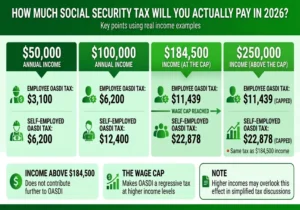
We can make the percentage easier to understand by using real numbers. The following is a graph of OASDI tax at four typical levels of income:
| Annual Income | Employee OASDI Tax | Self-Employed OASDI Tax |
| $50,000 | $3,100 | $6,200 |
| $100,000 | $6,200 | $12,400 |
| $184,500 (at the cap) | $11,439 | $22,878 |
| $250,000 (above the cap) | $11,439 (capped) | $22,878 (capped) |
Note that income above $184500 would not contribute even a penny to the OASDI bill. An employee with a salary of $250,000 will be paying the same OASDI tax as an employee with a salary of precisely $184,500. The wage cap makes OASDI a regressive tax at higher income levels, a point that simplified discussions often overlook when examining who bears a greater tax burden.
How Social Security Tax Works: Employees vs. Self-Employed
How Does Social Security Tax Work for W-2 Employees?
The automatic deduction of Social Security tax is done on each paycheck to W-2 employees. The employer pays out 6.2% prior to the issuance of the check and thereafter pays the sum to the IRS on a semi-weekly or monthly deposit basis, employee and employer respectively, depending on the size of the payroll. Workers do not make separate OASDI payments because employers withhold the tax through regular payroll processing.
How Does Social Security Tax Work for Self-Employed Individuals?
Self-employed workers do not have the automatic withholding but make quarterly estimated payments to Social Security. The IRS generally requires these payments on April 15, June 15, September 15, and January 15 of the following year. Taxpayers use Form 1040-ES to calculate the amount due. Missing a quarterly deadline may result in an underpayment penalty, although taxpayers can pay the remaining balance by the annual filing deadline. Freelancers, gig workers, and independent contractors generally fall into this category by default.
A rideshare driver or freelance designer with 1099 income does not have an employer to share the tax, so the entire 12.4% burden falls on them. Numerous self-employed taxpayers do not overestimate this requirement until the first year, and this is the reason why proactive Tax Management Services are important to anyone who has stopped working on a W-2 and has shifted to freelance or contract worker status.
How to Calculate Your Social Security Tax
- Determine gross wages or net self-employment earnings. This includes gross income before deductions and extends to $184,500 in 2026.
- If using the right rate. Multiply by 6.2% in the case of employees or 12.4% in the case of self-employed workers.
- Stop computing at the wage base of income. There is no OASDI tax above $184,500 per calendar year.
- Half deduction in case of self-employment. SECA filers can deduct 50% of their OASDI tax as an above-the-line deduction.
Who Is Exempt From Social Security Tax?
Under federal law, there are six types of groups that are exempted from Social Security taxes. A very specific set of criteria applies to each exemption; not liking taxes in general or not saving much does not make anybody eligible.
- Members of certain religious groups. Members of recognized religious groups that oppose insurance, including the Amish and Old Order Mennonites, can submit Form 4029 to request an exemption. Consent gives up all future Social Security and Medicare benefits.
- Self-employed individuals earning under $400 per year. The IRS does not require SECA tax filing below this net earnings threshold.
- Certain nonresident aliens on specific visas. F-1, J-1, M-1, and Q-1 visa holders, who are typically students, scholars, and researchers, may be exempt when they perform work directly related to their visa status.
- A-visa holders are foreign government employees. The government does not impose OASDI withholding on diplomatic or consular staff representing foreign governments in the U.S.
- State and local government employees covered by an equivalent public pension. Employees with a government pension plan that satisfies or surpasses the standards of Social Security benefits may not qualify to receive OASDI, should the plan have been in existence at particular federal deadlines.
- Certain student employees working for their own school. Students working at the college or university of their enrollment whose jobs are directly related to their enrollment are usually exempt during semesters in session.
Visa-Based Social Security Tax Exemptions
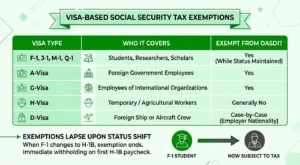
| Visa Type | Who It Covers | Exempt From OASDI? |
| F-1, J-1, M-1, Q-1 | Students, researchers, scholars | Yes, while status is maintained |
| A-visa | Foreign government employees | Yes |
| G-visa | Employees of international organizations | Yes |
| H-visa | Temporary or agricultural workers | Generally no |
| D-visa | Foreign ship or aircraft crew | Case-by-case based on employer nationality |
Exemptions in the form of visas lapse the instant there is a shift in immigration status. When an F-1 student changes to H-1B employment, it is immediately no longer exempt from OASDI and is subject to the normal withholding as of the first paycheck in the new status.
What Happens If You Don’t Pay Social Security Tax?
The inability to pay the necessary Social Security tax leads to the imposition of IRS penalties, and the accumulation of interest and eventual collection. The repercussions vary with the case of nonpayment by an employer or a self-employed person.
Consequences for Employers
Employers that do not pay or remit the OASDI tax incur the Trust Fund Recovery Penalty, which can impose a liability of 100 percent of the outstanding amount on the business owners and other financial officers. Liens against business property are also available, and intentional failure to comply may result in criminal prosecution whose resultant punishment of a jail sentence up to five years, as per the IRS guidance on employment tax enforcement.
Consequences for Self-Employed Individuals
Self-employed taxpayers who miss SECA payments may face a failure-to-pay penalty of 0.5% of the unpaid amount per month, up to 25%, plus interest that accrues daily. The IRS often notices unpaid self-employment tax as mismatches of 1099 income reported by clients, and in such cases, the mismatch seldom remains undetected beyond the next filing period. Proper recordkeeping, such as having a clear idea of What Are Debits and Credits? in a simple bookkeeping program, assists self-employed filers in following OASDI liability accrued throughout the year rather than having a startling balance in April.
What Does Social Security Tax Pay For?
The federal benefits that are financed by the Social Security tax are three types of benefits, namely retirement, disability and survivor. OASDI uses approximately 85% of its collected revenue to pay monthly retirement benefits. Additionally it uses the remaining revenue to fund disability and survivor benefits.
Credit eligibility is based on work credits, and not years worked. In 2026, a worker earns one Social Security credit for every $1,890 in wages, up to a maximum of four credits per year. Workers who earn 40 credits, which typically requires about 10 years of qualifying work, become fully insured and can receive retirement benefits at full retirement age. Disability and survivor benefits may have reduced credit requirements, based on the age of the worker when he becomes disabled or dies.
This relation is important: each dollar that is not paid at the required OASDI rate accumulates to a particular, estimable future payment. It is not a standard government tax but rather a systematized amount depending on individual earning history and credit buildup.
Social Security Tax vs. Medicare Tax: Key Differences
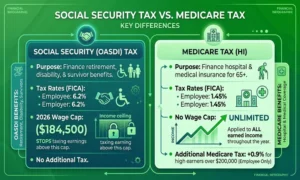
Social Security tax and Medicare tax are used to finance two totally different programs even though they are under FICA. OASDI tax contributes to retirement, disability and survivor benefits whereas Medicare tax is used to cover hospital and medical insurance of individuals aged 65 and above.
| Feature | Social Security (OASDI) | Medicare |
| Employee Rate | 6.2% | 1.45% |
| Employer Rate | 6.2% | 1.45% |
| 2026 Wage Cap | $184,500 | No cap |
| Additional Tax Over $200,000 | None | +0.9% (employee only) |
| Primary Benefit | Retirement, disability, survivors | Hospital and medical coverage |
The wage cap is the only largest structural difference. Individuals with high income cease to pay OASDI tax when their income is over $184,500 but Medicare tax is paid on all the income earned throughout the year and a surtax that starts beyond $200,000.
Can You Get a Refund If You Overpaid Social Security Tax?
Yes, employees that overpay the tax to the Social Security can receive a refund in their federal income tax return. Overpayment usually occurs when a person has two or more jobs in the year, and his or her wages together exceed the limit of $184,500. Although none of the individual employers had paid more than the right amount on the job alone.
In order to recover the excess, the taxpayers include it on Schedule 3 of Form 1040 when they are filing their annual return. The IRS uses the refund to offset any income tax due or makes it part of the regular refund. The situation is typical of employees who change their employers in the middle of the year or have part-time jobs.
Conclusion
Social Security tax is one of the few that is really inevitable in the U.S. tax code as a payroll tax. The combined 12.4% rate, the wage ceiling of $184,500, and the list of exemptions have been in place for decades, only the dollar amounts being updated each year. Knowing precisely where your income is on the wage scale, and whether your case falls within some exemption category or not, will help keep a tight rein on both overpayment shocks and compliance loopholes.
To business owners who monitor payroll tax and other end-of-year requirements, including the Annual Gift Tax Exclusion, remaining up to date with each threshold annually makes personal and business tax planning accurate.
FAQs
Is Social Security tax the same as OASDI tax?
OASDI is the official name of the program, and Social Security tax is its colloquial name. Both terms are used to mean the same 6.2%/6.2% payroll deduction.
Do self-employed individuals have to pay into Social Security tax?
Yes, self-employed people with income of $400 or higher a year are obligated to pay the entire 12.4% OASDI rate under SECA, which is reported in Schedule SE.
May I choose not to pay Social Security tax?
No, the only option is to have approved religious exemptions submitted on Form 4029. General preference or financial hardship is not exemptible.
What is the wage base limit of Social Security in 2026?
The 2026 wage base limit is $184,500. However income that is earned above this rate is not taxed under OASDI during the rest of the year.
Are there any religious exemptions to Social Security tax or Medicare?
Yes, a valid Form 4029 exemption not only waives either Social Security or Medicare taxes, but also the eligibility to receive future benefits in either of the programs.
Will I receive a tax refund on Social Security in case of overpayment?
Yes, overpaying taxpayers with more than one employer may claim the overpayment as a credit on Schedule 3 of Form 1040.
Do non US citizens have to pay Social Security tax?
Standard OASDI tax is charged on most nonresident workers. Exceptions exist in the case of certain types of visas, such as F-1, J-1, M-1, Q-1, and A-visa holders who complete qualifying work.
What will become of my Social Security tax should I never take benefits?
The contributions are still in the Social Security trust fund and help the greater program. Also, worker with less than 40 work credits loses personal entitlement to retirement benefits, but in some instances survivor benefits still accrue to dependents.