
Accounts payable is the amount a company owes suppliers for products or services acquired on credit. An invoice is usually included. Payment is usually due within 30 to 90 days. Accounts payable supports a company’s regular operations. A company owes money to a lender and records the debt in a written promissory note called notes payable.
Key Takeaways
- Accounts payable are short-term debts not associated with interest charged to the supplier that are categorized as a current liability.
- Notes payable are written undertakings to repay a loan, which may be with or without interest, and may be current or long-term as per the date of maturity.
- AP is founded on invoices and purchase orders. NP requires a promissory note.
- AP affects working capital and cash flow. NP has a greater impact on credit position and debt ratios.
- NP can be secured with collateral. AP tends to be unsecured.
- Smart businesses purchase AP on a routine basis and NP for large and planned investments.
Accounts Payable vs. Notes Payable at a Glance
| Feature | Accounts Payable | Notes Payable |
| Meaning | Owed to suppliers for goods or services bought on credit | Owed to a lender under a written promissory note |
| Documentation | Invoice, purchase order, receiving report | Signed promissory note or loan agreement |
| Typical creditor | Suppliers, vendors, contractors | Banks, credit companies, parent companies, owners, sometimes vendors |
| Typical term | 30 to 90 days (longer for custom or export orders) | Months to many years |
| Interest | Usually none (unless paid late) | Usually yes, fixed or variable |
| Balance sheet | Current liability | Current or non-current, depending on due date |
| Collateral | Rarely | Often possible |
| Purpose | Operating expenses and inventory | Equipment, property, expansion, acquisitions, working capital |
| Main impact | Cash flow and vendor relationships | Debt ratios and creditworthiness |
| Formality | Low | High |
What Are Accounts Payable?
Short-term debts include accounts payable which a business owes to its suppliers or vendors that sold goods or services on credit. When you receive an invoice but have not paid it, you record the unpaid amount in accounts payable until you make the payment.
AP appears as a current liability on the balance sheet and normally carries a credit balance. Quick payments support supplier relationships and build trade credit or the right to buy on the spot and pay later at more favorable rates.
What Counts as Accounts Payable?
- The goods that feed cost of goods sold are represented by inventory and raw materials that were purchased on credit.
- Professional services like consulting, marketing, IT support and transportation.
- Services and utilities
- Maintenance, cleaning and repair expenses.
- Debts to the contractors.
- Supplies and other office operating purchases.
The terms of payment are usually net 30, net 60 or net 90. Tailor-made or export orders can be large in size and have extended terms. Understanding How Debits and Credits Work can help businesses record these transactions accurately and manage payment obligations. Some vendors also allow installment-like payments, which give you more control over cash flow.
Why Accounts Payable Management Matters
- Cash flow control. Keeping a record of what you owe and when it is due lets you hold onto cash as long as the terms permit without damaging relationships. Properly run AP can result in more favorable supplier terms in the long run.
- Days Payable Outstanding (DPO). DPO is used to determine the average time of payment by a company. One of the formulas is:
DPO = (Accounts Payable ÷ Cost of Goods Sold) × Number of Days in the Period
A company with 30-day terms and a DPO of 45 or 50 days is paying late, either intentionally to retain cash or because of a process problem. Long payment terms are good but can lead to loss of credit facilities and supplier confidence.
- Creditworthiness. Timely vendor payments demonstrate reliability. Suppliers, trade credit insurers, and lenders consider payment history, which may result in better credit limits and loan terms.
- Cost of goods sold and profitability. AP is not an expense; it is a liability but the credit purchases behind it go into inventory and subsequently cost of goods sold. Correct, timely AP recording makes COGS and gross margin more accurate.
- Early payment discounts. You will find numerous suppliers giving terms like 2/10 or net 30, which translates to a 2% discount if paid within 10 days; otherwise, the full amount is due within 30 days. Passing on that discount would be technically to borrow at a yearly rate of about 37%, so it is generally worth it should you be able to afford it.
What Are Notes Payable?
Notes payable are documents in the form of written commitments to pay borrowed funds. Businesses use debits and credits to record these obligations accurately in their accounting records. The promissory note usually provides the amount of the principal, the rate of interest (fixed or variable), the time of repayment, the date of maturity, and any terms of collateral or default.The holder can receive payment on a specific future date or demand payment at any time.
Notes payable are issued when a business:
- Borrows money in a bank or credit company.
- Purchases a building, machinery or a car.
- Borrows from a parent company, owner, shareholder or other private lender.
- Converts a past-due supplier balance to an agreement of a longer term.
- Buys equipment directly with the supplier in instalments.
Short-Term vs. Long-Term Notes Payable
- Temporary notes are due within 12 months. They are usually called working capital requirements or seasonal requirements and are indicated as current liabilities.
- Permanent payables are due after more than a year. Usually used to finance long-term assets, mergers and acquisitions. They are classified as non-current liabilities.
Important: The balance sheet should reflect in the current part of current debt the value of a Permanent note that falls within 12 months.
Why Notes Payable Matter
Accounts payable is not as significant an organized liability as notes payable. Using Accounts payable services helps businesses track vendor payments, manage due dates and maintain healthy cash flow. Wise management of due dates, interest, and principal repayments protects your reputation with lenders. Another option is collateralised notes, which the lender backs with an asset that they can sell if the borrower defaults.
Key Differences Between Accounts Payable and Notes Payable
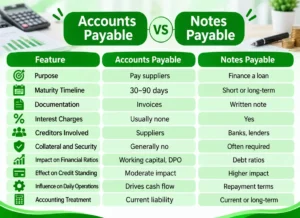
1. Definition and Purpose
AP represents a sum of money that you owe to suppliers as a result of goods or services obtained. It assists in everyday buying. NP refers to loans repaid under a formal promise. It supports larger, pre-established financing needs.
2. Maturity Timeline
AP is usually paid within 30-90 days. NP may be short-term or long-term, as it may reflect bigger purchases or loans.
3. Documentation
AP is based on purchase orders, invoices, and receiving records. NP must have a written, legally binding agreement.
4. Interest Charges
AP generally carries no interest over the credit period, but late charges may apply. NPs are almost always interest-bearing, and lenders charge interest on them as an expense.
5. Creditors Involved
Suppliers and service providers are owed AP. NP is due to banks, credit companies, financial institutions, parent companies, individual owners or other lenders.
6. Collateral and Security
AP tends to be unsecured.Pledged assets can secure NP, reduce lender risk, and possibly minimise the interest rate.
7. Impact on Financial Ratios
AP mostly impacts working capital, the current ratio, and DPO. NP has a significant impact on debt-to-equity, interest coverage, and other leverage ratios, and may not affect working capital at all in the long term.
8. Effect on Credit Standing
Both affect credit, but notes payable have a greater impact because lenders consider the amount of debt and repayment terms when evaluating financial health.
9. Influence on Daily Operations
AP influences day-to-day operations much more since it is a driver of cash flow and vendor relationships.
10. Accounting Treatment
Accounts payable
- Recorded as a current liability
- Credited when goods or services are bought on credit
- Debited when payments are made to suppliers
Notes payable
- Classified as current or non-current based on repayment terms
- Recorded as a separate liability account
- Credited for the principal when the note is issued
- Interest expense accrues over the term, with unpaid interest recorded as interest payable
- Debited as principal is repaid, removing the liability when the note is paid off
Journal Entry Examples
Buying inventory on credit (AP)
| Account | Debit | Credit |
| Inventory | $10,000 | |
| Accounts Payable | $10,000 |
Paying the supplier
| Account | Debit | Credit |
| Accounts Payable | $10,000 | |
| Cash | $10,000 |
Receiving a $50,000 bank loan (NP)
| Account | Debit | Credit |
| Cash | $50,000 | |
| Notes Payable | $50,000 |
Accruing interest on the note
| Account | Debit | Credit |
| Interest Expense | amount accrued | |
| Interest Payable | amount accrued |
Repaying principal
| Account | Debit | Credit |
| Notes Payable | amount repaid | |
| Cash | amount repaid |
What Accounts Payable and Notes Payable Have in Common
Both are liabilities. They are debts to suppliers, vendors or lenders that are to be paid. They are both on the balance sheet and they affect solvency and financial health.
Both are payable in nature. A company should pay each of them according to the agreement. For AP, that is usually 30, 60, or 90 days. In the case of NP, the lender will review the contract to determine the repayment terms.
Both affect credit. Late payment or default on either can hurt relationships and credit status.
Need help managing your business finances? Explore our professional bookkeeping services today.
Practical Examples
Example 1: Goods Purchased on Credit (Accounts Payable)
A retail store is supplied with 30-day merchandise of $10,000. No promissory note is involved, and the $10,000 is recorded as accounts payable, a current liability.
Example 2: Business Loan from a Bank (Notes Payable)
A small manufacturer takes out a $50,000 loan from a bank, payable with interest after three years. The written promissory note outlines the terms, so the company records the amount as notes payable. The company classifies most of it as long-term because it will repay the debt over three years. However, it records any amount due within 12 months as a current liability.
Example 3: Services Rendered on Credit (Accounts Payable)
A software company contracts a marketing firm with a six-month agreement with a payment at the end of the contract of $30,000. The requirement is due to services performed on credit and is, therefore, accounts payable.
Example 4: Equipment Financing (Notes Payable)
A restaurant buys $20,000 of kitchen appliances and the vendor lets it pay in installments over two years at an agreed interest rate. The written agreement with payment terms and interest charges makes this a note payable.
Example 5: Supplier Balance Converted to a Note
A company lags on a big bill to the supplier. The supplier will accept the debtor balance and convert it to a written note, which will include interest and a six-month schedule. ggg
Which Should You Use? Accounts Payable vs. Notes Payable in Procurement
Routine purchasing is done using accounts payable. AP is straightforward, flexible and often interest-free, making it suitable for supplies, utilities, services, rent and recurring vendor invoices. Understanding What Is Catch-Up Bookkeeping? can also help businesses identify and organize overdue financial records including unpaid supplier invoices.
Notes are used to finance big and planned investments. Lending a structured loan to fund big assets keeps short term cash to meet day to day operations and expenses in the long term.
Where They Fit in the Procure to Pay (P2P) Process
Procure to Pay carries out the process from the purchase request to final payment. P2P manages accounts payable by matching invoices and processing payments. It ensures that suppliers receive the correct payments on time, follows company policies, and maintains strong supplier relationships.
Notes payable tend to be outside regular P2P. Businesses using professional bookkeeping services can track these obligations accurately, maintain organized financial records, and manage liquidity for larger investments.
AP Automation and Accounting Software
Manual accounts payable work is where most payables mistakes start: lost invoices, duplicate payments, missed discounts, and late fees. AP automation and modern accounting software cut down on all of these by handling the repetitive steps for you.
What AP Automation Does
- Invoice capture. Invoices arrive by email or upload and are read automatically, so nobody has to key in vendor names, dates, and amounts by hand.
- Three-way matching. The software compares each invoice against the purchase order and receiving report, and flags anything that doesn’t match before payment goes out.
- Approval workflows. Invoices are routed to the right person based on amount, department, or vendor, with a clear record of who approved what.
- Scheduled payments. Bills are paid on the due date, not early (which wastes cash) and not late (which risks fees and strained supplier relationships).
- Discount tracking. The system flags early payment terms like 2/10 net 30 so you can capture the discount when it makes financial sense.
- Duplicate and fraud checks. Repeated invoice numbers, changed bank details, and unusual amounts get flagged for review.
Choosing Accounting Software
The majority of small and medium enterprises begin by using cloud accounting software like QuickBooks, Xero or Sage and then include a dedicated AP software once they have a significant volume of invoices to handle. When choosing options, check for:
- It automatically integrates with your general ledger and bank feeds.
- Approval flows & user privileges
- Invoice matching and duplicate detection
- Reporting on aging payables and DPO
- Note Tracking of payable notes with amortization schedule and recurring interest entries.
The latter one can be easy to forget. Notes payables are not part of the typical procure-to-pay, and as a result, a lot of companies maintain the records of notes payables in a spreadsheet. When you set up each loan in your accounting software, including the principal, the rate and the payment schedule, it helps ensure that you’re accruing the interest correctly and on time and that you’re reclassifying the current portion of the loan properly.
Software Doesn’t Replace Review
While automation is a great way to decrease the number of errors, it is best to have accurate records to start with. Someone still needs to reconcile the subledgers with the general ledger, verify that they record debits and credits correctly, and ensure that no one records a loan as a vendor bill. Is this conversation helpful so far? If your books are a mess or your payables process is behind, you can have professional accounts payable services or bookkeeping services clear up the books and establish a payables process that you can maintain in your software. Catch up bookkeeping is a good way to begin if you’ve got an inventory of unrecorded invoices.
Credit Cards vs. Notes Payable
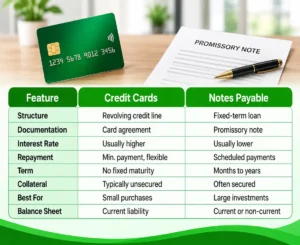
There are two types of “buy now, pay later” schemes: credit cards and notes payable. While they are similar in concept, they also have major differences and different costs. If you know which one is suitable for what purchase, you can save real money.
How Each One Works
A note payable is a formal loan that is secured by a signed promissory note. It has a fixed principal, interest rate, repayment schedule and maturity date.
A business credit card allows a business to borrow money through a revolving line of credit. The business repays a portion of the balance each month and pays interest on any outstanding debt. Unlike a fixed-term loan, a business credit card has no set repayment end date, as the balance changes with each purchase.
Side-by-Side Comparison
| Feature | Credit Cards | Notes Payable |
| Structure | Revolving credit line | Fixed-term loan |
| Documentation | Card agreement | Signed promissory note or loan agreement |
| Interest rate | Usually higher, often variable | Usually lower, fixed or variable |
| Repayment | Minimum monthly payment, flexible | Scheduled principal and interest payments |
| Term | No fixed maturity | Months to many years |
| Collateral | Typically unsecured | Often secured by an asset |
| Best for | Small, short-term, or routine purchases | Large, planned investments |
| Balance sheet | Current liability | Current or non-current, depending on due date |
Accounting Treatment
Typically, businesses record credit card balances in a separate liability account called Credit Card Payable and classify them as current liabilities. When a business makes a purchase using a credit card, it records the expense or asset as a debit and the credit card payable as a credit. This is because paying the statement will result in a debit to the card and a cash credit. Interest and/or any bank charges are listed as interest expense.
Example: equipment purchase on a credit card
| Account | Debit | Credit |
| Office Equipment | $3,000 | |
| Credit Card Payable | $3,000 |
A note payable is recorded when the company receives the loan and adds interest to the note over time. The company classifies the amount due within the next 12 months as a current liability. Review the journal entries in this guide and our debits and credits guide if you need to refresh yourself on how to post them.
Which Should You Use?
A credit card tends to make sense when:
- The transaction is a small one and the balance can be paid in full and on time.
- You wish to get rewards or cash-back in exchange for your purchases.
- You require short-term flexibility and the amount is not worth taking out a formal loan.
A note payable tends to make sense when:
- You’re purchasing equipment, vehicles, property or financing expansion.
- A longer repayment term and a consistent payment are a must.
- You want a lower rate than that a card would offer, especially if you can offer collateral.
The Cost of Carrying a Balance
Borrowing a credit card balance is typically the most costly method of borrowing. It might be beneficial to have a $20,000 piece of equipment on a card that has a high APR for a year or two, and then pay it off through a term loan. A note payable typically will lead to a lower total interest expense and a payment schedule that is more manageable to plan around, for larger purchases.
Strategic Use Cases
Notes Payable Use Cases
- Growth funding includes hiring, activity expansion, and growth.
- Financing for acquisitions of vehicles, machinery, data centers, buildings or other major expenditures.
- Satisfying urgent cash requirements without reducing operating capital.
- Developing a credit history by showing good payment.
- Tax planning: interest is usually deductible as a business expense and see local tax regulations.
Accounts Payable Use Cases
- Saving money by paying on the agreed due date.
- Early payment discounts at the expense of cash.
- Improving supplier relationships to have better conditions.
- Automation of invoice processing and payment to speed up processing and minimise errors.
- Swapping longer payment terms to boost working capital.
Best Practices for Managing Both
- Allocate map repayments to procurement cycles and cash inflows. Align the payment dates and revenue and quarterly budgets with the matching liquidity risk.
- Follow up on all invoices and due dates. AP automation and e-procurement dashboards help businesses prevent late payments and duplicate invoices.
- Monitor DPO. Check against deviations from the agreed terms, which could be a sign of cash pressures or process lapses.
- Make discounts when they are below your cost of cash. A net 30 2/10 is likely to work better than most short-term funding.
- Read all the notes. Type of interest rate on checks, prepayment of interest penalty, covenants, collateral, and default before signing.
- Re-classify the existing portion. Transfer principal due within 12 months of a durable note to current liabilities at reporting dates.
- Associate the nature of the liability and the purpose. Decide before purchase: temporary flexural need means AP and long-term asset or planned investment means NP.
- Reconcile regularly. Compare subledgers with the general ledger at the end of each month.
- Protect receivables too. Consider trade credit insurance so that, if a customer doesn’t pay, it doesn’t affect your ability to pay suppliers and lenders in the future while you’re selling on credit.
Common Mistakes to Avoid
- Recording an official loan as accounts payable or vice versa.
- Forgetting to accrue interest on notes payable
- Inability to subdivide short- and long-term parts of a note.
- Discount-free early payment and loss of cash mobility.
- Leaving DPO to operate far beyond its contract and deceiving suppliers.
- Assuming notes payable on routine expenses which could be paid by AP on interest-free terms.
Still not sure which liability type fits your business?
Conclusion
Both accounts payable and notes payable are vital to financial management, but they have different functions. Outsourced Accountants USA will help companies manage these obligations. Accounts payable are short-term obligations generally not involving interest, for various suppliers that support the day-to-day operations.
Formal lenders use the term notes payable for long-term, interest-bearing loans that businesses take out to finance larger investments.
FAQs
Is notes payable a current or long-term liability?
Either. It depends on the due date. Notes due within 12 months are current liabilities. The portion of notes due within the next 12 months appears as a current liability, while the remaining balance stays classified as a long-term liability.
Is accounts payable a current liability?
Yes. Accounts payable are almost always current liabilities because they are due within a short period, typically 30 to 90 days.
Does accounts payable have interest?
The supplier usually does not charge a penalty or finance fee unless the buyer pays the invoice late. Notes payable normally carry interest.
Can accounts payable become notes payable?
Yes. If a business cannot pay an invoice on time, the supplier may agree to convert it into a written promissory note with interest and a repayment schedule.
Which will most likely be riskier for a company: accounts payable or notes payable?
The nature of notes payable tends to be riskier due to interest costs, covenants, collateral and their impact on debt ratios. Even unpaid accounts that are payable can affect supplier relationships and credit.
What is the difference in the ways each impacts cash flow?
Short-term cash flow: Accounts payable helps in this regard by postponing payments when agreed. Notes payable are a source of cash financing or asset financing, with scheduled principal and interest payments in the future.
Is a promissory note identical to notes payable?
The Promissory Note is a legal document. The borrower must pay the amount called notes payable.
Where do they appear on the balance sheet?
The accounts payable appears under current liabilities. Notes payable may appear under current liabilities, long-term liabilities, or both, depending on the repayment period.