
Bookkeeping costs for small business owners range from $300 to $1,200 per month in 2026. Basic configurations begin at around $200. Complex ones top $2,500.
Three things determine your price. Your transaction volume. The scope of the package. The individual who does the work. The quotes for the same books from a freelancer, an online service, and a CPA firm will differ significantly.
Quick answer: Less than 100 transactions per month? Expect $300 to $500. Between 300 and 700? Plan on $800 to $1,500. Inventory, messy past books, or payroll: add them to the quote, and it goes up.
This guide covers pricing models, the cost of business size and industry, hidden charges, a cost estimator, and a quote comparison checklist. We constructed each range using the existing provider prices and open wage information, and we justify the difference between the figures.
Average Bookkeeping Cost at a Glance
The average bookkeeping cost for a small business is $300 to $800 per month. Simple packages begin around $200. Full-service packages are up to $2,000 or higher.
So how much does bookkeeping cost in practice? The majority of owners fall between $300 and $800 a month. That includes categorizing transactions, performing bank reconciliations, and preparing the monthly profit and loss statement. Include payroll, accounts payable, or accrual accounting, and your quote leaps to the next level.
The price is determined by scope. The issue of revenue is not as important as most owners believe. The following is a comparison of the four typical service levels.
| Service level | What you get | Monthly price |
| Basic | Transaction categorizing and bank reconciliation | $200 to $500 |
| Standard | Reconciliations, month-end close, profit and loss statement, balance sheet | $500 to $1,000 |
| Full-service | Accounts payable, accounts receivable, payroll reconciliation, close, full reporting | $1,000 to $2,000 |
| Advanced accounting support | Accruals, schedules, financial review, controller oversight | $2,000 to $4,000 |
These are market ranges, not quotes. The final figure is moved by the number of transactions you have made, the number of accounts you have, and the state of your books.
Bookkeeping Prices by Annual Revenue
Revenue provides a second way to check a quote. The monthly bookkeeping cost increases with the size of your business, since higher revenue typically means more transactions, accounts, and reports.
| Annual revenue | Monthly price | What it usually covers |
| Under $100K | $200 to $500 | Low transaction volume, one or two accounts |
| $100K to $500K | $300 to $900 | Monthly reconciliation, categorizing, profit and loss statement, balance sheet |
| $500K to $1M | $750 to $1,500 | Higher volume, payroll coordination, payables and receivables support |
| $1M to $5M | $1,200 to $2,500+ | Multiple accounts and entities, job costing, management reporting |
The 0.5% to 1.5% Rule of Thumb
Budget 0.5% to 1.5% of your annual income for bookkeeping. A business with $400,000 in revenue would plan for $2,000 to $6,000 a year, or roughly $170 to $500 a month.
Use it as a quick reality check, not as a price list. Paycheck, stockbook, and books drag you through the band.
A quote unusually low? Something is missing from scope. Far above it, a quote? What you are getting that the tables do not show. Not a billing rate; that’s wages. On top of that, providers include software, overhead, review time, and profit. Freelancers on Upwork average about $43 an hour, and experienced professionals bill $50 to $90 or more.
Bookkeeping Pricing Models Explained
Providers use five bookkeeping service pricing models: hourly, flat monthly, project-based, per-transaction, and hybrid. Flat monthly fees fit most small businesses. Hourly and project pricing fit one-off work.
The model matters as much as the number. Two $500 quotes can cover very different work, and that’s especially true when you’re weighing the cost savings of offshore bookkeeping services against domestic providers. A lower rate only saves money if the scope of work is the same.
Hourly Rates
Bookkeeping rates range from $25 to $90 per hour and can be higher. Entry-level and freelance bookkeepers usually charge $25 to $50. Professional, experienced bookkeepers charge $50 to $90 or more, and rates are higher in urban areas.
The average rate listed on Upwork is approximately $43 an hour. Bench charges $55 per hour for QuickBooks-certified assistance and onboarding. Take that as the price of a single provider, not the industry.
Hourly: one-off tasks: a hasty cleanup, a tax-season inquiry, an audit response. It does not work with constant work. The meter runs every time you ask a question, and your monthly bill swings.
Flat Monthly Fee
You pay a single price for a defined scope. Most small businesses pay between $300 and $1,200 per month, and online bookkeeping services start lower typically between $200 and $700. That makes it a useful benchmark when estimating your outsourced accounting cost in 2026.
It’s the easiest model to budget. You know what the bill will be at the start of the month, and your bookkeeper has no incentive to stretch the hours.
Check the transaction limit. Most flat-rate packages have monthly limits, and exceeding them will incur an overage fee or move you to the next level.
Project-Based Pricing
You are charged a standard fee for a single job. It is used by providers to do catch-up bookkeeping, cleanups, software migrations, and to set up accounts.
Prices vary widely. QuickBooks Live does not post a cleanup fee. It bases the quote on your sign-up month, tax-filing status, and opening month. Bookkeeper 360 costs $1,000 or more to use its onboarding and prior-bookkeeping add-on.
Inquire about what would occur should the provider discover additional issues during the project. Obtain the answer in writing.
Per-Transaction Pricing
Other providers may charge on an activity basis, such as per transaction, invoice, bill, account, or employee. Your charge varies with quantity.
While transparent, this model complicates budgeting for any growing business. Uncommonly offered by most firms, it primarily serves specialized, high-volume commercial niches where activity remains very easy to measure accurately.
Hybrid Pricing
A hybrid model includes an extra charge in addition to a basic monthly fee. Such extras may include transaction overages, one-time cleanup, project work, or controller review.
You have a degree of predictability and flexibility. You even receive a more complex invoice. Request that a list of all add-ons and their price be provided to you in writing.
Pricing Models Compared
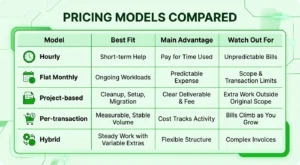
| Model | Best fit | Main advantage | Watch out for |
| Hourly | One-off tasks, short-term help | Pay only for time used | Unpredictable bills |
| Flat monthly | Ongoing, steady workloads | Predictable expense | Scope limits, transaction caps |
| Project-based | Cleanup, migration, setup | Clear deliverable and fee | Extra work outside the original scope |
| Per-transaction | Measurable, stable volume | Cost tracks activity | Bills climb as you grow |
| Hybrid | Steady work with variable extras | Flexible structure | Complex invoices |
What Owners Report Paying
The analysis by NerdWallet was based on over 2,200 comments in the three communities r/Bookkeeping, r/SmallBusiness, and r/TaxPros and covered the period between August 2024 and July 2025. It identified three levels of monthly bookkeeping:
- Basic: $250 to $350
- Mid-range: $500 to $700
- Premium: $1,000 and up
Reddit users are anonymous, and NerdWallet could not verify their situation. These figures are for context, not as a quote. They correspond to the ranges in the above tables.
Our recommendation? Select a per-month fee for ongoing work. Apply an hourly or project price to one-time jobs.
What Drives Bookkeeping Costs?
Price is driven by transaction volume. Next are the number of accounts, payroll, and the condition of your books.
The small business bookkeeping cost may vary greatly between two firms with the same revenue. Price is not determined by revenue. Workload does.
Transaction Volume Sets the Baseline
The more transactions there are, the more hours there are, and the higher the price. The data from Catalyst CPA reflects the trend.
| Monthly transactions | Bookkeeper hours | Freelancer price | CPA firm price |
| Under 100 | 2 to 4 | $300 to $500 | $400 to $700 |
| 100 to 300 | 4 to 8 | $500 to $800 | $700 to $1,100 |
| 300 to 700 | 8 to 15 | $800 to $1,500 | $1,100 to $2,000 |
| 700 to 1,500 | 15 to 25 | $1,500 to $2,500 | $2,000 to $3,500 |
Fincent’s examples agree. Around 50 transactions is approximately $250 to $400. A company with 201 to 500 transactions across multiple accounts costs approximately $800 to $ 1,500.
Inquire with each provider what it considers a transaction. Definitions vary.
Complexity Factors That Raise Your Price
Before comparing quotes, it helps to understand what a bookkeeper does for a small business beyond basic data entry. Each task below adds time, and time drives your price.
- Accounts: Every bank account, card, loan, and payment platform needs its own reconciliation.
- Entities and locations: Each one adds separate books and intercompany tracking.
- Accrual accounting: It takes more work than cash-basis books.
- Payroll: Employees add payroll entries and tax liabilities to reconcile.
- Payables and receivables: Bill entry, invoicing, and collections go beyond basic bookkeeping.
- Inventory: Your bookkeeper tracks purchases, cost of goods sold, and returns.
- Sales tax: Tracking, preparing, and filing returns are three different services.
- Integrations: Each connected system can create duplicates and mismatches.
- Reporting: Cash flow statements, budgets, and dashboards cost more than a basic profit-and-loss statement.
- Frequency: Weekly updates cost more than monthly ones.
Condition of Your Books
Messy books require the largest investment, but you pay once. Accounts and documents that are not reconciled and are missing should be fixed before the commencement of the continuous service.
This cleanup is quoted separately by the providers. Sources range from $500 to $3,000, up to $1,500 to $8,000 for books a year or more behind.
Experience and Certifications
More is charged by experienced bookkeepers. They also pick up issues quicker. Seek NACB or AIPB certification, and request two or three client references.
How Much Each Factor Adds
| Factor | Typical added cost |
| Each account beyond the first two | $25 to $75 per month |
| Each additional entity | $150 to $500 per month |
| Accrual accounting | 15% to 30% on top of your fee |
| Payroll reconciliation | $50 to $200 per month |
| Payables or receivables | $100 to $400 per month each |
| Inventory | $150 to $600 per month |
| Sales tax tracking or filing | $50 to $250 per month |
| Custom reporting | $100 to $500 per month |
| Weekly check-ins | $200 to $500 per month |
| Senior or certified bookkeeper | 20% to 50% on top of your fee |
Pile up a number of factors, and your price skyrockets.
Bookkeeping Fees for Small Business by Size and Revenue
Your price is dependent on your business stage. The lowest-paying owners are the early-stage ones. Multi-location operators are the highest paying.
Bookkeeping fees for small business owners follow four patterns:
- Solopreneurs and freelancers: $200 to $500 a month. You usually need basic categorizing, one or two accounts, and quarterly reports.
- Startups: $500 to $1,500 a month. Investors want accrual books, payroll, and runway reporting, and those push the price past what your transaction count suggests.
- Established small businesses: $750 to $2,000 a month. You need a full monthly close, payables and receivables, and several reconciled accounts.
- Multi-location businesses: $1,500 to $3,500+ a month. Consolidation, location reports, and internal controls come into play.
Bookkeeping Prices by Annual Revenue
Revenue gives you a quick price check. Higher revenue usually brings more transactions and more reporting.
| Annual revenue | Typical monthly price |
| Under $100K | $200 to $500 |
| $100K to $500K | $300 to $900 |
| $500K to $1M | $750 to $1,500 |
| $1M to $5M | $1,200 to $2,500+ |
Current bookkeeping rates for small businesses are consistent across providers; therefore, a quote that is significantly below the bands should be questioned.
Cost vs. Transactions
Increased transactions translate to a higher price. This chart continues to show where a freelancer’s price is at each volume.
| Monthly transactions | Midpoint monthly price |
| Under 100 | $400 |
| 100 to 300 | $650 |
| 300 to 700 | $1,150 |
| 700 to 1,500 | $2,000 |
Bookkeeping Pricing by Industry and Entity Type
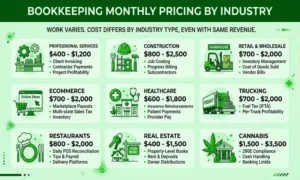
Work varies by industry. Daily sales are reconciled in a restaurant. Job costs are tracked by a contractor. There is very little that a consultant follows.
That is why the cost of bookkeeping for small businesses differs tremendously even with the same revenue. These are typical monthly bands.
| Industry | Monthly price | What adds work |
| Professional services | $400 to $1,200 | Client invoicing, contractor payments, project profitability |
| Ecommerce | $700 to $2,000 | Marketplace payouts, returns, multi-state sales tax, inventory |
| Restaurants | $800 to $2,000 | Daily POS reconciliation, tips, delivery platforms, payroll |
| Construction | $800 to $2,500 | Job costing, progress billing, retainage, subcontractors |
| Healthcare | $600 to $1,800 | Insurance reimbursements, patient payments, provider pay |
| Real estate | $400 to $1,500 | Property-level books, rent, deposits, owner distributions |
| Retail and wholesale | $700 to $2,000 | Inventory, cost of goods sold, vendor bills, returns |
| Trucking | $700 to $2,000 | Fuel tax (IFTA), per-truck profitability |
| Cannabis | $1,500 to $3,500 | Section 280E compliance, cash handling, banking limits |
Entity Type and Structure
Your legal structure changes the scope. Each layer adds work.
- Sole proprietor or single-member LLC: The simplest setup. It sits at the low end of every band.
- S-corp: Adds $100 to $300 a month for payroll posting and equity tracking.
- Multi-entity: Adds $150 to $500 a month for each extra entity. Expect intercompany entries and consolidated reports.
- Multi-state: Adds $100 to $400 a month for nexus tracking and multi-state sales tax.
Cost by Provider Type: DIY, Software, Freelancer, Virtual, Outsourced, CPA Firm
Who does the work is what alters your price more than anything else. The following is the cost of each option and what you receive.
DIY
- Cash cost: $30 to $90 a month for QuickBooks Online.
- Real cost: Your time. Eight hours a month at $150 an hour equals $1,200.
- Works when: You run a solo service business under $200K with fewer than 100 transactions.
- Fails when you fall two months behind, hire staff, or add entities.
Family Member or Spouse
- Cost: $0 to $500 a month.
- Upside: Cheap and trusted.
- Downside: Non-professionals miss deductions. Disputes spill into your home life.
- Works when: Your spouse has real bookkeeping training and a written scope.
Software and Online Services
- Typical online bookkeeping cost: Online bookkeeping costs run $200 to $500 a month. QuickBooks Live, Bench, and Pilot sit here.
- You get: A monthly close, light reconciliation, basic reports, and chat support.
- Limits: Little industry customization, frequent bookkeeper turnover, and no tax planning.
- Best for: Freelancers and simple LLCs under $500K in revenue.
Offshore Teams
- Typical outsourced bookkeeping cost: Outsourced bookkeeping with an offshore team runs $200 to $600 a month.
- Pros: Low price. Team-based coverage.
- Cons:
- Time-zone gaps slow replies.
- S. tax knowledge varies by firm.
- A chart of accounts built outside U.S. norms causes handoff trouble at tax time.
- Data security: Get written confidentiality terms, access controls, and a data-handling policy before you share bank logins.
- Best for: Standard books and owners who’ll spend an hour or two a week on oversight.
- Compare: Our outsourced bookkeeping services pair offshore efficiency with U.S. review. Read the benefits of outsourcing bookkeeping first.
Virtual Bookkeepers
- Typical virtual bookkeeping cost: It depends on the model. Freelancers on Upwork average about $43 an hour. Subscription services run $200 to $700 a month.
- Pros: Lower than hiring, and you pick your own provider.
- Cons: You work less closely together. Online services often rotate bookkeepers, so you may not have a single point of contact.
- Check: Make sure they use your accounting software. Switching costs time and money.
- Find them: Ask other owners in your industry for referrals.
U.S. Freelance Bookkeeper
- Cost: $300 to $1,200 a month.
- Pros: Personal attention and often industry focus.
- Cons:
- No license exists for “bookkeeper,” so quality varies.
- One person means one point of failure.
- You still need a CPA for tax filing.
- Best for: Established businesses at $300K to $2M with moderate complexity.
CPA Firm
- Cost: $400 to $3,000+ a month.
- Pros: Staff backup, consistent quality, no handoff friction at tax time, and audit support.
- Cons: Higher price.
- Best for: S-corps, real estate investors, and businesses nearing $1M.
In-House Hire
- Salary: The Bureau of Labor Statistics reports a median salary of $50,670 for bookkeeping clerks.
- Regional gap:C. averages $65,640. Oregon averages $52,920.
- Add on top: Payroll taxes, benefits, equipment, training, and turnover.
- Loaded cost: About $50,000 to $70,000 a year in high-cost metros.
- Verdict: Most small businesses don’t need a full-time employee.
What Does a Bookkeeping Package Include?
Not every quote covers the same work. Before you compare prices, check which of these tasks are included in your small business bookkeeping services package. Read our guide on what a bookkeeper does for a small business, including the daily details.
Not every quote covers the same work, so it’s worth asking what is included in bookkeeping services before you compare prices. Check which of these tasks are part of your small business bookkeeping services package. For the day-to-day details, read our guide on what a bookkeeper does for a small business.
What a Typical Package Covers
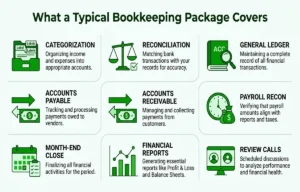
- Transaction categorization: Your bookkeeper codes every sale, expense, and transfer to the right account.
- Bank and credit card reconciliation: It matches your books to your statements and flags missing or duplicate entries.
- General ledger maintenance: They keep your chart of accounts clean and audit-ready.
- Accounts payable: They log vendor bills and track due dates. Basic tiers often exclude this.
- Accounts receivable: They track invoices, match payments, and age open balances. Basic tiers often exclude this too.
- Payroll reconciliation: They reconcile entries from your payroll provider. They don’t run payroll.
- Month-end close: They finish reconciliations and adjusting entries, then lock the month.
- Financial reports: You get a profit and loss statement and a balance sheet at minimum.
- Review calls: Some providers add a monthly or quarterly call to walk through the numbers.
What Costs Extra? Hidden Fees to Watch For
The cost of bookkeeping services often grows after you sign. Providers commonly bill extra for:
- Cleanup: $500 to $8,000, one-time
- Setup and onboarding
- Bill pay and collections
- Payroll processing, inventory, and sales tax
- Tax prep, 1099s, and year-end entries
- Custom reports and controller review
Watch for overage fees, rush fees, and software markups. Get every add-on in writing.
Total Cost of Ownership: Software and Add-Ons
Your bookkeeper’s fee isn’t the whole bill. Add:
- Bookkeeper: $300 to $1,200 a month
- Accounting software: $30 to $200 (QuickBooks Online tiers)
- Payroll add-on: $50 to $130
- Receipt app: $0 to $20
- Onboarding: one-time fee
Most owners spend $400 to $1,500 per month, all in. Confirm current software prices before you budget.
Free Bookkeeping Cost Estimator
[Calculator placeholder: transactions, accounts, payroll, inventory, months behind.]
Skip the tool? Count your transactions, list your accounts, note your add-ons, find your revenue band, then check the result against 0.5% to 1.5% of revenue.
Bookkeeper vs. Accountant vs. CPA vs. CFO: Cost Differences
Each role covers more and costs more:
- Bookkeeper: Records transactions. $300 to $1,200 a month.
- Accountant: Adjusts entries and reports results.
- CPA: Files taxes and represents you before the IRS. $150 to $400+ an hour.
- Controller and CFO: Oversee controls and strategy. Custom pricing.
Bookkeeping fees don’t include tax prep. Budget for it separately.
Is AI Making Bookkeeping Cheaper? Digital and Automated Options
Somewhat. Digital bookkeeping tools import bank feeds and suggest categories, which cuts data-entry hours. They still miscode loans and wave duplicates through.
Pay for the human review layer, not the “AI” label.
The Real Cost of Bad Bookkeeping (and the ROI of Good Bookkeeping)
Bad books cost more than good ones.
- Cleanup: $500 to $8,000
- 1099 penalties: $60 to $660 per missing form
- Late-filing and sales tax penalties
- Audit defense when records fall short
- Higher loan rates or a lower sale price
Good books pay you back. You recover 5 to 15 hours a month, decide faster, and skip tax-time surprises. Treat these figures as estimates.
When Should You Hire a Bookkeeper?
Hire help when you:
- Fall behind or find errors
- Spend more than five hours a month on books
- Mix personal and business spending
- Add payroll or sales tax
- Dread tax season
Hire before tax season, not during it. Starting? Set up your books from day one.
How to Compare Bookkeeping Quotes
Ask every provider:
- How do you define a transaction?
- Which accounts, payables, receivables, and payroll work do you include?
- Do you use cash or accrual?
- Who does and reviews the work?
- When do I get reports?
- What do you exclude, and what happens when I go over my volume cap?
- Who owns my file?
Then calculate the annual cost. [Download the quote scorecard (PDF).]
Contract Red Flags
- Auto-renewal with hard exit terms
- Steep overage tiers
- No discovery call
- No written scope
- No access to your own file
- No plan if the provider closes
How to Lower Your Bookkeeping Bill
- Separate business and personal spending.
- Connect your bank feeds.
- Keep records current every month.
- Cut duplicate systems.
- Ask about annual or bundled discounts, often 10% to 20%.
Don’t choose on price alone.
Are Bookkeeping Fees Tax Deductible?
Usually, yes. Most businesses deduct bookkeeping fees as ordinary business expenses. Rules vary by structure and location, so confirm with a tax professional.
Why Prices Differ Across Sources
Sources disagree because they measure different things. Scope, location, business complexity, and the condition of your books all move the number. A provider’s own price example isn’t an industry benchmark. Compare scope first. Then compare prices.
Why Choose Outsourced Accountants?
We offer affordable outsourced accounting services with flat monthly pricing, a written scope of work, and secure data handling.
Get a fixed monthly quote based on your actual books
FAQs
What is the average monthly bookkeeping cost for a small business?
Most pay $300 to $800. The full range runs $200 to $2,500+.
Is it cheaper to do my own bookkeeping?
Software costs $30 to $90 a month, but your time usually costs more.
What does a monthly bookkeeping fee include?
Categorizing, reconciliation, and monthly reports. Payables, receivables, and payroll vary.
Do bookkeepers charge hourly or monthly?
Both. Monthly suits ongoing work. Hourly ($25 to $90+) suits one-off tasks.
What does catch-up bookkeeping cost?
Expect $500 to $8,000, one-time, depending on months behind.
Is outsourced bookkeeping worth it?
Usually, yes, once you pass roughly $100K in revenue.
Does bookkeeping include tax preparation?
No. Providers bill tax prep separately.
Are bookkeeping fees deductible?
Generally yes. Confirm with a tax professional.
What makes bookkeeping prices go up?
Volume, accounts, payroll, inventory, accrual accounting, and messy books.
How often should bookkeeping be done?
Monthly at minimum. High-volume businesses benefit from weekly updates.